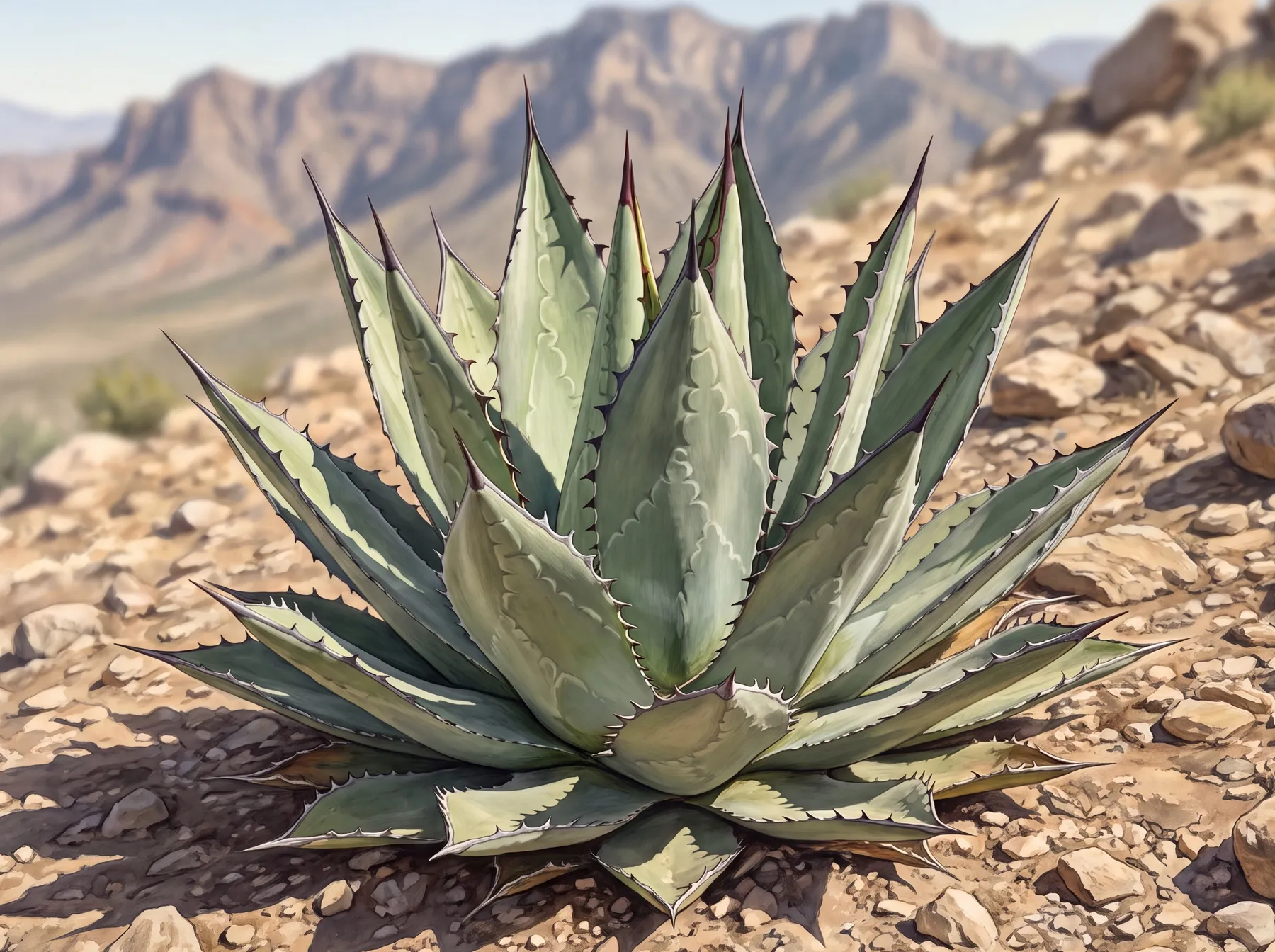
The plant is small enough to miss and armed enough that you won't want to grab it: a tight, near-globular rosette of stiff grey-green blades, often only about a foot across, each leaf edged with hooked grey teeth and tipped with one stout spine. It sits on bare rock doing nothing for years. Then it spends everything at once.
Where it sits is the first clue. Utah agave is a strict calcicole, a lime-lover, and it grows straight out of crevices in limestone outcrops and escarpments with almost no soil to speak of. On this bajada that means the exposed rocky ribs above the flats, not the sandy wash and not the creosote ground below. The community around it here is Joshua tree and blackbrush, grading up into pinyon and juniper on the higher, cooler slopes.
It is also the northernmost agave in the world. No other agave grows as far north as this one, which reaches about 37 degrees north into southern Utah and Nevada; its range covers northwestern Arizona, far southwestern Utah, southern Nevada, and eastern California. It runs from the low Mojave floor up to around 8,000 feet, on a working band of roughly 3,000 to 7,500. This ground sits near the bottom of that band, which makes the agave more a plant of the limestone ribs climbing above than of the flat itself.
The spending is the strange part. Utah agave is monocarpic. It grows for many years as a quiet rosette, then throws a single tall unbranched flower spike, a narrow wand of greenish-yellow flowers rather than the branched candelabra of the big agaves, sets seed, and the flowered rosette dies. The stalk stands five to fifteen feet from a rosette often only a foot wide, and that disproportion is most of what makes the plant worth a second look. A rosette can clone quietly from its roots, so the individual dies while the colony lives on; a 2024 survey in Nevada estimated some colonies at more than 150 years old.
That heavy investment is also what made it food. Across the Southwest, the sugar-rich heart of an agave, cut before it flowers and slow-roasted for days in a stone-lined pit, was a staple that could be dried and stored for months, and thousands of those rock-ringed roasting pits still survive across the region. The plant packs years of collected sugar into its base to fund a single bloom; harvested a season early, that fuel fed people instead.
Look close at a young leaf: its neighbor's teeth are printed into the face, a mirror pressed in the bud.