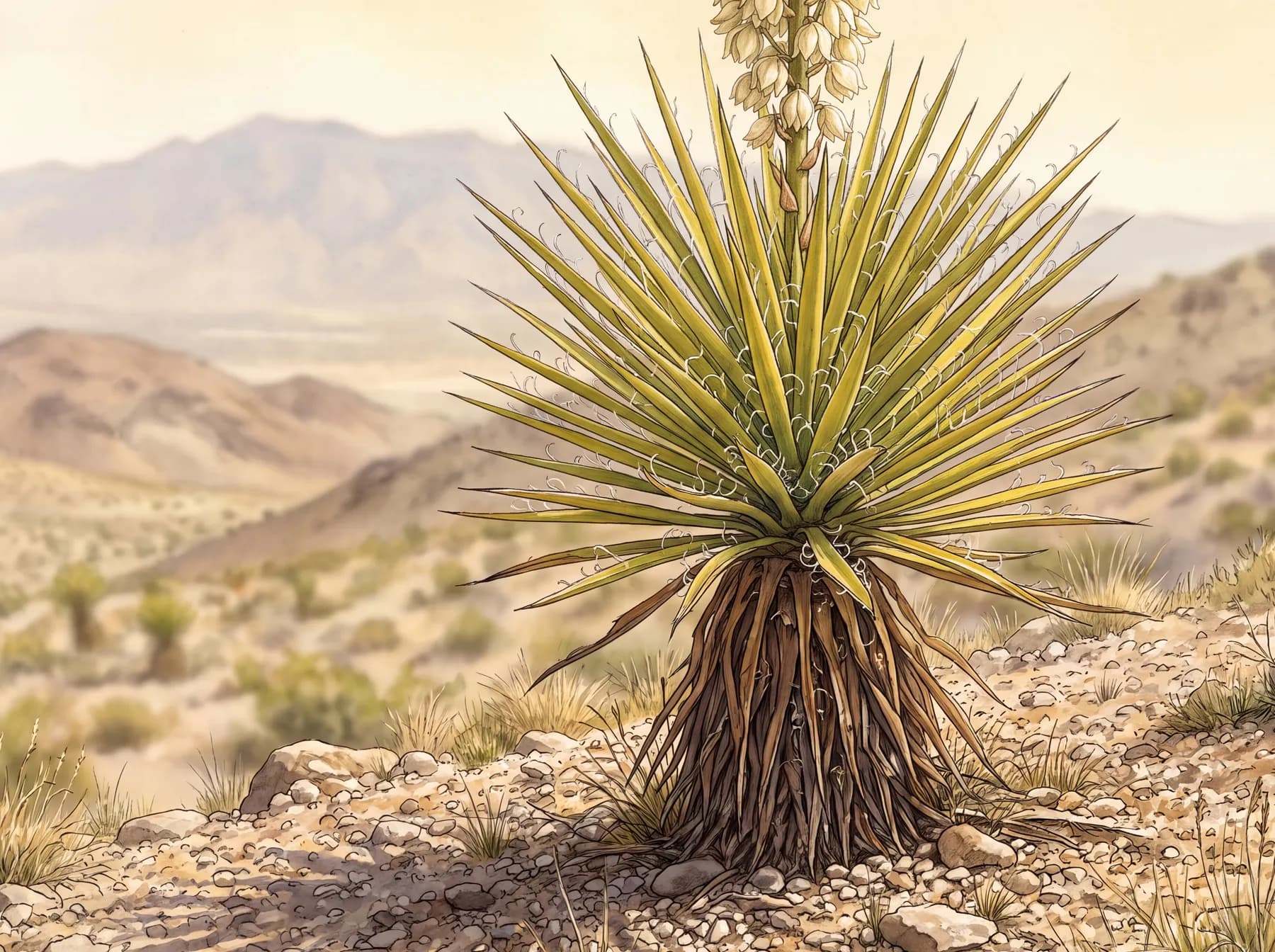
This is Joshua tree and blackbrush country, the same company Mojave yucca keeps everywhere it grows, so it belongs on this bajada whether or not it has been noticed yet. The trick is telling it from its famous neighbor. The Joshua tree gets the photographs, tall and branched with its arms thrown up. Mojave yucca stands lower and stiffer, a fan of long blades on one thick trunk, and the way to be sure which one you are looking at is to kneel and read the edge of a leaf.
The leaves are swords: rigid, yellow-green to blue-green, and long, roughly 30 to 150 centimeters, each ending in a hard point. Run your eye down the margin and you find the tell — coarse white fibers peeling away in curling threads, shaggier and more conspicuous than most of its neighbors. The plant's scientific name points straight at that shredding edge. It is the clean break from the Joshua tree, which is taller, to about 15 meters, heavily branched, and short-leaved. It also parts this plant from banana yucca, which builds little or no trunk and carries wider leaves. Fruit will not help you there: both ripen a fleshy berry, and it is the Joshua tree, not either of them, that dries its fruit into a capsule.
That shredding margin is more than a field mark. It is material. People across this desert pounded the leaves until the flesh came away and the fiber was left, then worked it into rope, sandals, nets, and baskets. The same plant is also soap. Its roots are loaded with saponins, compounds that lather in water, and the pounded root has long been used to wash hair and clothing. That is not folklore alone. Mojave yucca is one of only two commercial saponin crops in the world, alongside Quillaja saponaria.
None of that would matter if the plant could not hold its ground, and holding ground here is the hard part. This is dry, bright, cold-nighted country where the rain can skip a year. Mojave yucca meets it with leaves that are stiff, waxy, and thick, built to keep water rather than spend it, and with roots that run deep and wide. It can idle through a drought without dying back, so it does not need a good year to stay where it is. This ground sits inside the Arizona band where the species is at home, not at the edge where it gives out.
There is one thing it cannot do alone. Like the Joshua tree beside it, Mojave yucca is locked to a single insect, the yucca moth Tegeticula mojavella, which deliberately packs pollen onto the flower and lays her eggs in the ovary, where the larvae eat a share of the seeds. No moth, no seed, and the plant keeps no backup.
So when a big yucca stops you, kneel and read one leaf. If the margin is unraveling into curled white thread, you have found it.