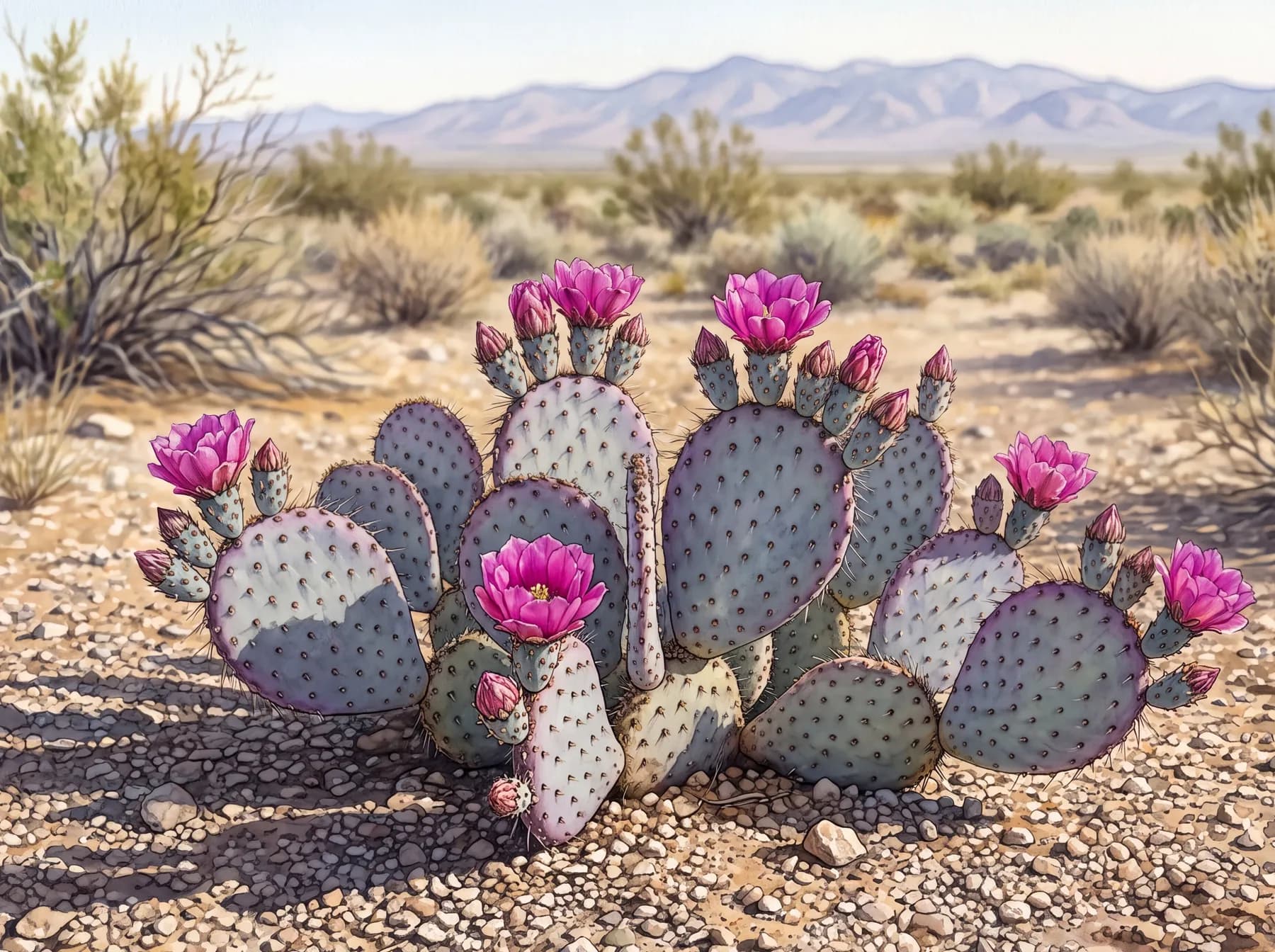
On this bajada, the cactus most likely to ruin an afternoon is also one of the least threatening to look at. Beavertail carries no long spines. Its pads are flat, chalky blue-grey, often flushed with lavender, and from a step away they look about as dangerous as a stack of paddles left out to dry. Up close the paddles tell a different story. Set into each pad in tidy, evenly spaced dots are the areoles, and every one holds a dense cluster of glochids: fine reddish-brown to dark-brown bristles, barbed along their length, that come away at the lightest brush, lodge in skin, and are too fine to grip and pull clean. Spineless is not the same as harmless.
So the tell is the absence itself. A blue-grey paddle studded with brown glochid dots and wearing no long spines keys this plant at a glance, and nothing local carries that exact combination. The chalky sheen is a waxy bloom that rubs off under a thumb. In season the plant removes all doubt: a flower of pink to magenta saturated enough to look synthetic, roughly 2.5 to 3.25 inches across, open somewhere between February and June. It is one of the few colors the desert spring throws that you can spot from across a wash. The habit stays low and clumped, rarely over 16 inches, on pads two to eight inches long.
The blue-grey does real work. That waxy coat reflects light and cuts the heat load on the tissue underneath, which is the part worth protecting, because the fleshy pad is mostly stored water, a bank the plant draws down through the rainless months. The bloom rubs off easily, and with it goes that protective layer. Like other prickly pears, beavertail runs its gas exchange on a night shift: it opens its pores in the dark to take in carbon dioxide and seals them against the day, so it can feed itself without breathing its water away under the sun.
The water bank explains the second surprise. A pad full of moisture ought to freeze and rupture on the cold nights this high desert delivers, and cultivated beavertail mostly does not, though that tolerance is measured in nurseries rather than in the field, so the wild limit stays inferred. The saturated bloom that follows is beautiful and, in the older sense, useful: the fruit is dry and hard, not the juicy tuna of a market prickly pear, and Native peoples worked it by drying the fruit and seeds rather than eating it fresh off the pad.
Look, do not touch. Come spring, watch the grey pads for that improbable magenta, the surest way to name this plant from a distance.