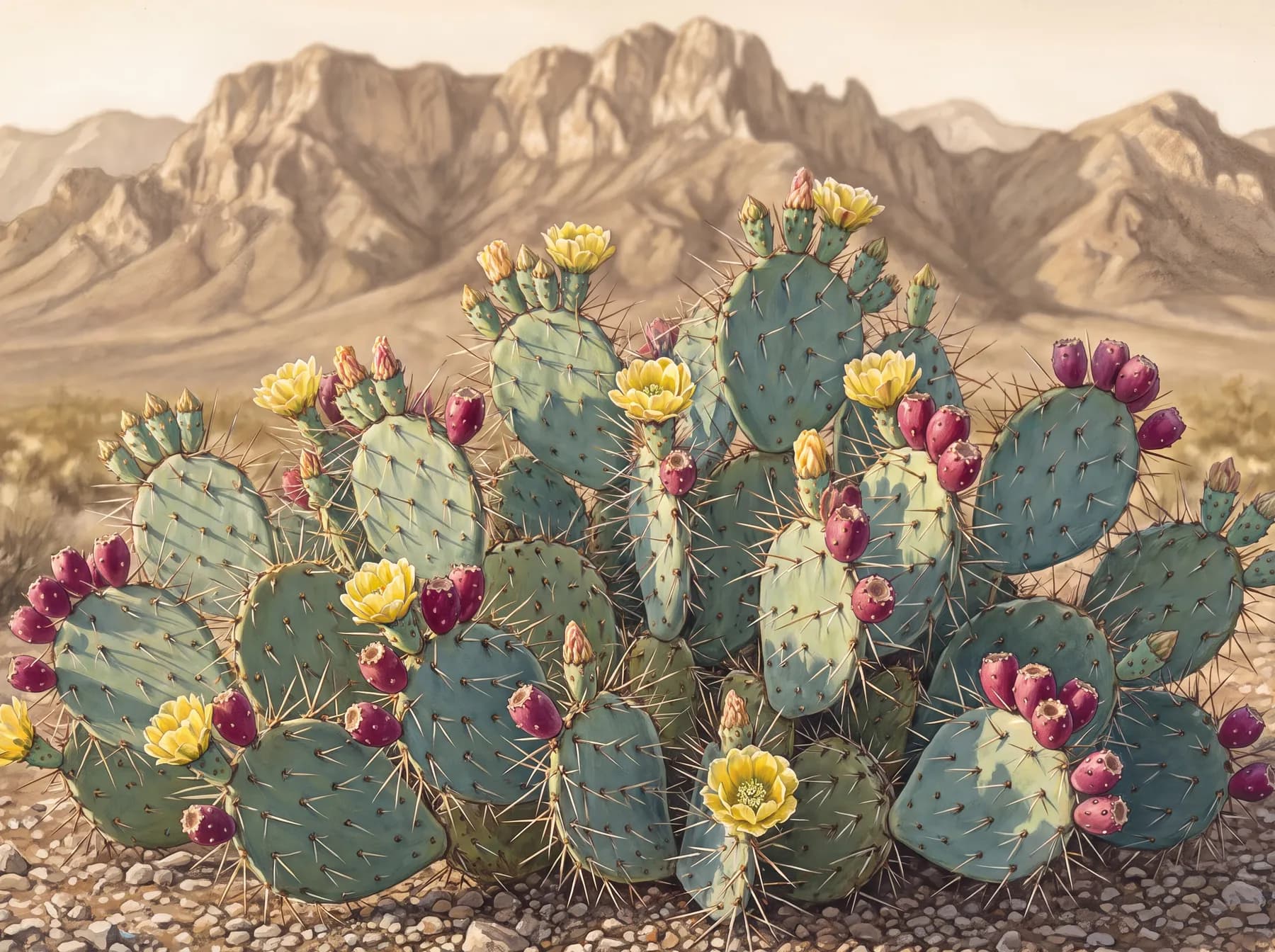
One of the most common prickly pears in the Southwest is uncommon on this ground, and the reason is a matter of when the rain falls. Opuntia engelmannii covers warm country from California to Louisiana and grows across something like half of Arizona. But here, near the cold upper edge of the Mojave, it thins to a scattered few. It is a Sonoran plant standing at the top of its country, and where it holds on this bajada it holds for a reason.
The reason is summer water. This cactus leans on the monsoon, the storms that push up from the south in July and August, and it keeps only where that rain is steady enough to count on. So it follows warm rocky slopes and the same high ground the saguaro likes, uphill rather than down on the flat. Where the summer rain fails, it drops out and a lower pad takes its place: beavertail, Opuntia basilaris, which asks nothing of the monsoon and lives on the winter rain alone. The height is not the limit. At this elevation the ground sits well inside the band where Engelmann's has been recorded; what makes it scarce is the season of the rain.
Being sure you have the right one takes a close look, because prickly pears are genuinely hard to tell apart, and this is the top of a range where three of them cross. Engelmann's is the big one, a shrub three to eight feet high in clumps to fifteen feet wide, built of thick blue-green oval pads up to a foot across. Read the areoles, the spaced dots studding the pad: each carries two to six stiff, chalky-white spines that splay downward like a bird's foot, above solid yellow flowers from spring into midsummer. Its two low neighbors give themselves away. Beavertail, no more than about fifteen inches tall, wears no long spines at all and flowers rose-magenta. The grizzlybear pad, Opuntia polyacantha var. erinacea, hides under a shaggy coat of slender spines to four inches long. Fewer, stouter, bird's-foot spines on a plant this size is the signature. Some local records may still be the shaggy one misread, so take it as uphill and likely, not certain.
The fruit is where the plant's company matters most. A prickly pear's red-purple tuna, the cactus apple, fills out only as well as its flowers were pollinated, and the pollinators that count are not honeybees but solitary, ground-nesting cactus bees, Diadasia. Researchers have found that the size of the edible pulp tracks the seed set, and the seed set tracks how well those native bees worked the flowers. Truck in a stack of honeybee hives and the crop does not improve. The fruit was traditionally eaten, and it is edible when properly prepared, but the plant guards it twice. Alongside the long spines, every areole carries glochids, tufts of tiny barbed bristles that lodge invisibly in skin and must be burned or scraped away first. The long spines you can see and step around. The glochids are the ones you carry home.
Look uphill, where the saguaros stand: a big blue-green pad, spines splayed like a bird's foot. Nothing low and shaggy makes that.