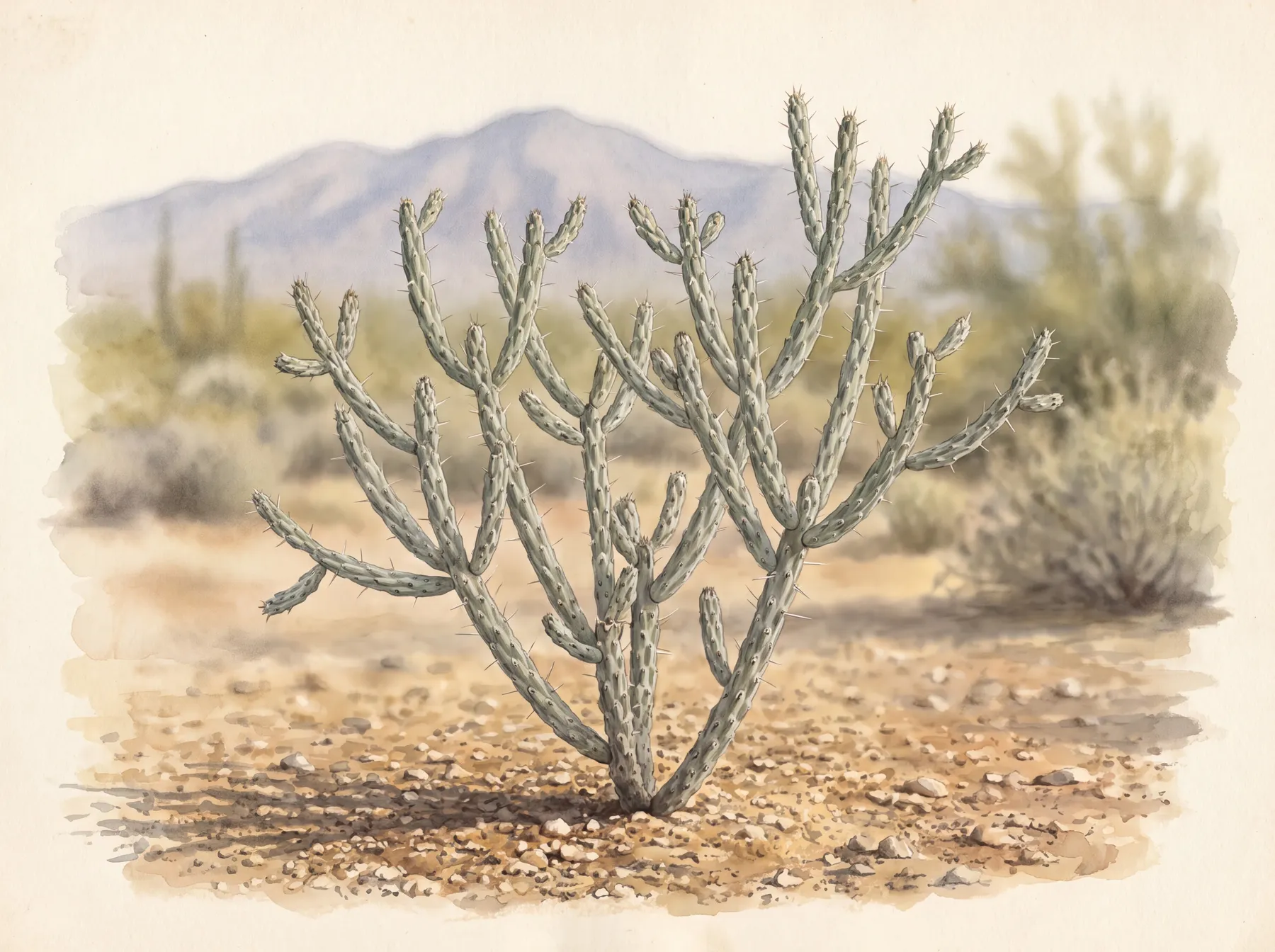
A cholla is usually the easiest thing on the slope to see. Not this one. Where silver cholla stands in a haze of straw-colored spines and buckhorn throws up branches like a set of antlers, the diamond cholla is thin, gray, and sparse, and it dries to nearly the color of the ground it stands on. It is the cholla that catches people who have walked this bajada for years and thought they had the ground learned. You do not notice it until you have already backed into it.
The tell is the stem. Diamond cholla runs under 1 cm across, less than 0.4 inches, where every other cholla here is at least 1.5. That one measurement is most of why it hides: fewer, thinner stems throw a fainter outline, and gray tissue against gray, stony, often volcanic ground gives your eye almost nothing to fix on. It is the thinnest-stemmed cholla in the region, and thinness is close to the whole plant.
Look closer and the name arrives. The skin of each pencil stem is divided into flat, diamond-shaped tubercles, less than a millimeter high, not knobs but a low pattern quilted into the surface. At the center of each diamond sits a single spine, and here is the plant's contradiction. The thinnest cholla carries the longest spine: up to 6 cm, roughly twice the 3.5 cm that tops out the other chollas nearby. A thread of a stem, and a long solitary dagger at every tile of skin.
Why a plant would commit to so little stem is a fair question, and the honest answer is a guess. The reading that fits this ground: in low, hot desert where the rain can skip a year, less stem means less tissue to keep alive and less surface to lose water through, a cheaper way to stay in business than a fat-jointed cholla can manage. That is reasoning from the plant's shape, not a measured fact, so hold it loosely. What is certain is smaller. The flower is the least of any cholla, about 2.5 cm across, close to the width of a quarter, pink to reddish-brown; the fruit that follows is a dry, spiny little body that stays on the plant into fall.
There is a catch worth saying plainly. This is a hot-desert, low-desert plant. Its stronghold is creosote-bush scrub and the lower washes of the warmer Mojave and the Sonoran, mostly well under 2,000 feet, and its range runs from southeast California through southern Nevada into western Arizona. Regional sources cap it near 3,500 feet. This parcel sits near the very top of that band, the elevation where diamond cholla is usually handing off to the Joshua-tree-belt chollas. So it earns its place here as a plant of the warm, sun-baked margins: plausible on good-draining slopes and stony washes, not something to expect on every rise.
To settle it, measure the stem: under a finger's width, gray, diamond-skinned, one long spine per tile. Nothing else here is that thin.