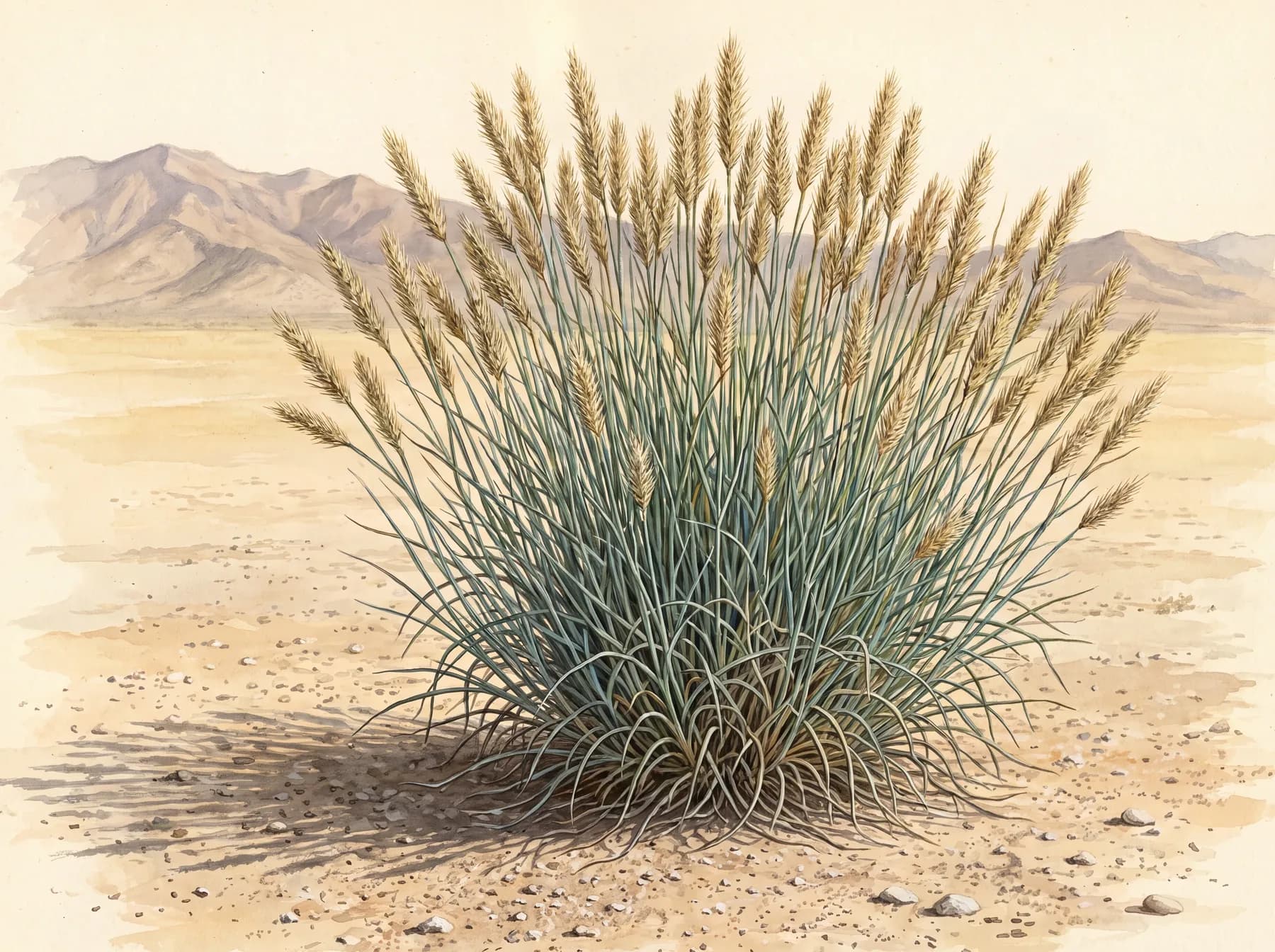
Snap a grass stem and you expect a straw. Nearly every grass on this bajada is hollow between the joints, a tube built to bend. Big galleta breaks the rule. Its culms are packed solid, pith-filled even in the middle of each segment, so a broken stem shows a plug where you looked for a hole. That single test, done on a stiff greyish clump on a dry flat, is most of the identification. Almost nothing else here is built this heavy.
The rest of the clump backs it up. Run a thumb over the nodes and they wear a collar of long, curly white hairs, woolly where other grasses are bare. The whole plant stands as a rigid, open, grey-green hummock, branched hard at the base, its coarse culms reaching to about a metre. When it flowers, the spikelets ride in threes along a zig-zag stalk and fall away as a unit, leaving a short herringbone brush a few inches long. Coarse, grey, and armored, it hardly looks like grass at all.
What it is really doing is keeping a different calendar than the plants trying to replace it. Big galleta is a warm-season, C4 grass with high water-use efficiency, which means it does its growing on summer heat and monsoon moisture, in the season when the invasive winter annuals have already dried and died. Researchers rate it the most drought-tolerant of its genus. It manages that on a surprisingly shallow root system, mostly in the top 3 to 4 inches of soil, catching light rain the moment it lands rather than mining deep water that is not there.
The staying power is underground, and it is not the roots. Big galleta spreads mainly by rhizome, hard woody runners that push out below the surface, so an established clump is knitting the ground together as it grows. That is why it holds blowing sand and even open dune, and why fire, which top-kills it, does not finish it: the rhizomes sprout again. Some clumps are reckoned to be more than 100 years old, which makes a stand less a plant than a slow, dug-in network wearing grass on top.
There is an honest edge to why this grass, of all of them, is the one still here. Green and growing after rain, it is good forage, and cattle and horses take it readily; the Navajo valued it for horses and sheep. Cured and dry, it turns coarse enough that stock eat it only when nothing better is left. Coarseness and a tolerance for trampling are exactly the traits that let a grass persist where finer, sweeter ones get grazed off and never return. That last step is inference about worn desert range, not recorded history for this ground, but the mechanism is sound, and big galleta is the toughest of a tough genus.
Snap a culm on a grey clump that refuses to be soft: solid stem, woolly collar, and it stayed.