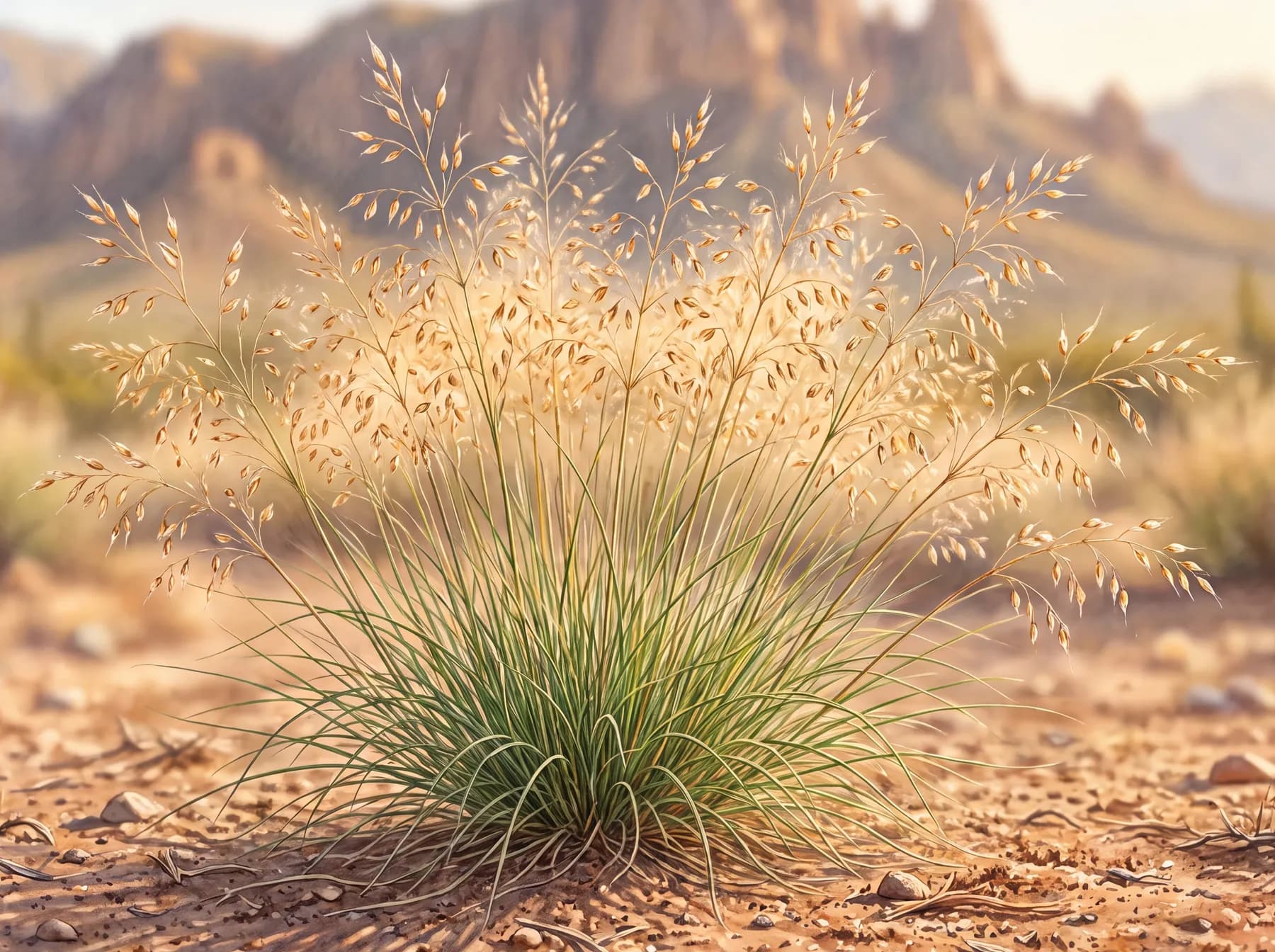
Catch it backlit in low winter sun and what you see is a puff of pale smoke, hovering a foot or two off the sand with no clear edges. Walk up and the smoke resolves into geometry: an airy, wide-open seedhead of hair-fine branches that fork and spread at deliberately wide angles, each thread ending in one plump, spindle-shaped seed in a papery hull. Nothing else on this bajada floats its seed on wire like that.
That hull is worth pinching. It is clothed in soft white hairs that rub off easily, and under them sits a dark, shiny grain, the rice of the name. The seed runs large for a desert grass and is protein-rich, and it fed people on this ground for a long time. Great Basin and Southwestern peoples, among them the Navajo, Hopi, Apache and Paiute, gathered it, ground it into meal, and cooked it as mush or bread. The Paiute kept it as a reserve food, something to fall back on in a thin year.
The same durable seed has a second life its gatherers would have had no reason to notice. Its hard coat enforces a deep dormancy, so a seed can lie in the sand and stay alive for years. Researchers have found it still viable after at least 14 years, with about 38 percent of a sample germinating after 20 years. That patience is a hedge against a desert that can skip its rain a year at a time. It also means the plant keeps its own clock: a seeded stand can take as long as two years to come in, because most of the seed is still underground, waiting out the odds.
The clock has a season set into it. Ricegrass is a cool-season bunchgrass, working the winter and early-spring moisture, budding as early as February or March and flowering before the summer drought arrives. That timing is its edge and its exposure at once. The introduced annual grasses now spread across the West, cheatgrass chief among them, exploit the very same early-moisture window and can seize it first, and where they take hold this native is losing the ground it is built for. It is often planted to heal disturbed sandy sites, though honestly it steadies a surface more than it stops sand on the move; blowing dunes are not its job.
It wants deep, sandy, well-drained soil, which is most of this parcel, and it belongs to the Joshua-tree and blackbrush country, at the low edge of a range that climbs to 10,000. We have not walked out and confirmed a clump here yet, but the sand and the plant community make it one to expect.
The field mark is the seed on its wire: pinch one hull, roll the white hairs off, and look for the dark grain underneath.