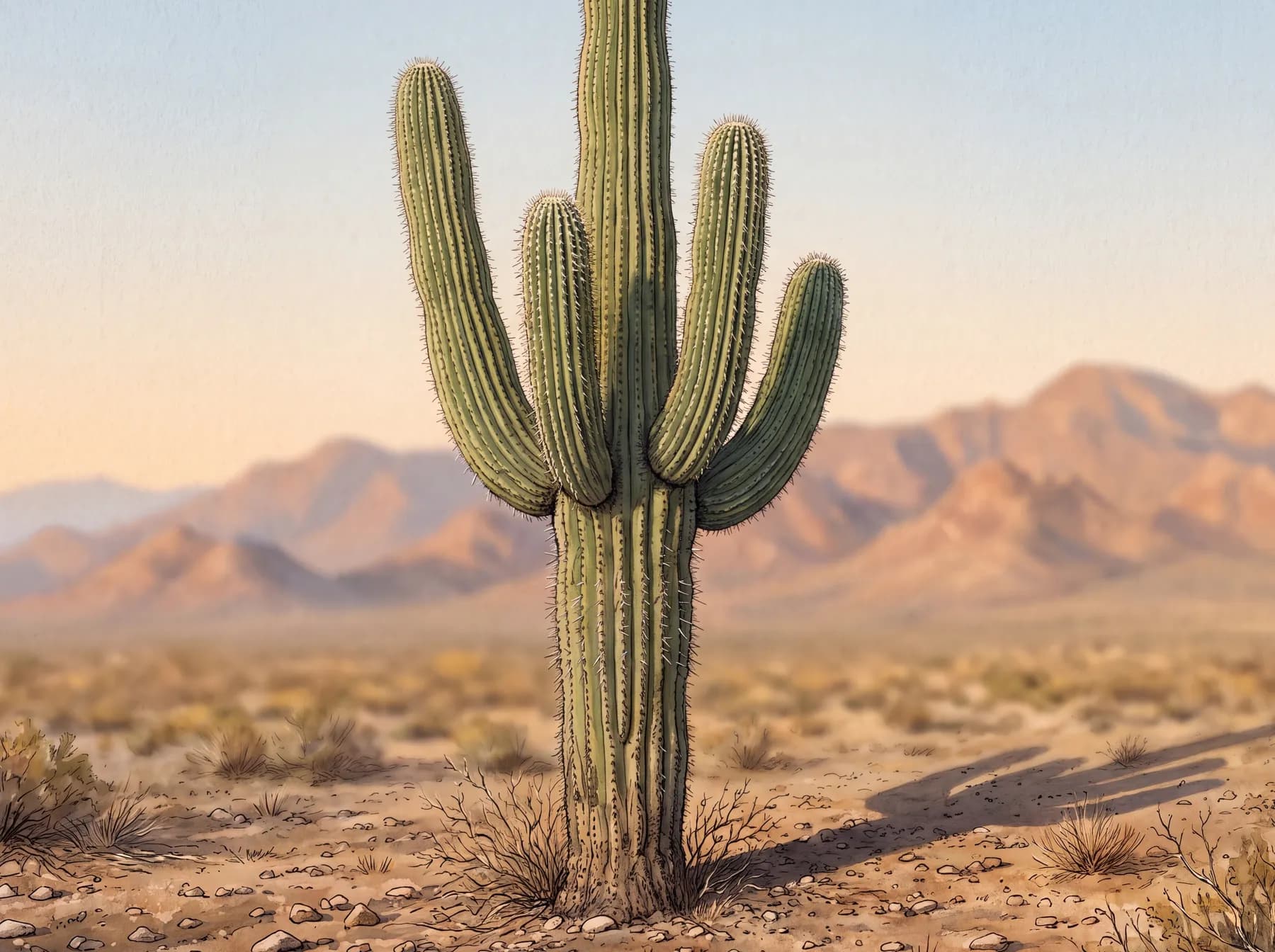
The hills above this ground are studded with saguaro. The flat below has none. Stand at the edge where the two meet and the line is almost sharp enough to draw, and it asks the obvious question: what does a warm south slope have that the flat a hundred yards downhill does not?
It is not the cold, or not the way you would think. A saguaro can take a hard freeze. What kills it is a long one. Where the temperature stays below freezing for around 24 unbroken hours, the plant begins to die, and the whole northern edge of its range follows that line almost exactly, tracking not the coldest night but the longest freeze. This county is where the Sonoran Desert runs out against the colder Mojave, and that boundary is drawn in hours below freezing.
Two things put the flat on the wrong side of the line. Cold air is denser than warm air, so at night it slides off the high ground and pools on the flat, which sits under a lake of the coldest air in the valley long after the slopes have drained theirs downhill. Then the morning works against it too. At eight o'clock on a December morning that hillside, about 33 degrees of slope pointed south-southeast, takes something like 3.5 times the direct sun this flat is taking, so it thaws first and fastest. The slope is warmer than the ground beneath it, which is backwards from what anyone expects, and it is the whole reason the giants stand where they stand.
The cactus itself is built to wait out a desert. It grows about an inch in its first 8 years, does not flower until it is 35, and does not put out its first arm until somewhere between 50 and 100 years old, so a tall one carrying several arms is an elder that was standing before anyone now alive was born. Nearly every one of them started under a nurse plant, a paloverde or creosote that shaded the seedling and buffered the frost, and often died as the saguaro it sheltered outgrew it. The odds it beat are severe: a mature plant may drop around 300,000 seeds in a year and 40 million across a lifetime, and fewer than one seedling in 100 survives its first year.
What it built with all that time is a reservoir. A saguaro runs to about 85 percent water and can hold better than a ton of it, its pleated column swelling and shrinking with what it has drunk, stiffened inside by 15 or 20 woody ribs. Its roots go almost nowhere downward and as much as 30 metres outward, a shallow net spread wide to catch a rain before it sinks. It is protected, too: Arizona lists it as Highly Safeguarded, the top tier, and the law covers the fruit and the seeds as much as the plant.
So read the slope, not just the plant. Where the saguaro stops coming down the hill is the line where the freeze first runs long.