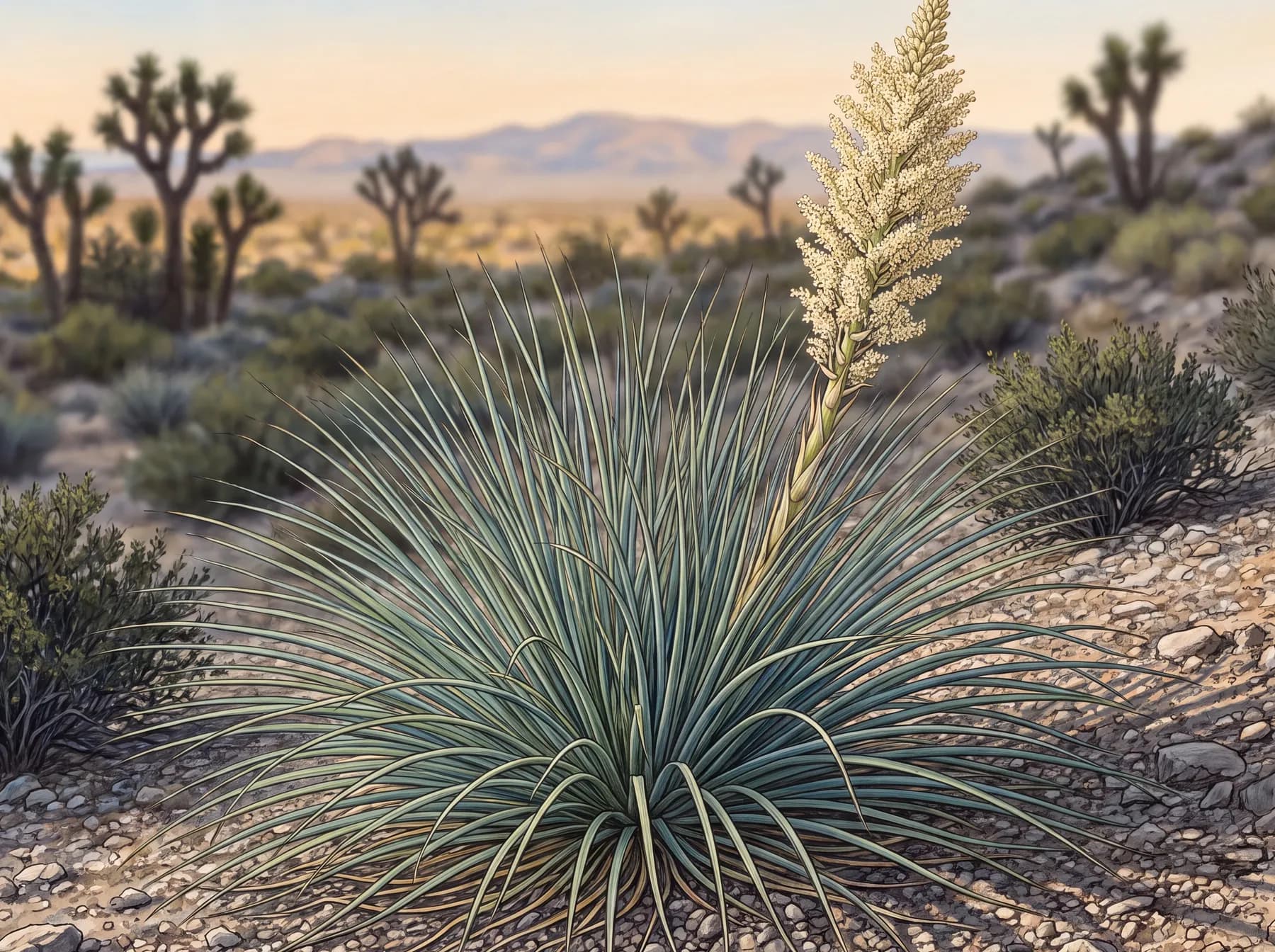
Reach out and close your hand around the top of one, gently, and nothing happens. That is the first surprise, because from a distance this looks like a yucca, and a yucca would have drawn blood. What fills your hand instead is a fountain of long, soft, arching blades, grass-like and flexible, each tapering to a point that folds rather than stabs. Almost everyone who walks up to it calls it a yucca, and almost everyone is wrong.
It is not a grass either, though the drape invites that mistake too. Bigelow's nolina belongs to the asparagus family, in the subfamily Nolinoideae, closer to asparagus than to any true grass or to the yuccas and agaves it grows beside. The grass look is convergence: three separate lineages, once filed as separate families, arriving at the same narrow-leaved shape because the same dry ground kept asking the same question. Nolina's answer just happens to be the flexible one.
Where a yucca hardens each leaf tip into a spine, nolina spends its structure differently. A single rosette can carry around 150 blades, each two to three feet long, rising from a thick fleshy base and thinning to that harmless tip. The real tell is at the edge. Run a fingertip along a young leaf and you feel fine teeth; on an older one, the margin has frayed into thin, curling, papery-white fibers that peel away from the blade. That shredding edge, filiferous is the botanical word, is the mark no yucca offers, and the same fiber, stripped and worked, was used for basketry across the Southwest long before the plant was anyone's ornamental.
Two more things separate it from its neighbors. Nolina is dioecious: male and female flowers grow on separate plants, so only the female clumps ever set the dry seed capsules, and something like half the rosettes on a slope will flower without fruiting at all. And when it does flower, it does not die for the effort. The agave beside it is monocarpic, throwing up one great stalk and spending its whole life on it. Nolina is polycarpic: it lifts a densely branched plume of thousands of tiny cream-white flowers, standing as much as 13 feet above the leaves, and then goes on living.
On this ground it sits near the cool upper edge of its range. This is a plant of hot, low, rocky slopes in western Arizona and the Lower Colorado River Valley, reaching only up toward 4,900 feet at the northern end of its country. In the upper Mojave, among Joshua trees and blackbrush, it is near the ceiling of where it is comfortable, so you would look for it not on the open flats but on warm, well-drained, south-facing rock, tucked among granite boulders. We have it on the list for those exposures, and have not yet closed a hand around one to be sure.
So the field test stays simple: find the frayed white threads along a leaf edge, then close your hand on the tip without flinching.