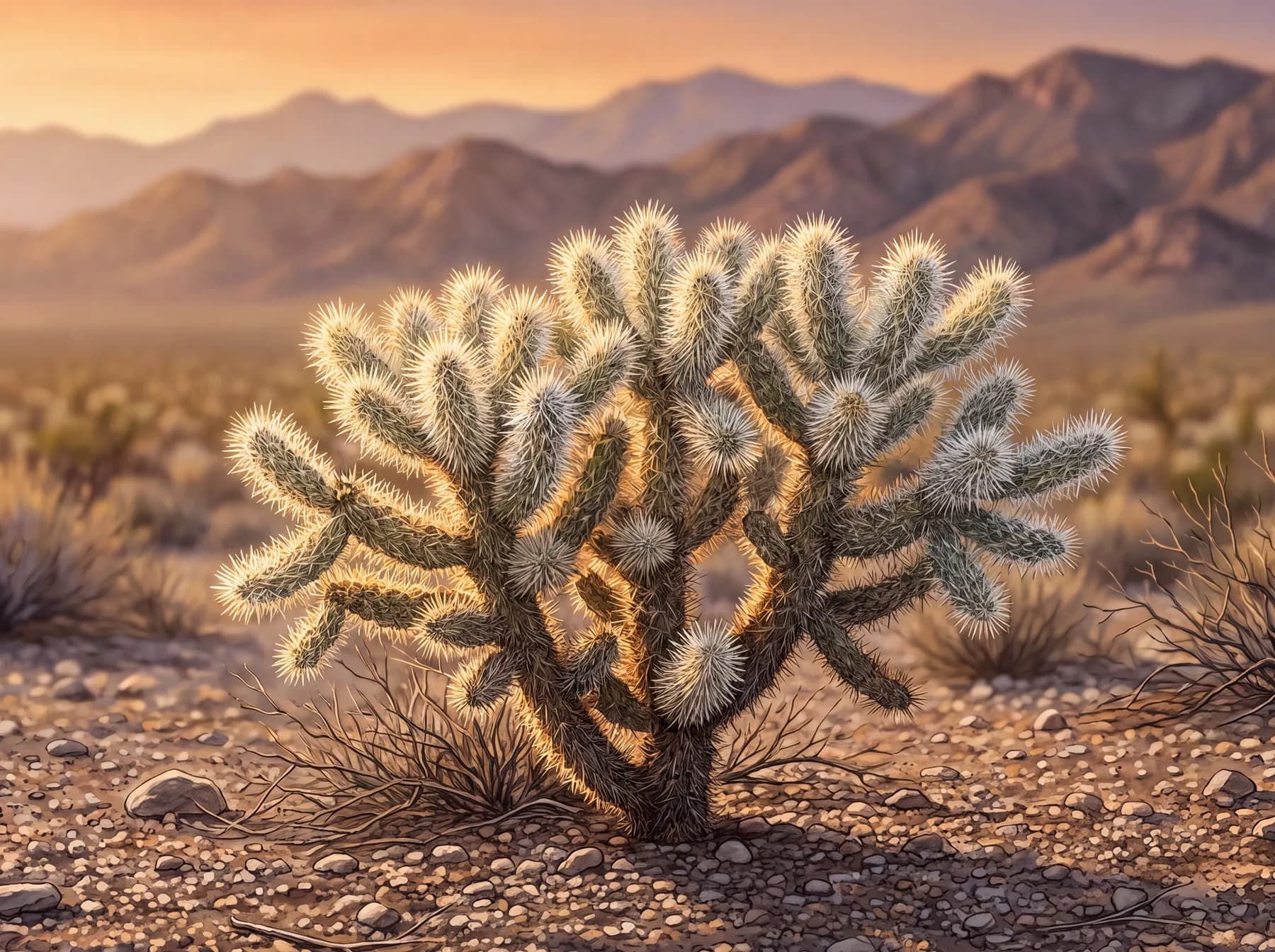
Catch it with the sun low behind it and a silver cholla stops looking like a plant at all. The whole compact shrub lights up in a metallic halo, straw-gold at the edges. That glow is the fastest way to know the plant, and it is not the stem doing the work. It is the armor.
Each areole carries 6 to 22 spines, 2.2 to 5 centimeters long, and every spine wears a loose papery sheath, white at the base and golden above. Massed over short, densely packed joints, those baggy sheaths overlap into a continuous coat that catches raking light and throws it back. Buckhorn cholla, the shaggier cousin it is often mistaken for, leaves gaps where green or purple stem shows through. Silver cholla does not. The armor is close to total, which is the point: in low or side sun the plant reads silver-gold rather than green, and up close the give-away is that nearly every areole is fully sheathed, its tubercles less than twice as long as wide.
Something lives inside that armor. The cactus wren threads in and out through the spines to nest deep in the cholla, using the plant's defenses as its own: a bird small enough to move between the spines gets a nursery a predator cannot easily reach. The armor that reads as decoration at dawn is a working fence, and at least one desert bird nests on the far side of it.
The stranger thing is how the plant travels. Silver cholla can set seed, modest greenish-yellow flowers around 2 to 2.3 centimeters that open March to June and give way to spiny tan fruit, but it does not need to. Its short joints attach so lightly that the smallest contact detaches a whole segment, and a detached joint is a clone. Where it falls, it roots. This is the honest version of the jumping cholla story: nothing jumps and nothing is thrown. The teddybear and chainfruit chollas own that nickname; silver cholla only shares the trick. A boot or a passing animal carries a stuck segment off, and it starts a new plant a stride from the one it left.
So the same armor that glows and shelters the wren is also the plant's legs. A cholla that never flowers in a dry year can still spread, one hitched joint at a time, no pollinator required. On this bajada, a common cactus of the blackbrush country, that is a quiet advantage: the desert can skip a bloom and the plant still moves.
If a joint catches you, do not use fingers. A comb or two flat rocks flings it clear; fingers only relocate it.