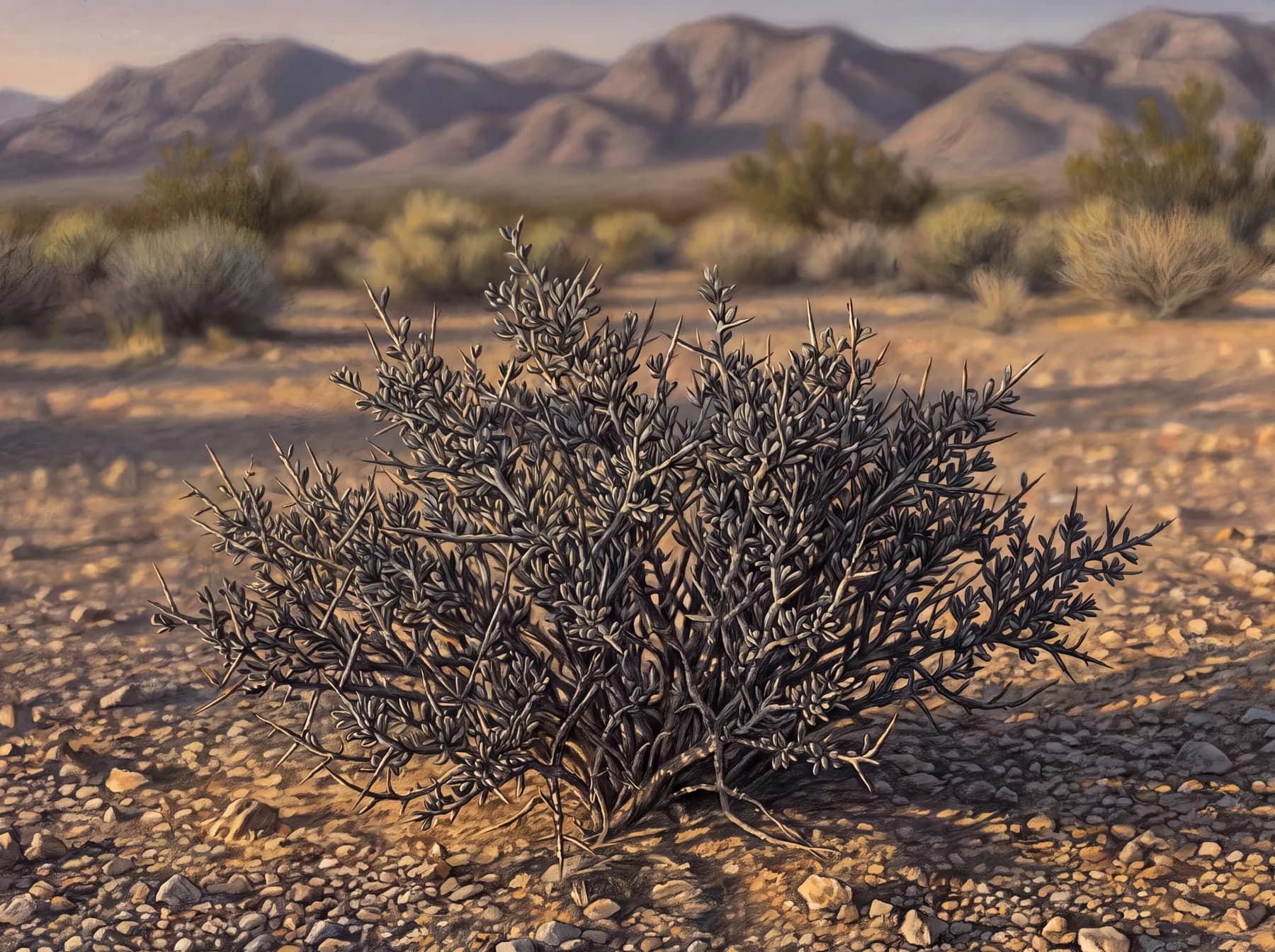
The dark, low, even shrub that covers this bajada is not background. It is a boundary line you can stand in. Blackbrush forms near-monotypic stands over huge areas, and where it dominates it marks the transition between the Mojave and the Great Basin so reliably that ecologists use its stands to draw that ecotone on a map. It is bounded below by creosote and above by juniper and sagebrush, so a place where blackbrush runs the ground is sitting in the middle of its indicator zone. The name of this community, Joshua tree and blackbrush, is half this plant.
Up close it does not look like much: a tangled gray snarl of rigid twigs with tiny leaves crowded at the joints. The mark that names it is easy to miss and hard to unsee once you have it. The twigs branch oppositely, in pairs off each node, which is uncommon among the shrubs it grows with, and the short terminal branchlets die back and dry to stiff spines. Grays that look nearly black up close, and blacker still when wet, are why whole hillsides of it read charcoal from a distance. In spring it flowers without petals at all, four yellowish sepals and a brush of stamens, which is an odd thing for a member of the rose family to do.
What the plant is really built for is patience. Individual blackbrush have been aged from about 3 to 122 years, and the stands themselves can persist apparently unchanged for over a century, growing slowly, living long, and setting seedlings only rarely, in sporadic mast years, with no lasting seed bank to fall back on. It sits out multi-year drought without dying, running lean on small tough leaves that lose little water. Standing in an old stand of it, you are looking at time laid flat across the ground.
There is one thing it cannot do, and it is the thing that matters most here. Blackbrush does not resprout after fire. Burn a stand and the short-lived seed in the soil burns with it, so recovery depends entirely on seed blown or carried back in from somewhere unburned. It can be simply gone from a burned site for 25 to 30 years, and may need 60 years or more to return, if it returns at all. That gap is the whole danger, because invasive cheatgrass threads fine fuel through the stand, the community burns, and what grows back is annual grassland, not blackbrush. It is among the most threatened plant communities in the Southwest.
So it is tough and fragile at once: it can wait out a decade of drought and cannot survive a single good fire. Look at a stand of it and you are looking at a century you cannot put back. Clear what you cannot replace only knowing that.
Read the twigs to be sure. Paired, rigid, spine-tipped branchlets off each node, tiny leaves clustered between, gray going to black: that is blackbrush.