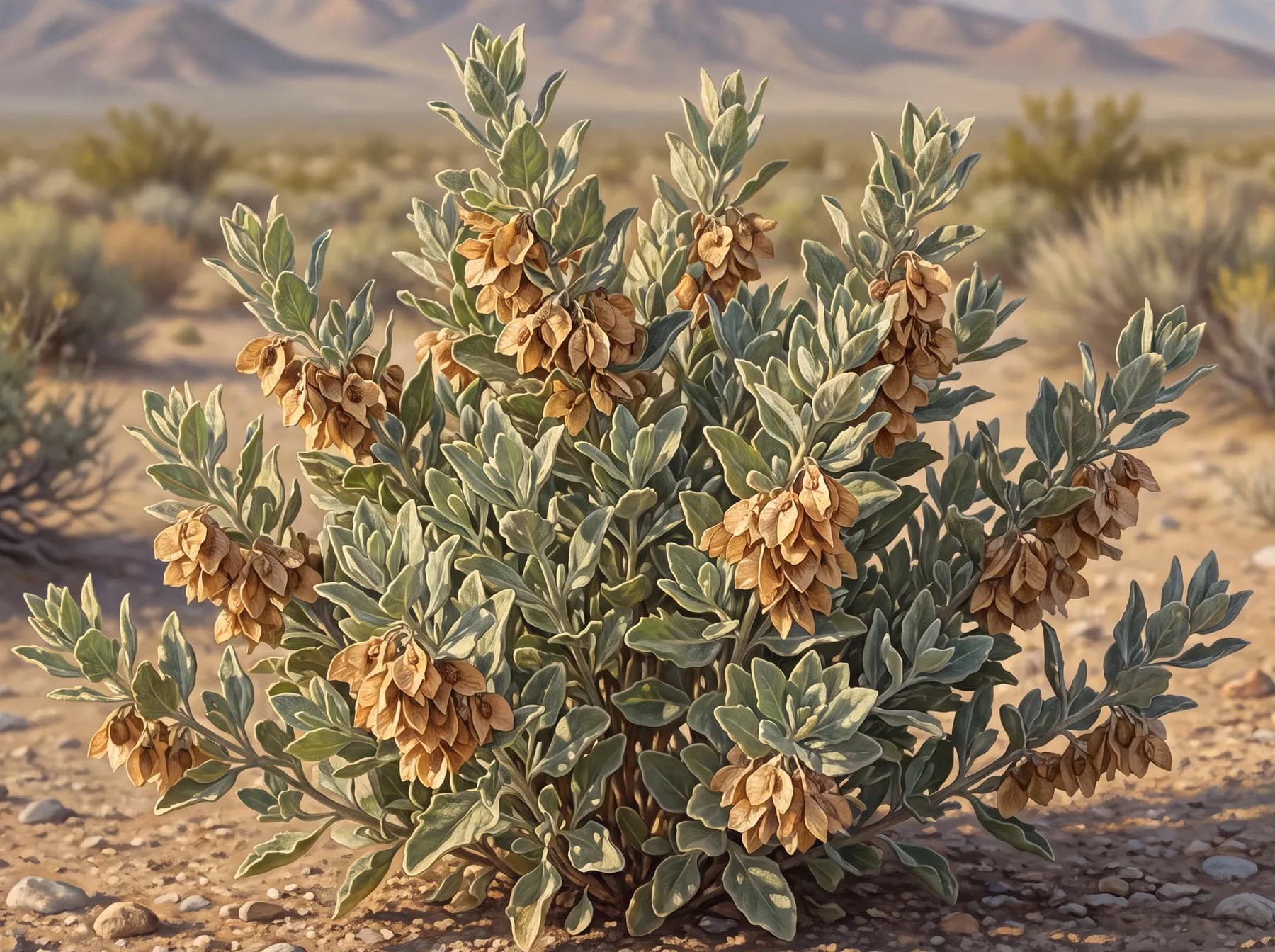
Run your thumb along a leaf of this shrub and a fine gray powder comes off, the way it lifts from a stick of chalk. The powder is salt. The plant drew it up out of the ground, carried it to the leaf surface, and left it there to dry, which is an odd thing to do with a poison it worked to collect.
Fourwing saltbush is a secretohalophyte, a plant that survives salty, alkaline ground not by keeping salt out but by taking it in and then setting it aside. It loads sodium into bladder-like hairs on the leaf skin, and researchers who studied the plant found those bladders can hold on the order of 1,000 times more sodium than an ordinary leaf cell. The bladders swell, collapse, and dry to the silvery scurf you see, so the coating that offloads the toxin also reflects sun and slows water loss. It runs on C4 photosynthesis, the more heat- and water-thrifty pathway, which is much of why it keeps hot, dry, alkaline ground where softer plants quit.
That tolerance is why it shows up on the worst ground first: compacted, scraped, salt-burdened, the kind of surface a graded pad or a wash cut leaves behind. On this bajada it belongs to the same salt-desert scrub as blackbrush and the Joshua tree, a semi-evergreen shrub commonly 2 to 4 feet tall over a taproot that can run past 20 feet, down toward water the surface never sees. Its Arizona range sits below about 6,500 feet, so ground just over 3,000 falls well inside it, nowhere near an edge.
The name is in the seed, and the seed is a small machine. On a female plant each dry fruit is a papery case wearing four flat wings set at right angles, 1/2 to 1 inch across, made in great number and built to catch wind and tumble away from the parent — which, where water is the limit, means a seed escaping the shade of its own mother. But look and you will find plants that never carry a wing. Those are not a second species and not skipping a year. Fourwing saltbush is dioecious: more than 90% of plants are male or female, and only females fruit. Stranger still, they do not always stay put. In one 7-year study close to 40% of plants changed sex, often female to male under stress.
The dull coloring hides real feed. Semi-evergreen, it holds its leaves through cold and drought when the grasses go dormant, and tip growth has run near 18% crude protein, roughly comparable to alfalfa. Deer and cattle take it in the months the range offers little else.
To settle it, find one fruit: a tan case with four papery wings at right angles. Nothing else here wears that.