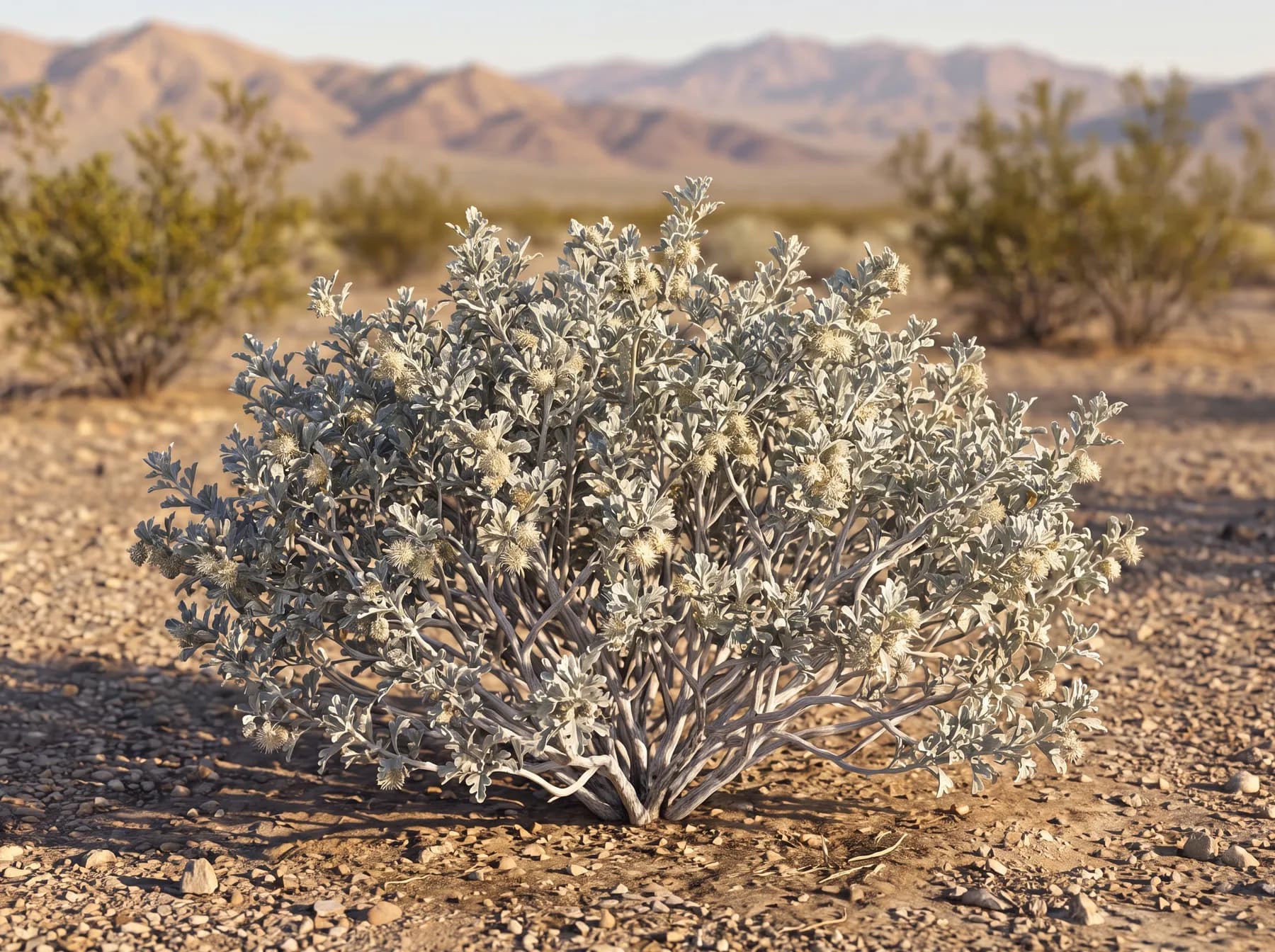
Count the shrubs on an open stretch of this bajada and you will probably overlook one of the two that define it. Creosote you notice, tall and resinous and green after rain. Its partner sits lower and grayer, a rounded tangle of twigs mostly no higher than your knee, and the eye slides right past it. That gray one is white bursage, and across the basin floors of the Mojave and Sonoran deserts it stands beside creosote as the other half of the most widespread desert plant community in North America.
Here it is near the top of its reach. Most references put its upper limit around 3,000 feet, and this ground sits just above that line, in the band where creosote-bursage flats grade upward into Joshua tree and blackbrush. So the thing to expect is not a dense lowland carpet but a thinning stand, holding its place at the edge of the elevation it can take.
The surprise is what the small plant does for the big one. White bursage is a nurse plant: its low, twiggy canopy throws a little shade and traps a little moisture and litter, and seedlings get a start beneath it that they could not manage in open sun. What makes that strange is which seedlings. In one study, 85.5 percent of young creosotebush were found either rooted under living white bursage or next to dead ones. The tall shrub's next generation gets going in the shelter of the short one. The plant you walked past is where the plant you noticed began.
It manages that on a tight budget, mostly by quitting. White bursage is drought-deciduous: when the ground dries out, it sheds its leaves rather than keep spending water to hold them, and simply stops transpiring. The bare skeleton left behind can look thoroughly dead, its dropped leaves so dry that live and dead are genuinely hard to tell apart, and then rain comes and it leafs out again. The leaves themselves are built for thrift, pale and densely woolly on both faces to throw back sun and slow water loss, which is why the whole plant reads gray instead of green.
Its flowers admit how little it spends on display. They are tiny greenish heads with no petals, male and female mixed on one plant, because white bursage is a ragweed, genus Ambrosia, and it courts the wind instead of insects. There is nothing showy to find and nothing for a bee to work. The cost surfaces elsewhere. Its wind-borne pollen is a documented allergen, kin to the ragweeds that trouble people in wetter country.
The bur is the tell: a small dry fruit in the leaf axils, spined and roundish, that no other gray shrub here makes.