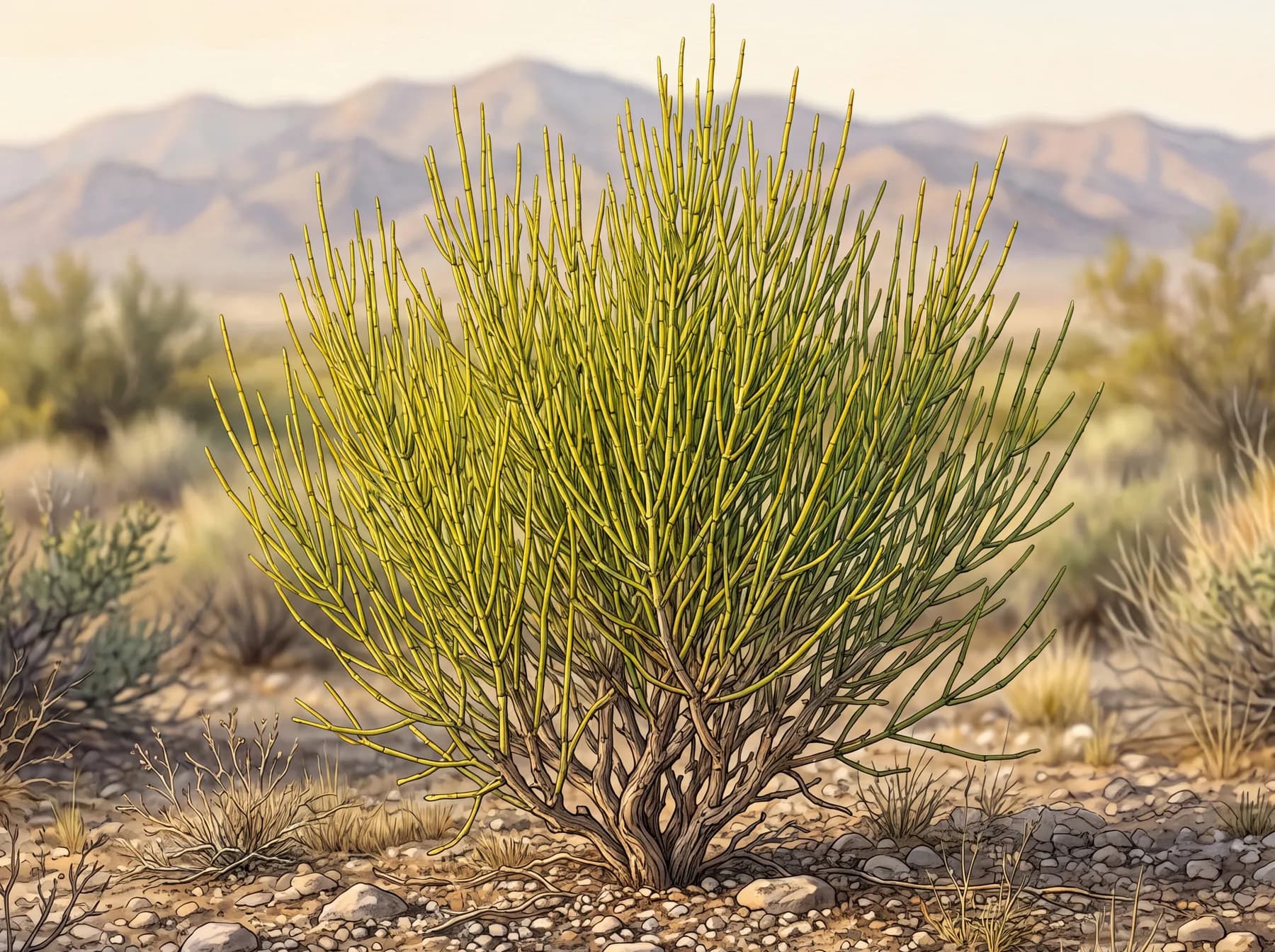
On the worst, rockiest, most exposed ground here, a knee-high bundle of green sticks keeps standing long after more ambitious plants have gone brown and folded for the season. It appears to be doing nothing. That is the plant to stop for, because it has almost no leaves and is getting by anyway.
The trick is that it deleted the leaf and kept the leaf's job. Look closely at any joint in the stems and you find no blade, only a tiny pair of scales fused into a collar around the node, often already brown and shedding. The photosynthesis has moved into the green stems themselves. A leaf is mostly surface, and surface is where a plant loses water to dry air; a bundle of jointed green twigs has far less of it. Where the rain can skip a season, doing a leaf's work without paying a leaf's water is the whole strategy.
It is not a flowering plant at all. This is Ephedra, a gymnosperm, kin to the conifers rather than to the wildflowers scattered around it, and it makes small cones instead of flowers, usually around April. The leafless green broom is close to the only thing in this flora built this way. Nothing else here fakes a shrub out of naked green sticks.
The name it carries here, Mormon tea, records a use rather than a drug. Settlers and Indigenous peoples of the Southwest brewed the stems into a mild, slightly astringent tea, and that beverage is what the name remembers. The drug confusion comes from a cousin. The Asian species of Ephedra are the commercial source of ephedrine, at something like 1 to 6 percent total alkaloids; this species, Ephedra nevadensis, carries less than 0.1 percent, or none. It pays not to overstate the point, since a couple of other North American ephedras do hold pseudoephedrine, but the plant on this ground is effectively the alkaloid-free one. A tea, and a plain one.
We have not confirmed it on this bajada yet, though it belongs here on the reasoning. Its elevation band runs from about 2,790 to 7,050 feet, and this ground at roughly 3,050 sits well inside it, in the tree-poor blackbrush and Joshua-tree country it favors. The local plant should be Nevada jointfir, low and rounded, one to four feet, knee to waist. To sort it from its higher, cooler cousin, green Mormon tea, read the node: gray shedding leaf bases and spreading gray-green branchlets here, versus brown persistent bases and tight, erect yellow-green ones on the other.
Point a lens at one joint: a swollen node, a paired brown scale, and no leaf, on a green stick. That is the diagnosis.