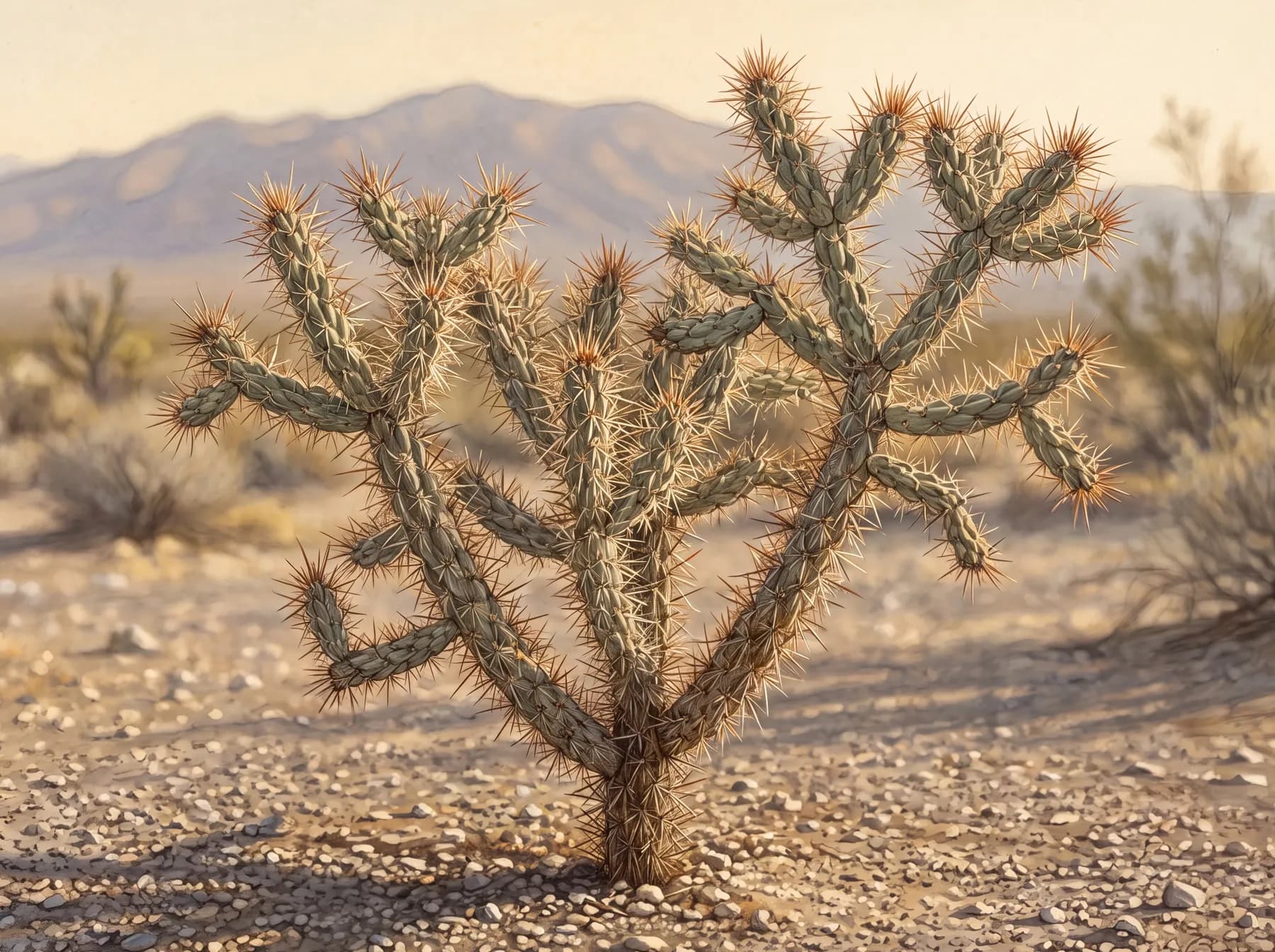
A buckhorn cholla standing by itself in open ground is a quiet puzzle. There is no parent plant nearby, and no easy story for how a seed reached ground this dry and held on long enough to grow. The plant has a simpler answer, and it skips the seed entirely.
Its joints are only loosely attached. A barbed spine catches a passing coyote or a brushed pant leg, the segment breaks free at a touch, rides along, and drops somewhere new, where it can root within weeks into a clone of the plant it left. No pollinator, no seed, no waiting on a wet year to line up a flower. This is not the jumping cholla of farther south; the joints come away easily but they do not leap. They only need something to walk past. It is why a cholla can turn up all alone in open desert: something went by with a joint hooked to it, then shed the passenger here.
The plant announces itself first as a silhouette. Its arms fork and re-fork into an open, candelabra shape that reads, at a squint, like a stand of antlers held up off the ground. That is where the name comes from: buckhorn. In spring the joint tips carry flowers that can run from yellow through bronze to brick-red, sometimes several shades on the same plant, which is unusual restlessness for a cactus and a good thing to catch when it blooms.
Come in close and the surface resolves into design. Each joint is raised into long tubercles, low ridges 1.5 to 4.5 centimeters long, and from the tip of every one springs a cluster of barbed spines sheathed in thin, baggy paper, straw-colored to gold. That papery sheath is the surest cholla tell you have up close. Because the tubercles stand proud and the spines stay sparse, green stem shows between them, which is how you tell buckhorn from silver cholla, whose denser spines bury the stem out of sight.
The same armament that punishes a careless animal is what a cactus wren goes looking for. The wren weaves a football-shaped nest, roughly 7 inches across and 12 long, down into the spined joints, so a snake or a raptor after the eggs meets a wall of barbs first. Thrashers use the cholla too. On this mid-elevation scrub, with Joshua tree and blackbrush for company and little that stands tall, defended cover is the scarce commodity, and the cholla is renting it out.
The tell is the paper: a loose, straw-to-gold sheath bagging over each barbed spine. Find that, and you have named the plant.