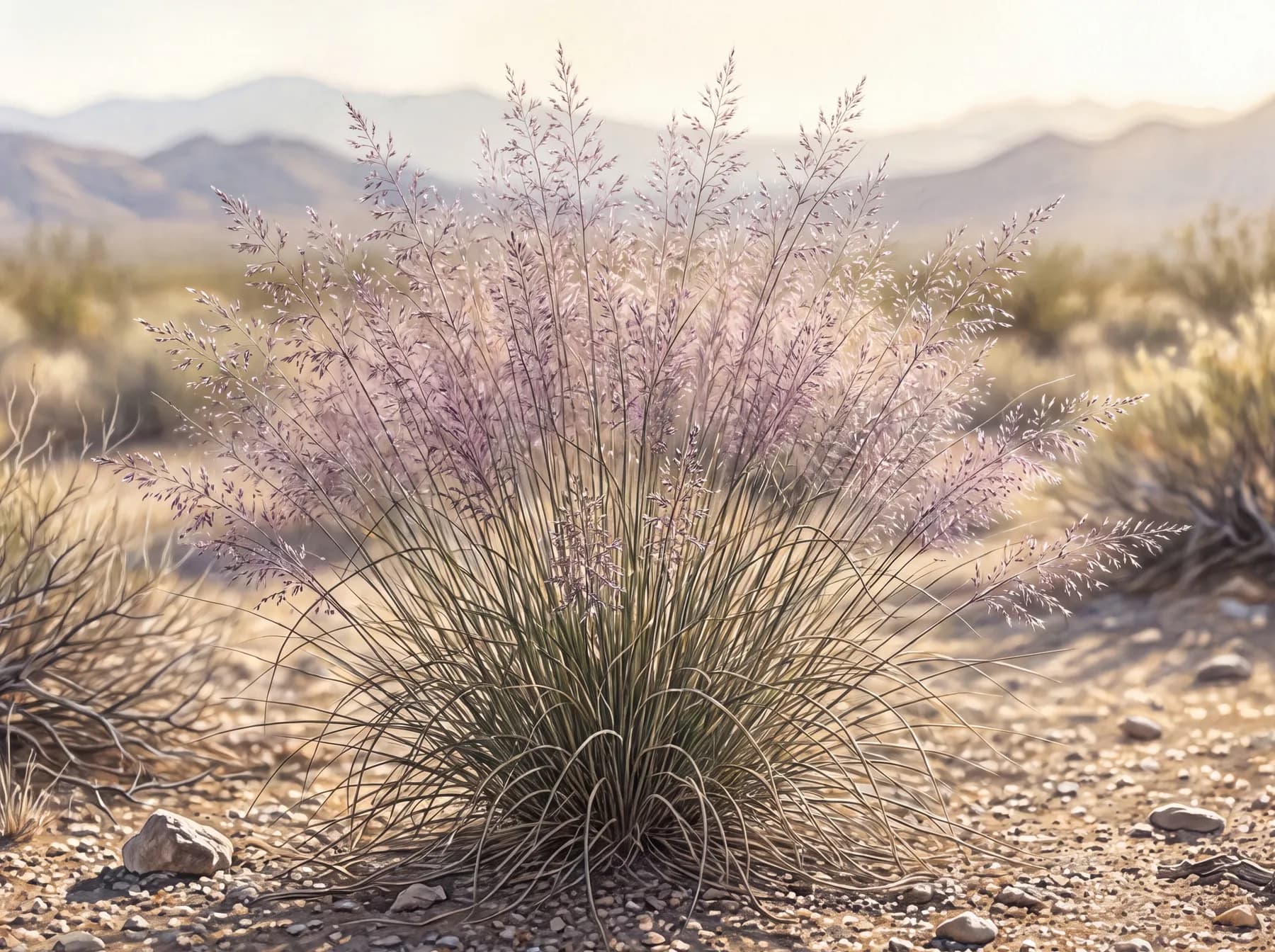
Bush muhly is highly palatable to all kinds of livestock, eaten readily year-round wherever a mouth can reach it, and it was once one of the most abundant grasses of southern Arizona. Settlers valued it enough to harvest it with hoes, which is how it earned the folk name Hoe Grass. A plant that useful, left in the open where animals graze, gets eaten to nothing. Across old cattle country most of it is gone now, and the plants that remain are not standing in the open.
The answer, across much of its range, is that it mostly stops growing in the open. Look for it instead up inside a shrub — a creosote, a mesquite, a catclaw — its fine wiry stems threaded through the branches of something armed. It does not fight the animals off; it simply grows where they cannot easily reach. Botanists put it plainly: bush muhly is found under the protection of shrubs more than in open areas, and those shrubs may give it some cover from large grazers.
That habit turns the grass into a readable sign. Because of its branching form it is extremely susceptible to heavy grazing, hurt once it is cropped below about a 4-inch stubble, and it has declined sharply where cattle run: once dominant in New Mexico desert grassland, now secondary. So its whereabouts carry information. Bush muhly standing in the open means ground that has not been hammered; surviving only inside the shrubs means it probably was. It is a useful clue, though other pressures can thin a stand too.
You will know it by its airiness. It is a weak-stemmed perennial bunchgrass rising from a hard, knotty base, its slender, many-branched stems tangling into a rounded, see-through mass up to roughly 3 ft across and hazed over in warm weather by a diffuse purple panicle nearly as wide as it is long. No other grass on this bajada reads that way. Next to a coarse, solid bunchgrass it looks like little more than a purple mist. A warm-season C4 grass, it runs the photosynthetic pathway that wastes less water in heat, and it leans on warm-season heat and moisture, greening late in the cold season and flowering into summer.
In this creosote and Joshua-tree country, the habitat and elevation are textbook for it, so we expect it on this ground even though we have not yet knelt to a confirmed plant. Until we do, recognition is the whole assignment, and it hangs on one strange sight.
Look for a shrub that seems to be smoking. Part its branches, and the purple haze resolves into a grass hiding where teeth cannot follow.