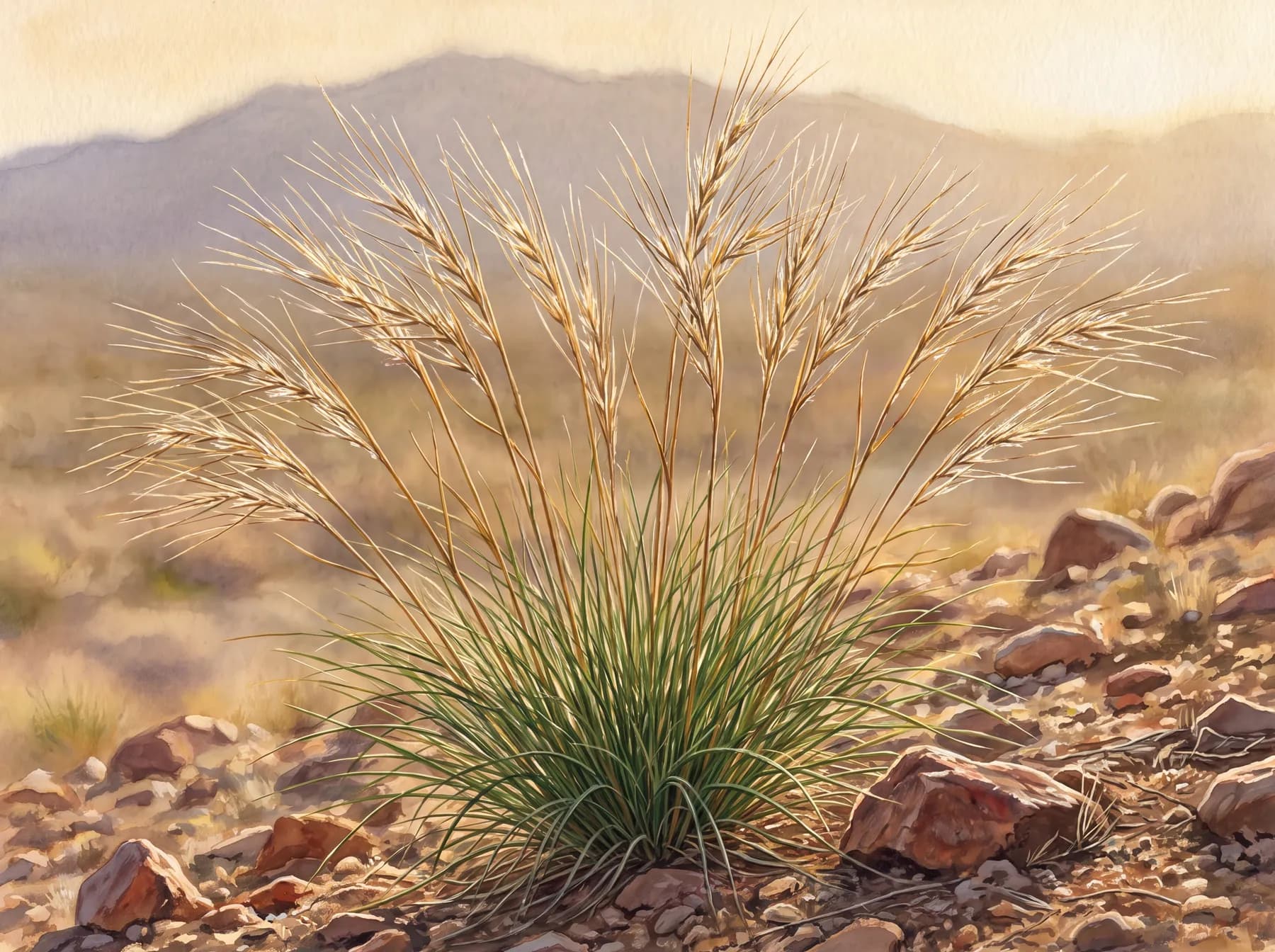
A grass seed cannot walk, and out here almost nothing will reliably carry this one to a good spot. So desert needlegrass grows a seed that plants itself, and it does the whole job with one moving part.
You will most likely notice it by being the wrong color at the wrong time. Most grass on this bajada is warm-season and waits for the summer monsoon; needlegrass is a cool-season native that greens on winter and spring moisture, so a fresh green tuft standing among dry stems is a fair first clue. It is a dense bunchgrass, 30 to 60 cm tall, its base wrapped in shiny reddish-brown old sheaths, its leaves rolled so tight they read as wire rather than blades — 0.5 to 2.0 mm across.
In late spring it lifts a silky, feathered flower head. Look closely at a single floret and you find the tool: one stiff awn about 2 inches long, bent hard near 90 degrees at its middle, feathery on the lower half, bare at the tip, set on a hard sharp point. That bend is the engine. The awn is hygroscopic. It twists as the air turns damp and untwists as it dries, and because the kinked tip snags on soil and grit, each turn screws the sharp end a little deeper. Wet night, dry morning, over and over, the seed walks itself into the ground under its own power.
The burial is the point. In a study of this grass, seeds driven deep by their own awns came up faster than ones left near the surface — the difference between a seed baking on open ground and a seed set where there is a little more water and a little less heat. The awn is not trim on the seed. It is how the seed chooses where it ends up.
The same shape has a second use it never asked for. A sharp point, backward-leaning hairs, and one-way travel work as well in fur and hide as in soil. Anyone who runs dogs or stock in this country knows these awns, because once one starts into an ear or through skin it moves inward and will not back out. So needlegrass is good native cover and passable forage while it is green, then a hazard once the seed heads ripen. The plant that feeds is the plant that drills. The trick is not its own invention; its relatives in the same grass tribe, and the barbed cheatgrass foxtails, run the same machine. Needlegrass just shows it plainly. Old grazing and invasive annual grasses have thinned these native stands across the Mojave, so a full clump is worth noticing, not assuming.
Under a hand lens, look for the bend: one awn kinked near 90 degrees, feathered on the bottom half, bare at the tip.