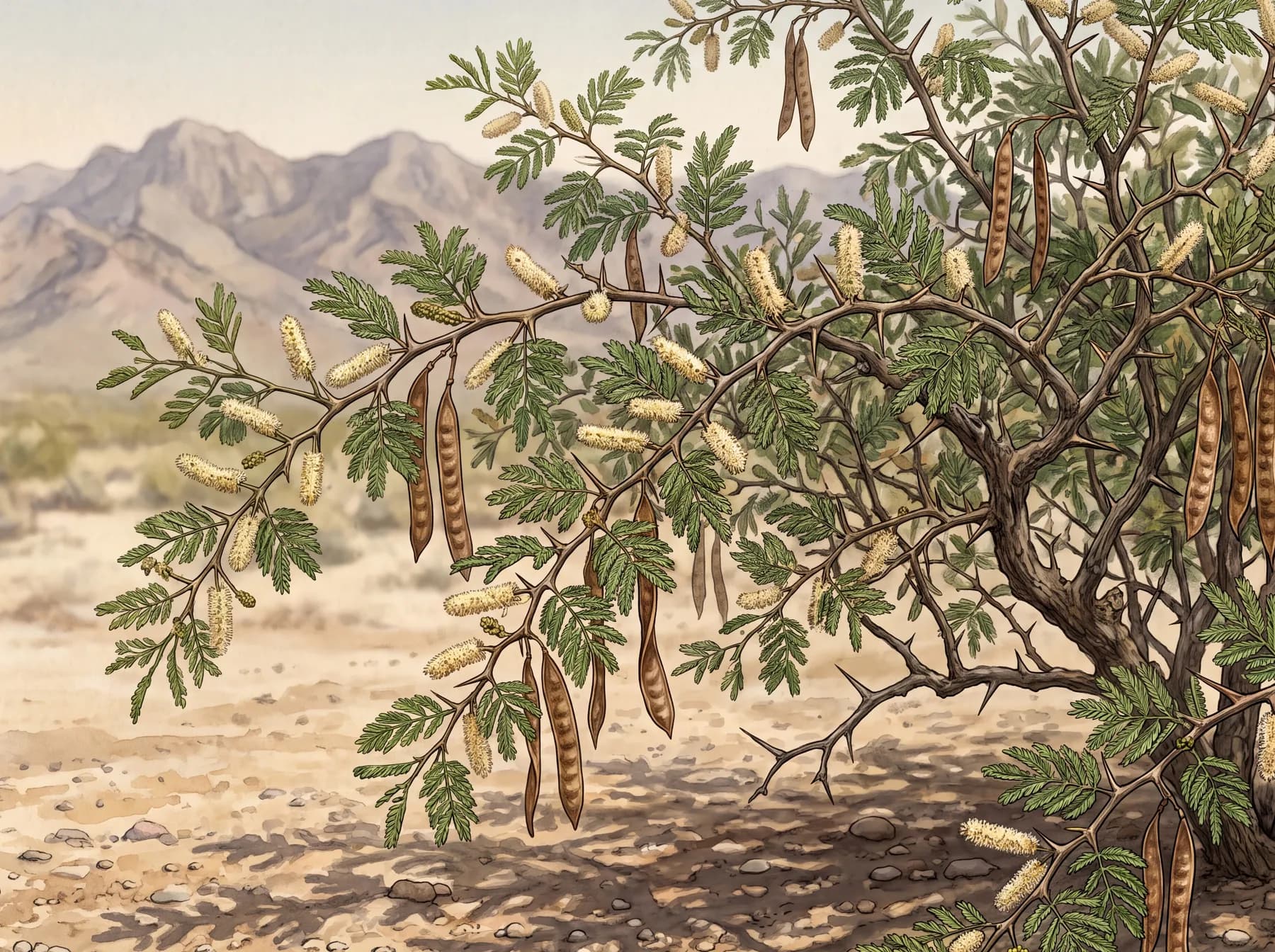
The common name is a warning dressed as a joke: wait-a-minute bush. Brush past a catclaw acacia in a wash and it will not let you keep walking. The thorns are small, only 3 to 4 millimeters, but they are curved and hooked backward along the twigs, set at the internodes, and built to catch rather than stab. Pull against one and the hook only bites deeper into your sleeve. So you stop, back up, and work it loose one point at a time. That is the whole of the name.
Up close it sorts easily from the mesquite it often shares a wash line with. Mesquite carries straight spines in pairs at the nodes; catclaw's are single, curved, and hooked, exactly the claw the name promises. Both wear the fine bipinnate leaves of an acacia, twice-divided into small leaflets. When it flowers, roughly April through October and sometimes in a second flush, it does not raise the round puff-balls of some acacias but pale cream spikes, cylindrical little bottlebrushes. It is usually a large armed shrub or a small tree, not the 30-foot form it reaches only where water runs generous.
Which raises the real question: how does a shrub this substantial live on ground that counts its rain in inches? The answer is underground and mostly out of sight. Catclaw is a wash plant, and not by accident. It settles in arroyos, valley bottoms, and the slopes where outcrops and boulders funnel surface water toward its roots, and those roots go deep, recorded past 18 feet in southeastern Arizona. It is drinking from water most desert plants never reach. That is why it traces the drainages here on the bench and stays off the open flats. Follow the catclaw and you are reading where the water runs when it runs.
There is a tidy story that wants to be told here, and it is wrong. Catclaw is a legume, like the mesquite beside it, and legumes are supposed to be the plants that pull nitrogen from the air and feed it into starved ground. This one does not. Unlike its mesquite neighbor, it is not known to form the root partnerships with bacteria that fix nitrogen; in controlled experiments the nodules never formed. It carries the family's pods, flat and thin and twisted between the seeds, and skips the one trick the family is known for.
What it offers instead is flowers, for months. That long cream bloom makes it one of the desert's premier honey plants, worked mainly by bees, and the honey it yields is bottled as a named regional specialty. The wood is another matter entirely: strong, hard, and heavy, dense enough that it has been cut for tools, fence posts, and firewood. And the same armed thicket that snags your sleeve is cover and a year-round larder for Gambel's and scaled quail, and shelter for rabbits.
One caution for the field: the thorns do not quit when the plant dies. A dead catclaw still catches. Give it the same room.