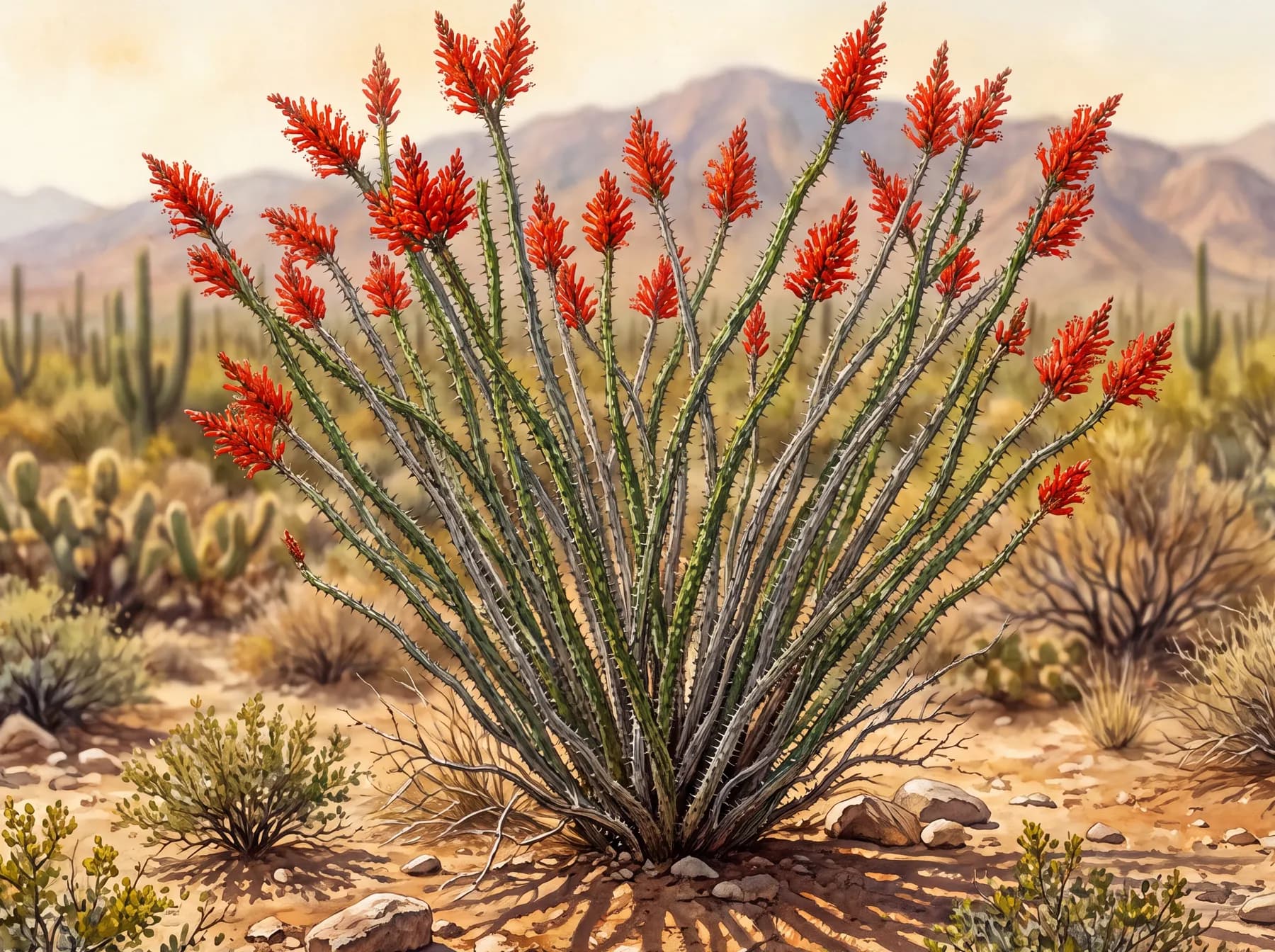
The range table says it should be able to live here. Ocotillo grows from sea level to about 5,200 feet, and on warm Texas limestone it reaches 6,700 feet, so this bench sits well under the ceiling. By that one number it belongs. Yet you will not find it on this ground, and the reason it is missing turns out to be more useful than the reason it might have fit.
It is easy to know once you have seen one. From a single low crown, a spray of long woody canes fans straight up, many unbranched wands between 6 and 20 feet tall, each lined its whole length with stout spines. Nothing else in this desert makes that silhouette: a loose bundle of thorny buggy-whips rising from a common base. For a few months in spring it lights up, dense scarlet tubes clustered at the very cane tips, March through July, the reddest thing on a dry hillside.
So why not here? Elevation is not the gate; the plant community is. Ocotillo is a creature of the warm Sonoran and Chihuahuan flats, the creosote and mixed succulent scrub of hotter, lower country. This bench is upper Mojave, Joshua tree and blackbrush, a cold-sink transition where night air pools and settles. And ocotillo has little tolerance for prolonged cold. At the northern and upper edge of its range it pulls back to warm south- and southeast-facing slopes, ground that thaws each day through winter. A blackbrush bench does not offer that.
The trait worth carrying downhill to meet it is how it treats drought. Most of the year the canes stand bare and grey, and a whole plant reads as dead. Then rain arrives and small oval leaves flush along every cane within days; when the soil dries again it sheds them and shuts down, and it repeats that on-off cycle several times in a single warm season. It looks like a cactus running the same play, and it is not one. Ocotillo has a plant family of its own, and its spines grew from leaf stalks rather than from a cactus's areoles: the same desert problem answered twice, by two lineages that never met.
Where it does grow thick, the bloom is aimed at something in motion. Those scarlet tubes are shaped for hummingbird bills, and the flowering overlaps the birds moving north in spring, so a slope of ocotillo becomes a refueling line strung along the route. In that same warm country people have long cut canes and pushed them into the ground as a living fence; the cuttings root and leaf out into a self-repairing hedge of thorns. That is a warm-lowland habit, though, not something this cold bench would keep alive.
To meet it, look south and downhill: the hot rock and river country below, where grey canes turn red in spring.