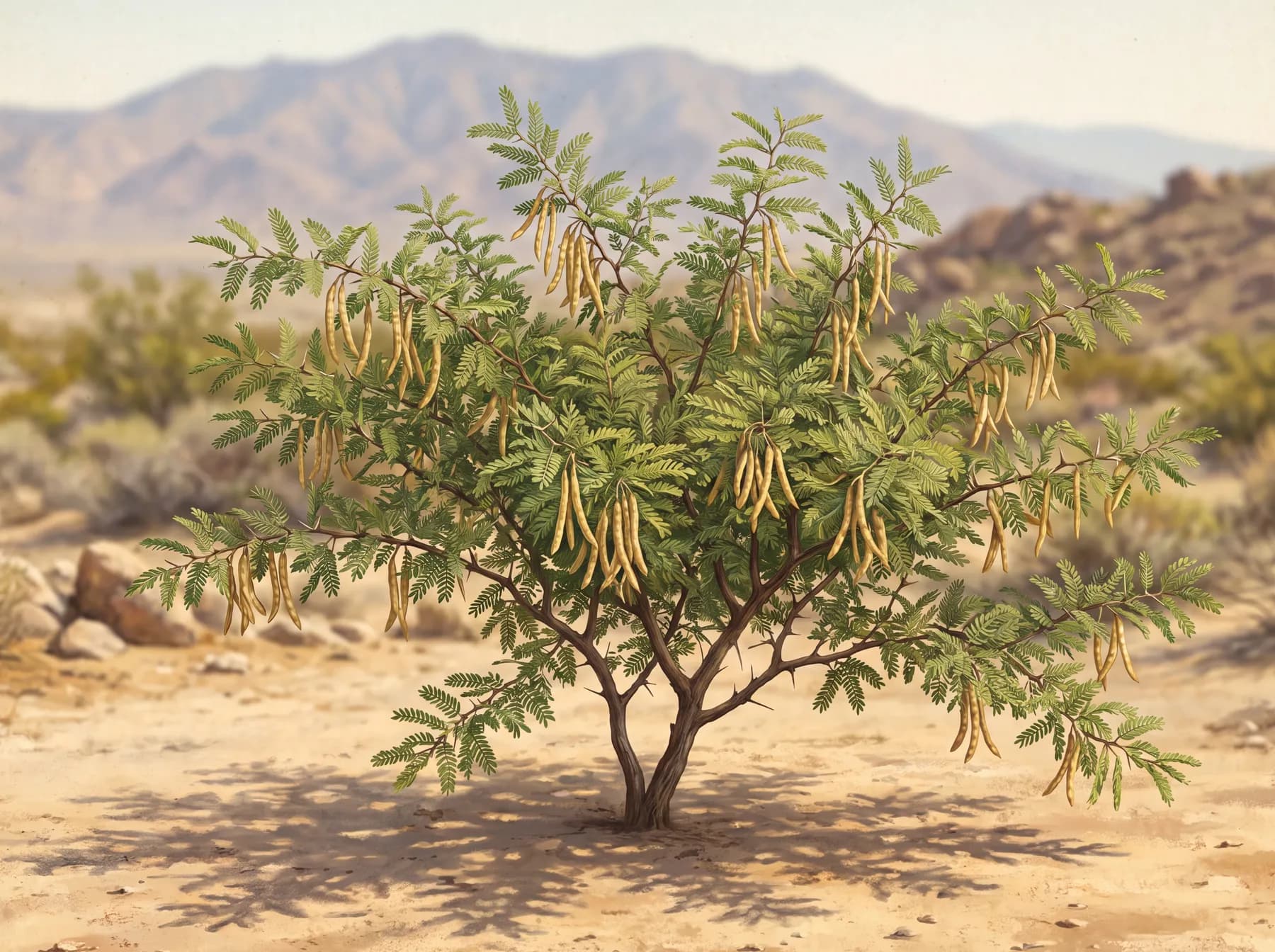
After a dry spring the uplands turn the color of the ground, and then there is a line of trees down in the wash still holding green leaves, as if the drought were happening to somebody else. That green is the tell. The honey mesquite is not tougher than its neighbors. It is reaching a supply they cannot.
It manages this by digging. Mesquite is a phreatophyte, a plant that plumbs down to the water table instead of waiting on the rain, and it commits to that strategy further than anything else on this ground. The taproot commonly reaches around 40 feet, and one has been recorded at 190 feet below the surface; a root followed down a 1949 Arizona open-pit mine measured about 175 feet, among the deepest ever documented for any plant. Where rainfall alone would never wet the soil enough to keep it alive, the tree reaches past the weather instead. That is why you find it keyed to the washes and drainages and not scattered over the open flats the way creosote is. It has to stand where the groundwater runs close enough to chase.
There is a second thing it does underground, and it changes the dirt around it. Mesquite is a legume, and like other legumes it works with soil bacteria to pull nitrogen straight out of the air. One accounting in the Sonoran Desert of California put that fixation as high as 66 pounds per acre per year, with the tree drawing roughly half of its own nitrogen from the bacteria. Nitrogen and water are the two things this desert rations hardest, and the mesquite shows up making one and finding the other. Catclaw acacia, which shares these washes, is a legume too, so the tree is not alone in the trick. It is the one that runs it at scale.
Above ground it is generous in a more visible way. The flowers hang in pale spikes loaded with nectar, and something like 160 bee species work mesquites across the Southwest; the honey is distinct enough to sell under the tree's own name. The straw-colored pods that follow were a staple food here for thousands of years, ground into a flour that keeps well and runs over 15 percent protein in some testing. They mattered because they came even in drought years, when little else did, though raw pods want processing before they are food.
To be sure you have mesquite and not a look-alike, check two marks together. The leaf is twice-divided and feathery, a lacy fern-like blade, and a pair of straight, stiff, whitish spines flanks each leaf node. Straight thorns beside a feathery leaf is the signature. Catclaw carries thorns that hook like a cat's claw, and its pods twist and split open; screwbean mesquite winds its pods into tight coils. Honey mesquite's pods stay straight, stay closed, and drop whole.
In a browning June, look to the drainages for the tree that stayed green. Straight spines, feathery leaves, long closed pods.