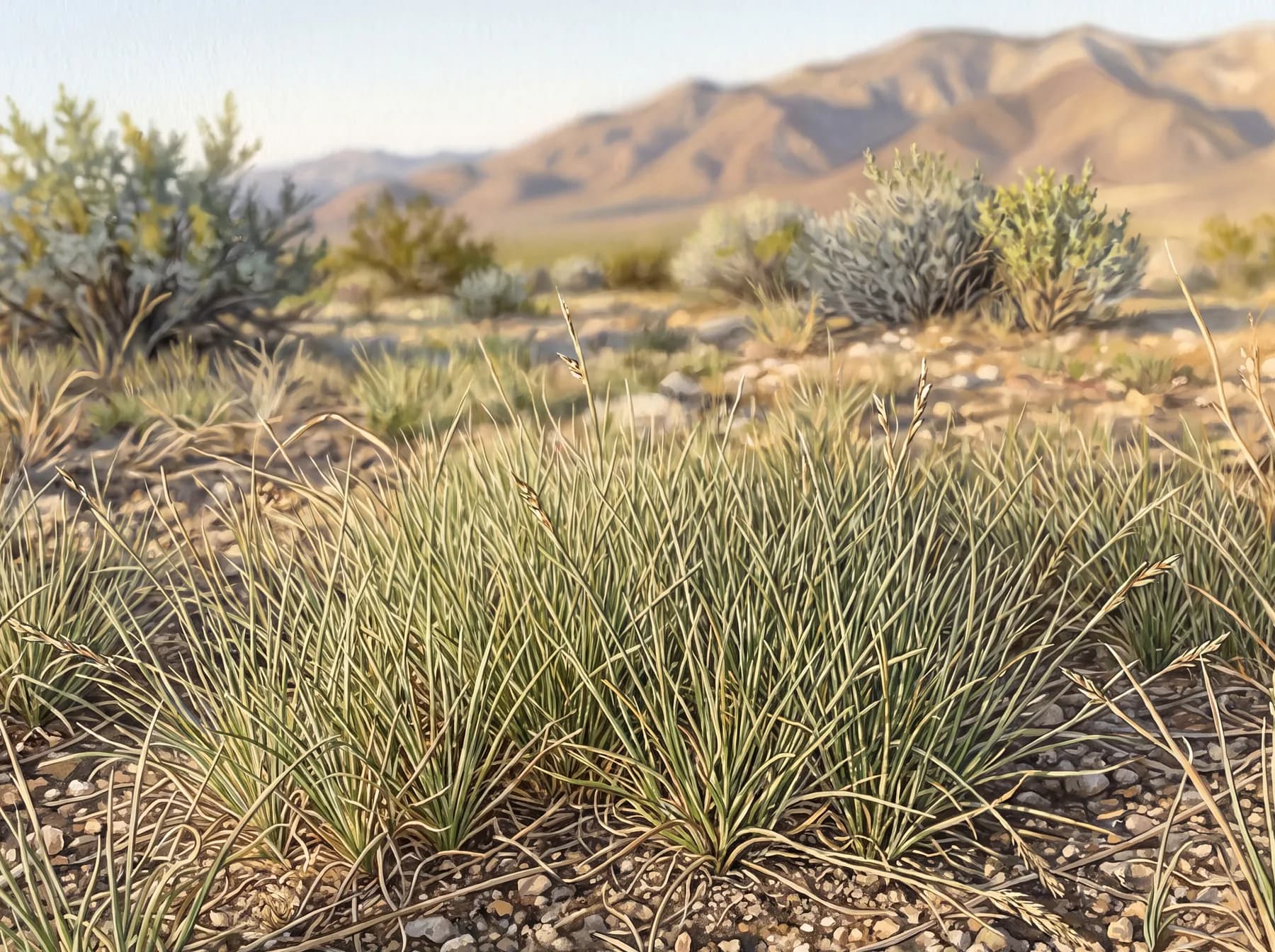
The thing to notice is not the plant. It is the ground between the plants. A creosote or a bursage keeps a clear ring of bare dirt around itself, and for a long time the space between shrubs on this bajada was mostly that: open, stony, empty. Mediterranean grass fills it. In a wet winter the interspaces come up in a low, fine, greenish fuzz, a few inches of curled blades, and the desert looks a little softer than it did. That softening is the problem.
The plant itself is easy to overlook, and easy to. It grows as a small tuft of narrow inrolled blades, 5 to 10 centimeters long and a millimeter or two wide, topped by short dense heads of awnless spikelets, each 4 to 8 millimeters and holding a few florets, aging from tan to reddish. On good ground the species can reach 40 centimeters, but here it rarely clears a few inches, the kind of plant your eye slides over rather than names. Two nearly identical species, Schismus barbatus and Schismus arabicus, grow tangled on this kind of flat, and separating them takes a hand lens and a look at the floret; for reading this ground it does not matter. Both are introduced, native to the Mediterranean and to Eurasia and North Africa, and both arrived in the Southwest after roughly the 1940s. The grass reaches its greatest abundance at the lower elevations of the Mojave, and this high-desert flat sits well inside its range.
What matters is the pattern, not the plant. Desert shrubland here historically rarely carried fire, for a plain reason: fire needs fuel it can cross, and the bare interspaces broke the chain. A lightning strike burned one bush and stopped, because nothing continuous carried it to the next. Mediterranean grass lays down the missing link. By late spring the green cures in place to dry straw, fine and still standing, and the gaps the shrubs worked to keep open are floored wall to wall with tinder. Height was never the hazard. Continuity is. The USGS says it plainly: where invasive grass fills these spaces, fire spreads faster and burns far more of the land than it could over open, rocky ground.
The size of that change has been measured. In a national study of fires from 2000 to 2015, ground where this grass had invaded burned far more often than ground without it — about 5 percent of uninvaded sites against 16.5 percent of invaded ones. Across the invasive grasses examined, presence raised how often a place burned by 27 to 230 percent, and this one showed the largest effect of any. Then the fire feeds the grass. In Mojave plots, burned ground carried two to five times more invasive cover than unburned ground for roughly twenty years after, and where it burned repeatedly the invaders passed 70 percent of the cover. Native shrubs do not take frequent fire well, so each burn trades a little more shrubland for annual grass, and the grass is what carries the next fire.
Read the dirt, not the plant. When the bare gaps between shrubs fill with fine grass, green or straw, the firebreak is gone.