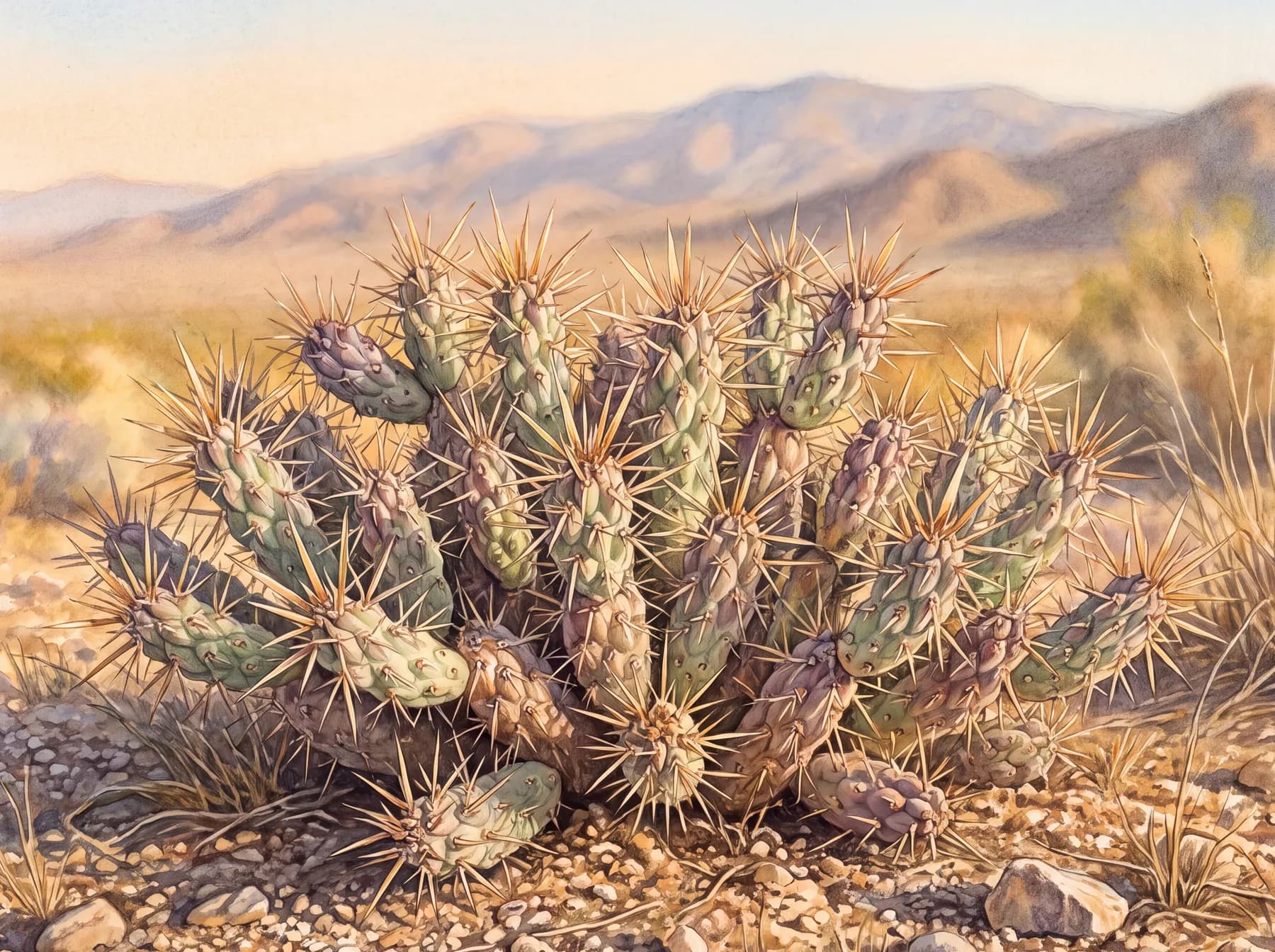
Most of what makes this ground dangerous stands up where you can see it. The club cholla does the opposite. It lies flat, ankle-high, a low clump of stubby joints so buried in spines that no green shows through, and from standing height it reads as a heap of dead twigs raked into a pile. People here call it dead cholla for that reason. The trouble with the name is that the plant is not dead, and the pile is where you put your foot.
Look closer and the litter resolves into a cactus. The stems are short, club-shaped segments, fat toward the tip. Each cluster carries more than a dozen flattened spines — flattened, not round, which is the mark that separates it from the tall chollas, whose spines are cylindrical and wear papery sheaths. The longest here run close to 2 inches, straw-white and bent hard downward, and they cover the stem completely. Young spines come in red or pink, then fade through grey to white with age, until they match dry desert grass. None of that is incidental. A plant the color of dead bunchgrass, at the height of your ankle, is one you will not see until you are standing in it.
The strange part is the size of one plant. The stems root along their undersides as they creep, so a wide mat can be a single clonal individual, walking slowly outward from where it first took hold, up to about 6 feet across and genetically one cactus rather than a stand of many. That carries a consequence in the field. A segment that snags on a boot or a dog's leg and rides off is not debris. It is a viable cutting, the plant's way of starting over somewhere down the trail.
Its defenses save the worst for the part that looks harmless. The fruit is club-shaped and pale yellow and wears no spines at all, which invites a bare hand. What covers it instead is a dense coat of yellow glochids, hair-fine barbed bristles that let go at a touch, work into skin, and stay. The barbs are why a glochid, once in, will not back out; the big flattened spines do their damage by length and downward angle, not by holding. Both lessons tend to arrive on the same afternoon.
On this bajada it keeps to the flat ground rather than the slope: the sandy, gravelly flats and wash margins under the creosote and the Joshua trees, up near 3,000 feet, near the upper edge of where it is usually found. It is uncommon here, and we have not confirmed it on this parcel. There are only about 57 records for the whole state of Arizona, few enough that the plant is as easy to under-count as it is to overlook. For a stretch in May through July it gives itself away, opening pale lemon flowers with a thin red line down each petal, though reportedly for only about 2 hours at a time, which is most of the reason you rarely catch it in bloom.
Watch the ground, not the skyline. A flat mat of straw-colored daggers at your ankle is the plant. It has been there a while.