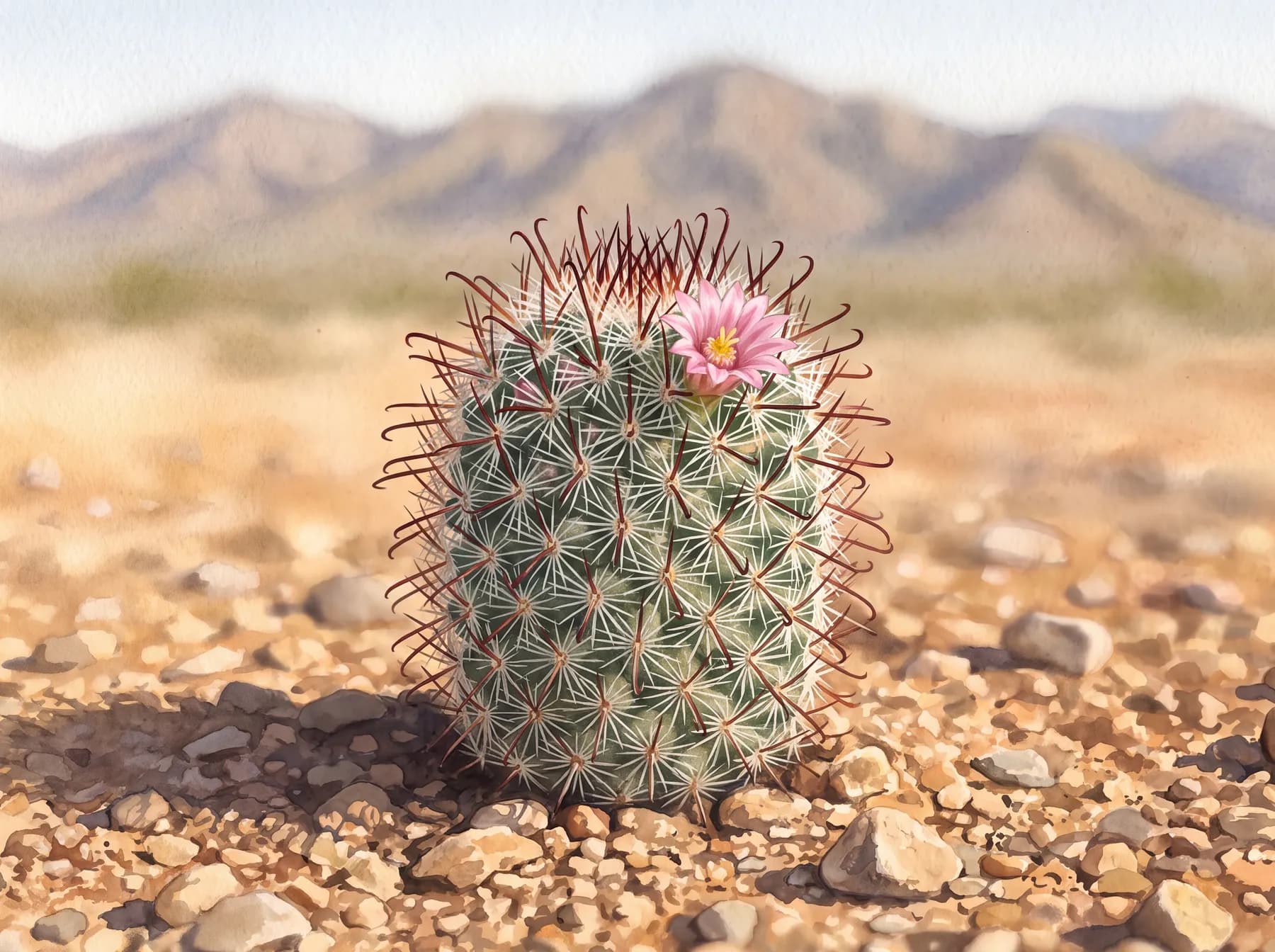
Spend an afternoon crossing this bajada and you can miss it entirely, then look down and find you have nearly set a boot on one. The fishhook cactus is a single grey-green cylinder, often just 2 to 3 inches tall and rarely more than 10, and it likes to sit low and half-sunk in gravel where a bigger plant would stand out. Being hard to see is most of the plan here.
The first thing you notice, if you notice anything, is a soft white haze around the body. That is a sheath of 30 to 60 hair-like radial spines, white with dark tips, laid so densely they blur the plant's outline and throw back the sun. Look past the haze for the lock: 3 to 4 stiffer, darker central spines, at least one of them curled into a true fishhook. The name carries it, tetrancistra, Greek for four and hook. Botanists moved the plant to the genus Cochemiea in 2021, though many guides still file it under its older name, Mammillaria tetrancistra. Straight-spined neighbors have no such curl, and no other spine on this ground does the same work.
A hook invites a tidy story, and the tidy story is wrong. It is easy to guess the curved spines are a way to catch a ride: snag a passing animal, travel off in its fur, drop a seed somewhere new. But this is a solitary cactus that does not break into joints the way a cholla does, so there is nothing for the hook to hand off. Its seeds go a different way. A small, shiny red fruit pushes out from between the tubercles, fleshy and club-shaped, holding black seeds jacketed in corky arils. What the hook seems to do is simpler and closer to home: it guards a soft, water-filled body, and it will not release the way a straight spine does.
Smallness explains the rest. It keeps its real bulk out of sight, anchored on a fleshy, tuberous root, a buried tank unusual among its small mammillaria kin. Above ground the plant stays low and spends almost nothing. Then, in early summer, it does the one extravagant thing it allows itself and rings its crown with pink-to-lavender flowers 2 to 4 centimeters across, wide for so small a body, then gone.
Its range runs through the Mojave and Sonoran deserts, across California, Arizona, Nevada, and Utah and down into Baja California and Sonora, so this parcel's gravelly upper-Mojave flats sit well inside its country. We expect the plant here more than we have earned the right to say we have found it. Something this small and this good at hiding is easy to cross every week and never once kneel to.
Look for the single hooked central spine inside the white halo. Straight spines slide back out; that one holds, so keep your hands clear.