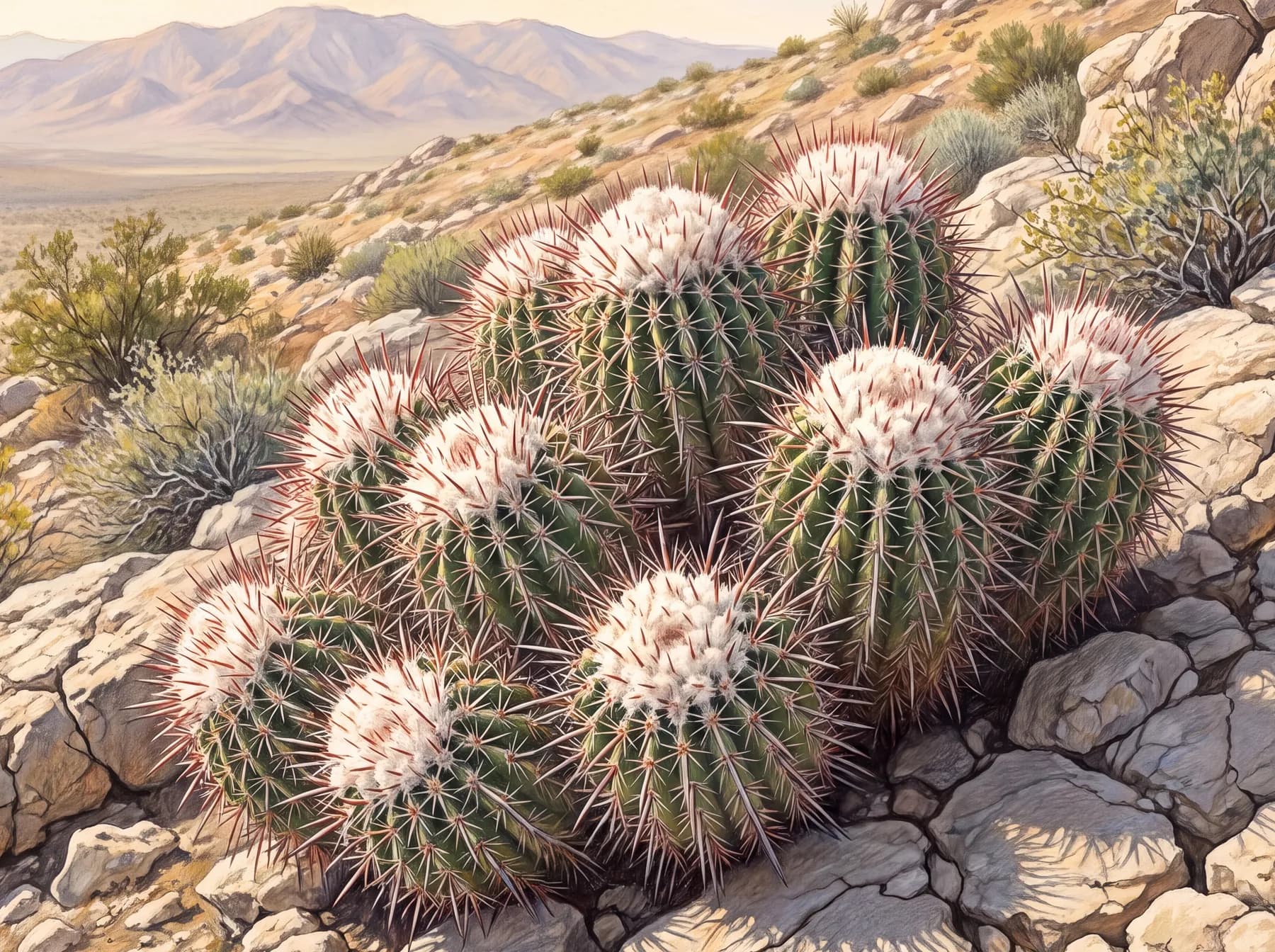
On the hardest ground here — the gravel and broken rock where almost nothing else takes root — look for a low mound of barrel heads crowded together, each crown carrying a cap of dense white felt. That cap is the whole reason for the name cottontop. From a few steps off you might take it for a scrap of wool snagged on the spines. It is nothing of the kind: it is the plant's own growing tip, wrapped in insulation it grew itself.
The felt sits over the meristem, the narrow band of dividing cells that builds every new rib and spine, the softest and newest tissue the cactus owns. Out here that tissue faces a full day of desert sun, then a cold night, then more sun. The wool shades it, reflects light off it, and buffers the swing between heat and cold. Later the same cap takes on a second job: it holds the flowers and ripens the fruit. The plant earns its name twice from one patch of wool.
None of this happens quickly. Cottontop is among the slowest cacti alive; a good year might add a quarter inch of girth, and a dry one adds nothing at all. A seedling will not even begin to branch until it is roughly twenty years old, so the packed clumps, commonly ten to twenty heads and sometimes thirty to fifty, are not a cluster of separate plants but one fused individual well past a century old. The species name, polycephalus, means many-headed. It is a single plant wearing many crowns.
The spines work the same logic at another scale. They are heavy, curved, flattened, red fading to grey, and set so thickly they nearly cage the body; the longest reach about five inches. They are defense, but a dense screen of spines also breaks up the direct sun and traps a thin layer of still air against the skin, which slows the water leaving it. The lattice is tight enough that the small yellow flowers, when they arrive in the warm months, often cannot open fully through it. Do not read those curves as hooks. This is not a fishhook barrel; the spines twist and bend but do not catch.
The wool comes back at the end of the cycle. The ripe fruit is packed with white hair, and birds and small mammals tug that cotton loose for nesting material. Pulling it free, they scatter the comparatively large seeds across the same stony ground the parent settled on. The cap that once shielded the growing tip becomes, months later, the thing that carries the next generation a short way downslope.
Whether it holds this exact slope is a fair question. The parcel sits near the top of the elevation band the narrowest sources give this cactus, though a higher-country variety on limestone and granite climbs well above that. Best to call it present in the region and near its ceiling here, not a sure thing on this ground.
Look for the white felt on the crown, caged in curved spines. Nothing else on this bajada wears that.