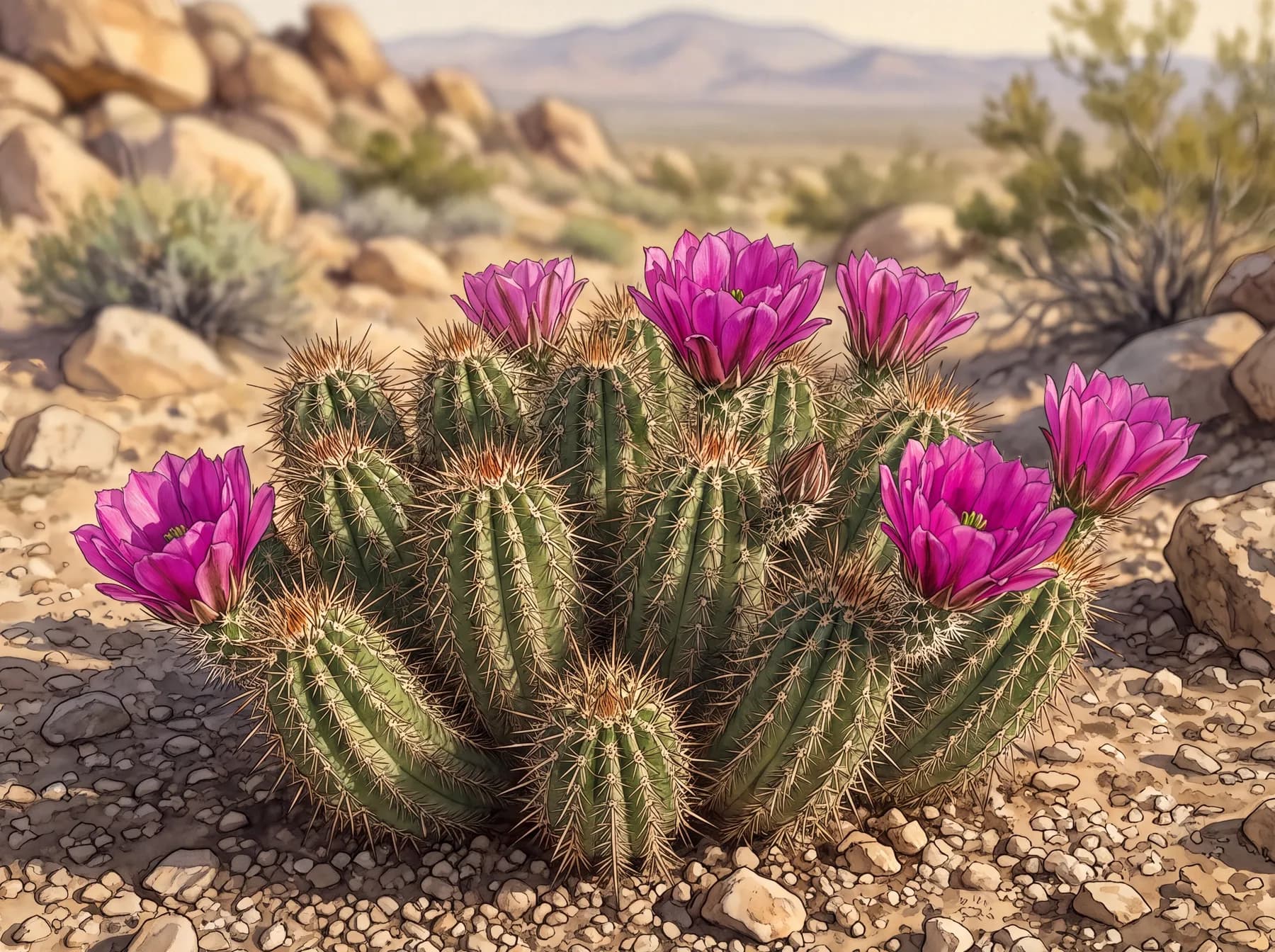
Find two of these cactuses growing a stone's throw apart, and you may not be able to prove they are the same plant. One wears a neat white rosette of spines; the next is armed in yellow, or pink, or gray shading to dark brown, and the color can change across a single clump. This is Engelmann's hedgehog cactus, a low mound of short cylindrical green stems, each so densely sheathed in stiff radiating spines that from a few feet off you read armor before you read plant. Late in the day, with the sun behind it, the whole spine cage lights up like wire.
The stems are ribbed and finger-thick, and they cluster into loose mounds: a handful at first, then a dozen or twenty, and in a vigorous old colony fifty or sixty stems spreading a yard wide. Run a careful eye over them and you will not find glochids, the near-invisible barbed hairs that make a prickly pear or cholla so miserable to brush against; every hedgehog spine is out where you can see it. This is Mojave desertscrub, creosote and bursage grading into blackbrush and Joshua tree on the rockier slopes, and this ground sits near the middle of the cactus's elevation range, not at any edge of it.
Those spines do more than keep teeth off. Across the hedgehog cacti, the spine layer works as insulation and shade, buffering the living stem against both the day's heat and the cold that floods in on a clear desert night. Fire is where that second job shows. Surveys of burned ground in southern Arizona found hedgehog mortality ran to about 82 percent, against 46 percent on unburned ground nearby, and some survivors die slowly over the following years, left standing among the skeletons of the ones that went first. Strip the spines and you have pulled the plant's blanket; what remains is open to frost, to sun, and to anything hungry enough to test it.
For a plant this well defended, the flowers are a startling surrender: big funnel-shaped blooms in bright magenta, over three inches across, a ring of yellow stamens around a green, many-lobed stigma at the center. Here that color most likely arrives in April or May, some of the earliest real nectar this dry ground offers. And the plant does not spend it all at once. Each flower opens in the morning, closes at night, and opens again the next day, holding for about five days instead of dying after a single showing, a slow economy in a place that rewards nothing hasty.
When a flower is spent, it leaves a spiny reddish fruit with white pulp, sweet enough that the plant is sometimes called the strawberry hedgehog. That fruit fed people here long before it fed anyone's field notes: Pima, Yavapai, Apache, and Mescalero gathered it and ate it raw or dried, and the Yavapai boiled the buds. A cactus that spends most of the year as a fist of spines becomes, for a few weeks, food.
Look low among the rocks for a green fist of finger-thick stems, packed in spines no two clumps color the same. That glow is it.