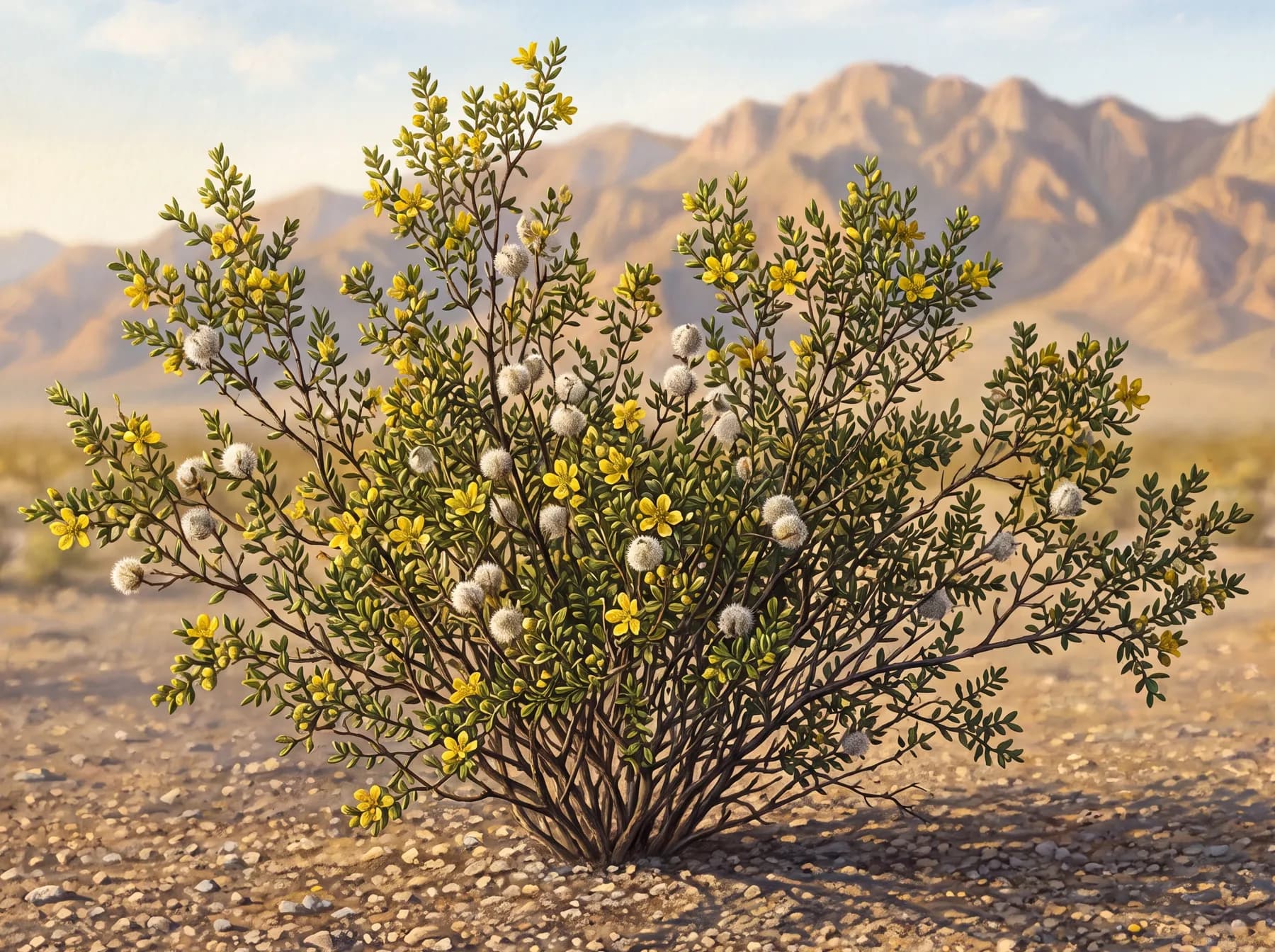
The smell most people call desert rain arrives a moment before the rain does, and it is not the rain but this shrub. When the first drops wet its leaves, creosote releases the volatile resin it carries on every surface, and that resin is what you are smelling: the plant, not the weather. The scent is strongest on a wet or crushed leaf, which makes it one of the surest ways to name creosote with your eyes closed.
That coating does much more than smell. The resin can run to as much as a tenth of a creosote leaf's dry weight, most of it a single phenolic compound with an unlovely name, nordihydroguaiaretic acid. It works as a multi-tool. It seals the tiny leaf against water loss, screens it from ultraviolet light, and makes the foliage bitter enough to turn most browsers away. A leaf defended that well can afford to stay on the plant year-round rather than be grown and dropped each season.
The endurance behind that evergreen leaf is stubborn rather than dramatic. In drought, creosote throttles its gas exchange down hard and holds on at tissue-water levels that would kill most plants, staying alive without doing much. Then, within hours of a rain, it restarts. It does not go dormant and it does not shut off; it downregulates and waits. The strategy is not to out-grow the competition in a good year but to still be standing after a run of bad ones.
Stand on an open flat and the creosote can look planted: shrubs spaced almost evenly, each with clear ground around it, the whole stand see-through rather than crowded. The tidy explanation is that the plant poisons the soil around itself, and that is the part to be careful with. Creosote does carry leaf compounds that chemically discourage seedlings, including its own, which helps keep a stand open. But the even spacing is most likely the work of roots competing underground for scarce water, with the leaf chemistry a contributing and still-debated factor rather than the cause. The ground looks landscaped. The reason is mostly thirst.
What that patience buys is time on a scale that is hard to hold in the head. As an old creosote's central crown dies, it clones outward in a slowly widening ring of genetically identical stems, the same plant taking more ground while it abandons its middle. One Mojave ring has been estimated at roughly 9,000 to 12,000 years old, which would place it among the oldest living things known. That age is an extrapolation from measured growth rate rather than a counted one, so it is a strong estimate and not a fact. At this elevation, creosote does not own the ground the way it does on the warmer flats lower down; here it shares the benches with blackbrush and Joshua tree, holding the last open ground before the cold higher up edges it out.
Two marks settle it up close. The flowers are solitary in the leaf axils, five yellow petals each set at a slight twist, like a pinwheel; the fruit that follows is a small round ball densely furred in white-to-rusty hairs. And the name is a trap worth knowing: tridentata means three-toothed, taken from an early specimen, and does not describe the mature leaf, which carries two leaflets, not three.
The give-away is the leaf: two leaflets, 3 to 6 millimeters, fused into a tiny green V, lacquered and sticky to the touch.