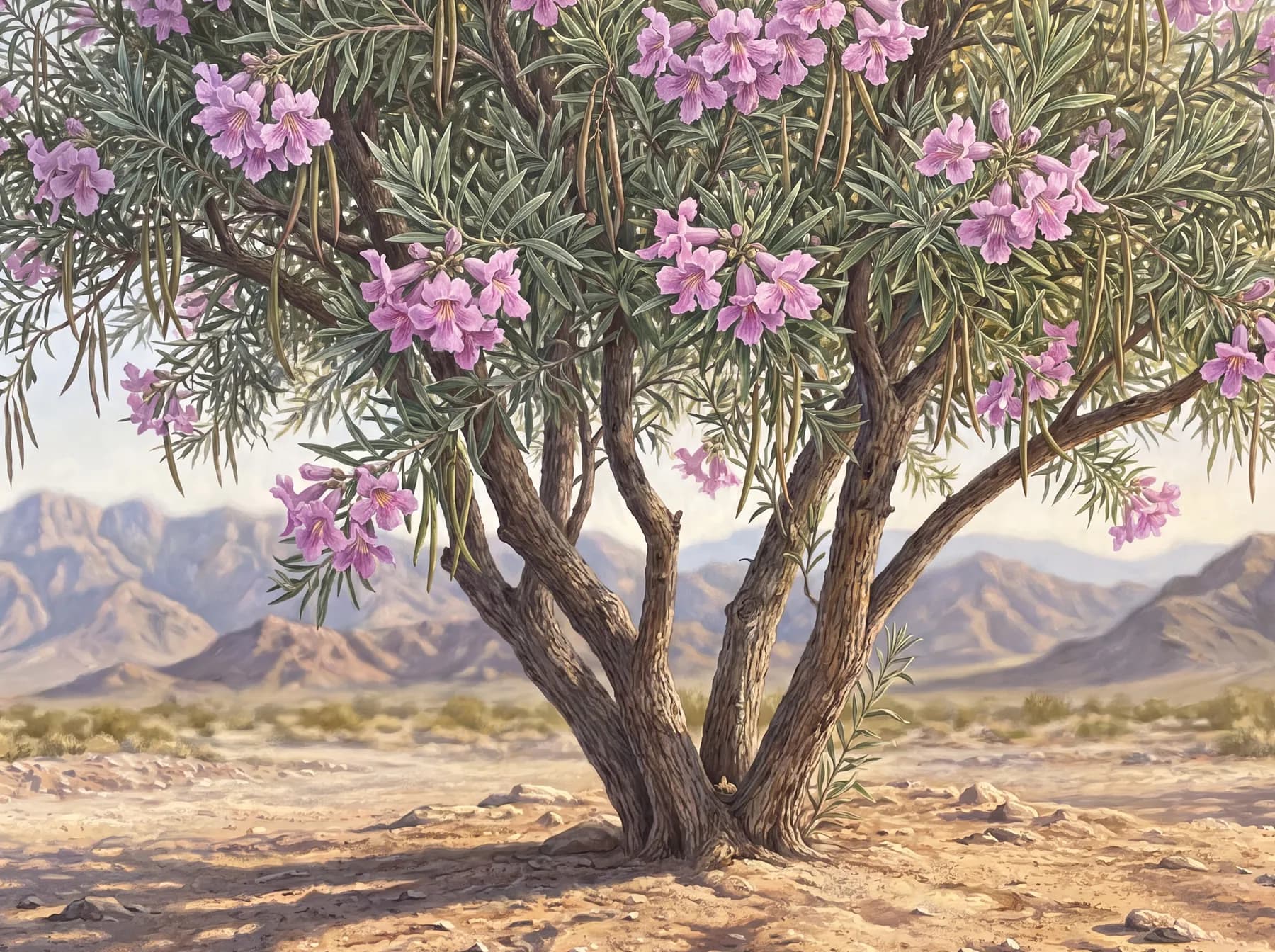
A tree with willow leaves stands in the middle of a dry wash, and both halves of that sentence are set up to fool you. The leaves are long and narrow and willow-thin, 10 to 30 centimeters of slender blade, so the eye files the plant as a willow and moves on. The channel is bone dry on top, so the eye files it as a tree toughing out a drought. Both readings are wrong, and what is actually here is stranger than either.
It is not a willow, and not even a distant relative of one. The true willows are Salix; this is Chilopsis linearis, in the catalpa and trumpet-creeper family, Bignoniaceae. The resemblance stops at the leaf, which wears a thick waxy skin no streambank willow bothers with. Wait for it to bloom and the disguise falls apart, because no willow ever made a flower like this.
The flower is the give-away and the reason people forgive the tree everything else. It is a ruffled trumpet, 2.5 to 4 centimeters long, flaring into five crimped lobes somewhere between pink, lavender, and white, its throat ridged in yellow and streaked in purple. Those marks are not decoration. They are a painted runway, aimed to steer an insect straight down the tube toward the nectar and across the pollen on the way in.
It looks built for a hummingbird, and hummingbirds do come, crossing open desert to reach it, along with hawkmoths and heavy carpenter bees. But visiting and pollinating are different jobs. Researchers who watched the flower closely found that most of those showy callers leave without doing the work; the seed is set mainly by large bees, chiefly the Sonoran bumble bee. The birds are guests. The bees are the reason there is a next tree.
The dry wash was the other setup. Desert willow is a water opportunist, tied to a shallow water table it can still reach when the surface is only dust. It grows down in the channel rather than up on the bajada slope because the channel is where the water hides, which turns the tree into a sign you can read: where one stands, water sits somewhere under the sand. Given that buried water it grows fast for this country, close to a meter, roughly 3 feet, in a single year, and so it claims fresh wash deposits before slower plants arrive. It is not thriving on the drought. It is drinking from a source you cannot see.
Come winter it drops every leaf and quits the willow act, and the fruit finishes the correction. Slender capsules 15 to 25 centimeters long hang on the bare branches like beans, then split to spill flat seeds fringed with fine hairs that carry them off on the wind. That is a catalpa's fruit, not anything a willow makes.
Find one flowering in a dry wash and you have found the water. It is standing on what it cannot let you see.