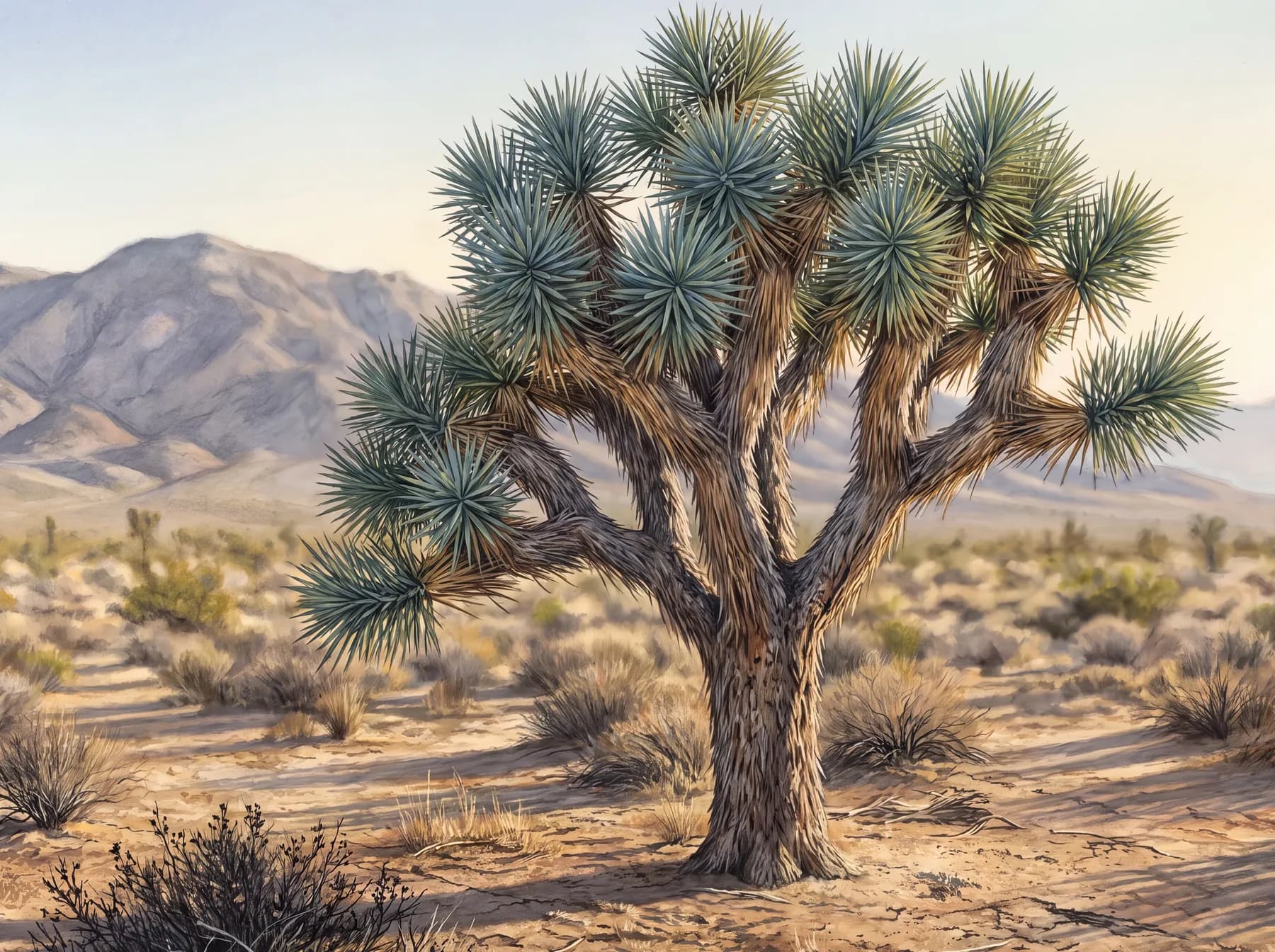
The tallest yucca on this parcel has stood here longer than anyone has been building here, and it got that way by doing very little, very slowly. A Joshua tree adds something like half an inch to three inches in a good year, and in a dry one, nothing at all. That is not laziness. It is the only growth rate this desert will finance. Where the rain can skip a year or two running, a plant that sprints during a drought has spent water it does not have, so what reads as a big old tree is really a long ledger of restraint.
It is not a tree, despite the trunk and the branching arms. It is a yucca, a monocot with no true wood and no annual rings, which is why no one can hand you its age except as a guess from its height. And it is a specific one. The Joshua tree was split into two species in 2007; this is the eastern one, Yucca jaegeriana, shorter and more densely branched than the tall, bare-trunked western tree, and its range runs through Arizona, Nevada, eastern California, and a sliver of Utah. A high-desert parcel in Mohave County sits well inside the eastern tree's country and nowhere near the western one's.
It cannot make a seed without one particular insect, and the deal is absolute. The eastern tree is pollinated by its own yucca moth, Tegeticula antithetica, and she does the work on purpose: she gathers pollen, carries it to another flower, and packs it into the stigma by hand, in a way no accidental visitor manages. Then she lays her eggs in the ovary, and her larvae eat some of the seeds she just helped make. Neither partner has a backup. No moth, no seed; no seed, no tree; no tree, no moth. They have held that knot for millions of years.
There is a second partner in the story, and it is gone. Joshua tree seeds are large and heavy and travel badly today, yet the fossil record shows the plant once spread far faster and farther than it can now, back when the Shasta ground sloth was still here to eat the fruit and move the seed. Scientists think that vanished animal was the tree's long-distance courier. If they are right, every Joshua tree in open ground is still dispersing at a pace it inherited from an animal that has been gone since the Ice Age, packing seeds for a ride that no longer comes.
On this bajada that history has a practical edge. Arizona protects the Joshua tree as a salvage-restricted native plant, so moving or clearing one runs through state permits and tags rather than free choice. The law carves out exceptions for small residential parcels, so the real reason to leave it standing is not the paperwork. It is that you cannot put back a century of this kind of growth, and neither can the moth.
Look close for the give-away: a dense armored rosette of blue-green blades at each branch tip. Nothing else here makes that star.