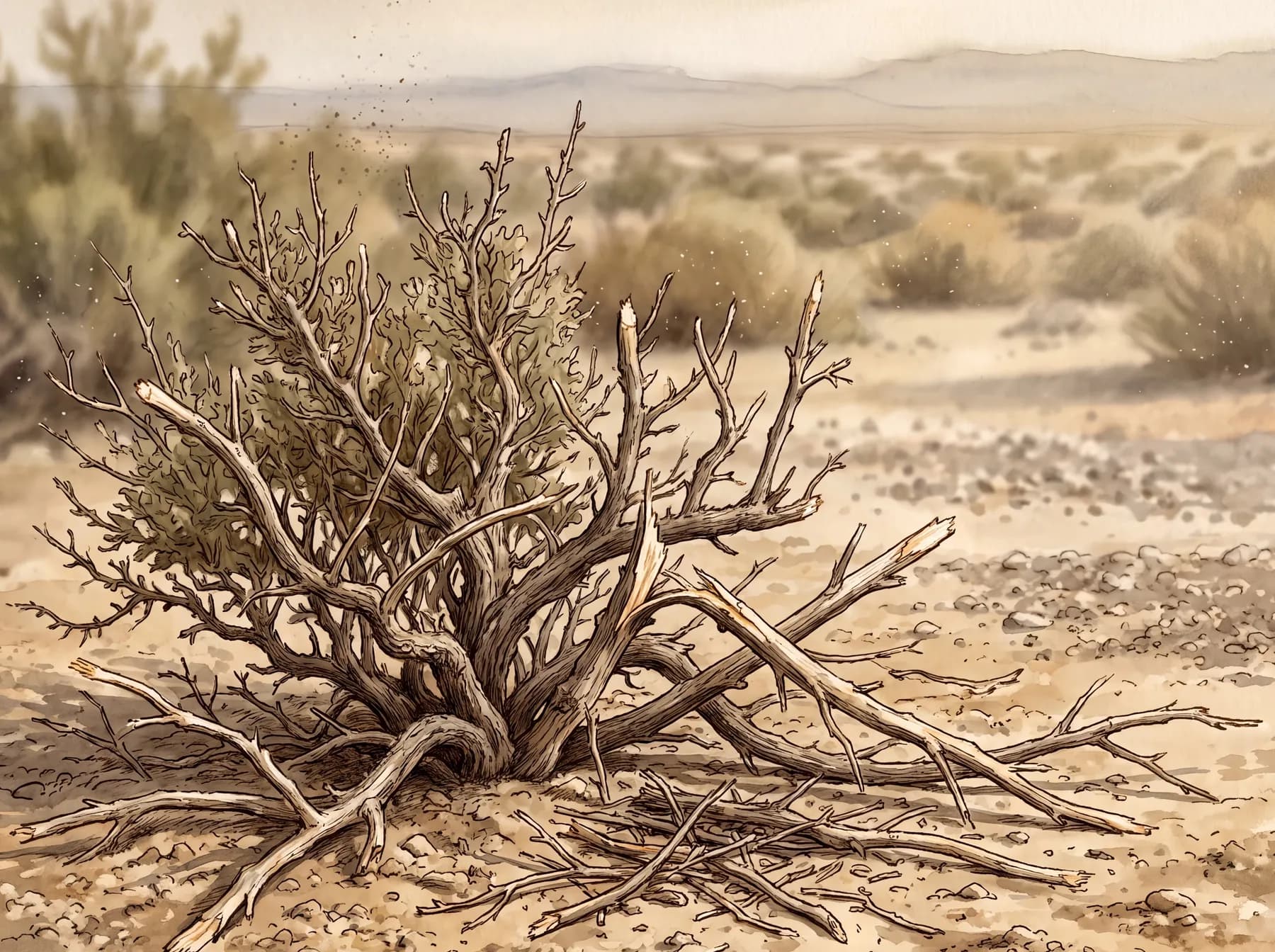
Something has been eating this plant; the harder question is who. On this bajada a bitten stem ends one of two ways, and that ending is the entire entry: a clean angled snip or a ragged tear. Learn to read the stub and you can name the mouth that left it without seeing the animal at all.
The clean cut comes from a mouth built like pruning shears. Rodents and rabbits carry incisors top and bottom, and when those upper and lower edges pass each other they shear a stem clean through. What they leave looks pruned by secateurs, a smooth face lying at roughly 45 degrees. Deer have no such tool at the front of the mouth. Where a rabbit has upper incisors, a deer has only a hard dental pad, so it cannot slice. It pins the twig against that pad and jerks its head, and the stem tears loose in a frayed break.
Height is the cue most people reach for first, and it is the one that misleads them. Rabbits and rodents work low, 1 to 2 feet off the ground, the limit of their reach. Deer browse from the ground up to about 6 feet, so damage high on a shrub is deer. The trouble is that deer also feed low, right down at rabbit height, and there the two ranges overlap completely. A twig clipped near your boot could be either animal. Height sorts the tall damage and settles nothing near the ground; the cut end settles all of it.
The same tooth anatomy writes other sign. In a hard, dry stretch rabbits and rodents will gnaw bark and can ring a young trunk, leaving twin parallel grooves where the incisors dragged; a deer, lacking upper incisors, leaves no grooves in bark at all, which is itself a tell. Groove width sorts the gnawer, roughly a spoon-tip for a rabbit against a fork-tine for a rodent. A cactus pad chewed low to the ground is usually a desert rabbit after moisture in the dry, not a deer.
One pattern still tempts a wrong call. A level browse line, every shrub trimmed to the same even ceiling, is not the signature of one species; it is a large herbivore working up to its reach limit, deer or livestock, and this is open range country where both belong.
When the height is ambiguous, ignore it and read the cut: pruned smooth means rabbit or rodent, torn and stringy means deer.