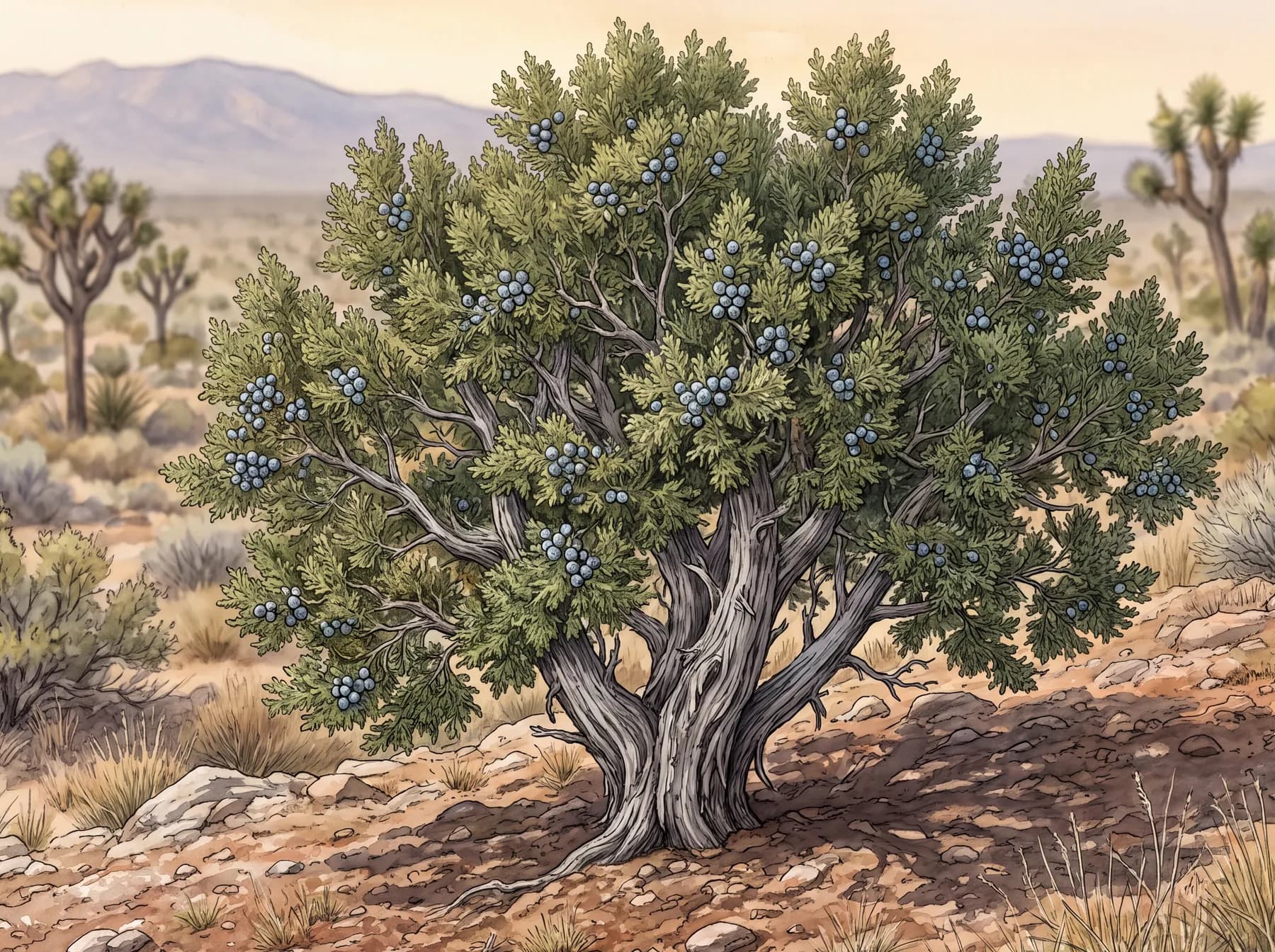
A juniper can hold a whole limb of grey, dead wood and go on living around it. The tidy version you will hear is that the tree cut the branch loose on purpose, an amputation to save the rest. The mechanism under that story is real. The certainty is not.
Junipers have what researchers call a sectored, segmented hydraulic architecture. The water columns feeding one branch are largely walled off from the next, so when drought pulls air into the plumbing and a branch begins to fail, the damage can be confined to the outer shoots instead of climbing into the trunk. One arm dries out while the core keeps its water. That much is a genuine survival strategy. But not every grey branch is a controlled sacrifice; hard drought also kills limbs outright, and the tree neither chooses that nor always grows back. From the ground you cannot always tell the deliberate loss from the plain casualty.
That distinction matters here, because this is the ground where a juniper is most tested. California juniper is the low, hot, desert end of the genus, with Utah juniper holding the higher country, and where it appears at all the high desert has begun. This bajada sits near the floor of that belt, and acute drought has caused rapid juniper dieback across the Southwest, worst at exactly these hot, dry, low-elevation sites. The dead wood is not incidental at this edge. It is the cost of living at the bottom of the range.
It grows as a shrub or a small tree, mostly 3 to 8 meters, often more branch than trunk. Whether this particular one is California juniper is the thing to check, since Utah juniper shares the county and can meet it near this elevation. Two tells settle it under a hand lens. California juniper almost always carries a single sex, so a given tree bears either pollen cones or the blue berries, rarely both; a tree wearing both at once is the other species. And its leaf margins are finely toothed where Utah's stay smooth. The leaves are the water story in miniature: scales just 1 to 2 millimeters long, pressed flat to cord-like twigs, leaving the tree almost no surface to lose water through in the heat.
The berries are not berries. They are fleshy seed cones, fused scales gone soft and pale blue under a waxy bloom, 9 to 10 millimeters across, and they are how a plant this slow travels at all. Wood-production rotations run from 100 years on good ground to 300 on poor, a rough measure of how little a juniper builds in a season; birds and mammals eat the cones and carry the seed out, and the tree leans on them to do it. People took the crop too, grinding the berries into cakes said to taste sweet and cutting the aromatic, rot-resistant wood for bows and lasting posts.
Rub a pale blue cone and the waxy bloom smears to dull green. On finely toothed foliage, that names the tree.