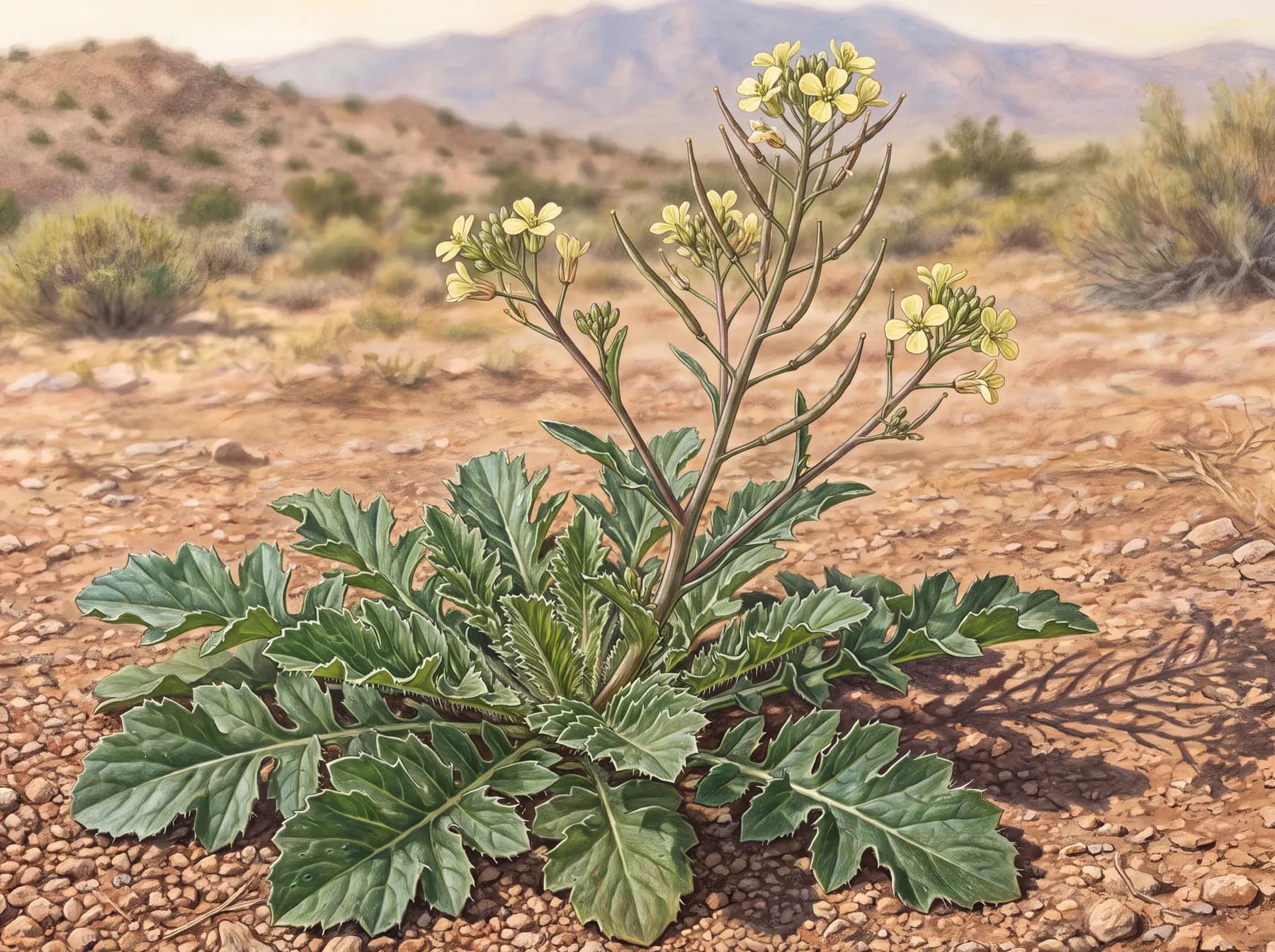
The wettest winters here are supposed to be the good ones. The rain that lets the annual wildflowers carpet the bajada is the same rain that hands the ground to a plant from the Sahara instead. Sahara mustard is an introduced winter annual, native to North Africa, the Mediterranean, and the arid country east to India, and it reached California in the 1920s and Arizona by the 1940s already fitted for exactly this kind of dry ground. This ground sits inside its established range, below the roughly 3,500-foot line it tends to keep to. We expect it here and have not confirmed it, which makes it a plant to watch for and to catch early.
The trick is speed. Like the native annuals it germinates on the early winter rain and dies back by summer, but it runs the schedule faster than they can. It presses a flat rosette of coarse, deeply lobed leaves to the soil, stiff-haired on both sides and sandpaper-rough if you drag a thumb across them, which is the quickest way to separate it from the smoother native mustards. From that rosette it bolts a branching stalk of small pale-yellow flowers while the sand verbena, globemallow, and chia around it are still low. Up first, it takes the light and water the natives were going to use.
Then it makes seed on a scale the natives cannot match. A well-developed plant carries 750 to 9,000 seeds; one study measured up to 16,000 on a single large plant. When it dries it snaps off at the base and tumbles in the wind like Russian thistle, broadcasting seed across the ground as it rolls. What it drops stays viable in the soil for years, so a single wet season seeds several to come.
The result is not only fewer flowers. Where Sahara mustard has increased in the Coachella Valley, researchers recorded the native annual plants and the native insects that live on them declining together. Its dry biomass also feeds a grass-and-fire cycle that can push fire-sensitive desert scrub toward nonnative grassland, which is why prescribed burning is the one control managers of this plant don't recommend: fire favors the invader. It does its worst damage in exactly the years that are supposed to be the best ones.
There is a real answer, and it is unusually plain for an invasive. Pulled green in damp winter soil, the whole taproot lifts out clean, and a plant pulled before it flowers never seeds. The one honest catch is that once green pods have formed, a pulled plant keeps ripening them on the ground, so those belong in a bag, not back in the dirt. On infested ground the treatment is a yearly walk after the winter rain, until the seed bank runs down.
Pull it green, before it seeds. Look for the flat green pinwheel, sandpaper-rough, yellow-flowering while everything native is still low.