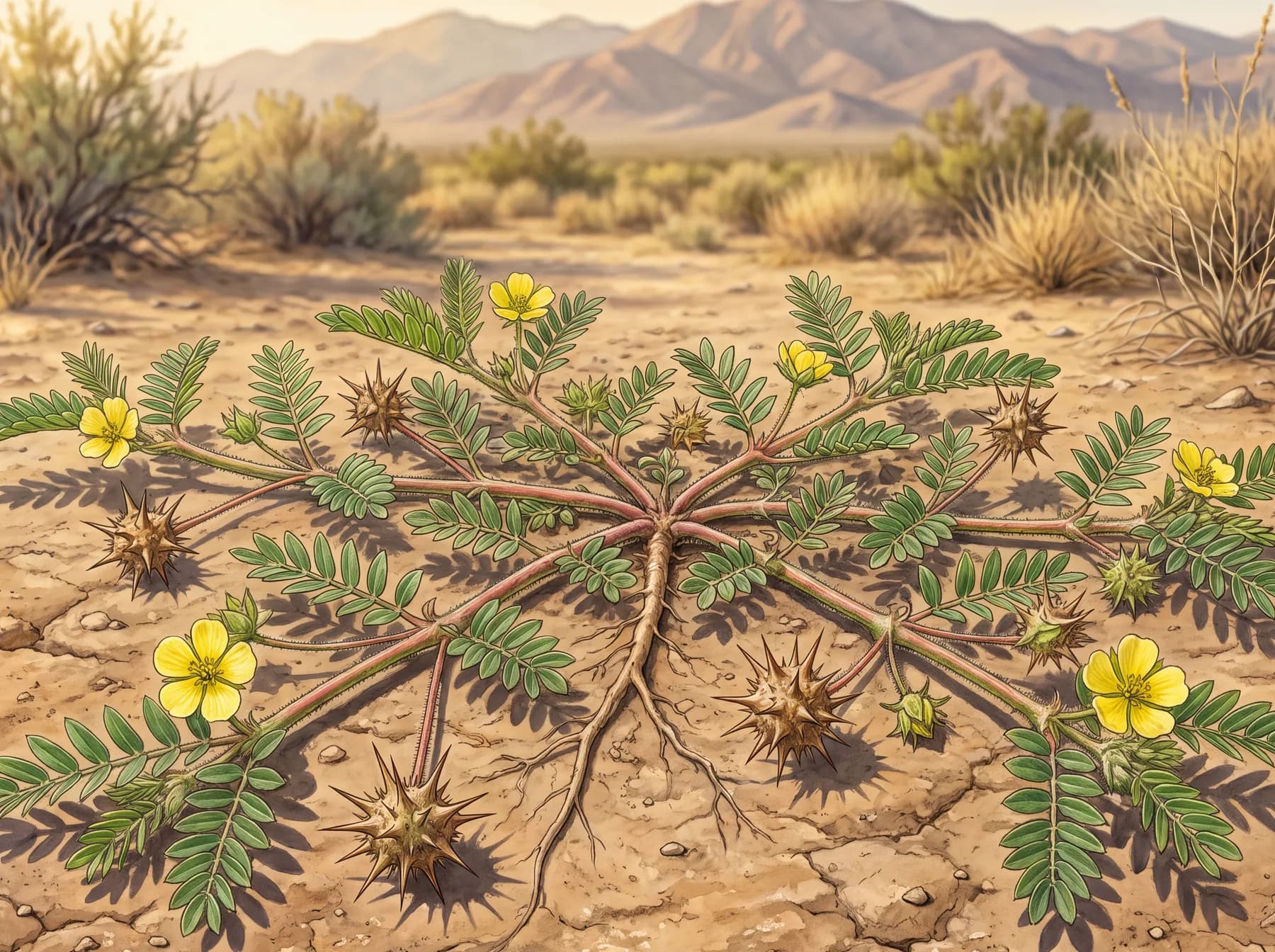
Something on this ground is built to ride, and it will use a tire to do it. You usually meet the burr before the plant: a hard, woody nutlet that has broken into wedges, each wedge armed with two stout spines splayed like the horns on a goat's head. The spines run 1/8 to 1/4 inch, long enough to go through a bicycle tire, a work boot, or a dog's pad. That burr is the one close-up that names the plant with certainty. The plant is puncturevine, and it is not from here.
It came from the Mediterranean, arrived in the Southwest as a stowaway, and Arizona now lists it as a regulated noxious weed. What it wants is exactly what building a place makes: bare, compacted, full-sun dirt with nothing else growing in it. The drive, the pad, the graded edges, the disturbed dry ground around a new structure — that is puncturevine habitat, delivered. It cannot compete in an intact plant community, so it waits for the ground to be opened, which on a homestead it always is.
Then it does arithmetic. A single plant, a low mat 2 to 5 feet across that you could step over without noticing, will set somewhere between 200 and 5,000 seeds in one growing season. The burr is the reason those seeds travel: however it falls, it lands with at least one spine pointing up, ready to lodge in a hoof, a paw, a boot sole, a tire, and be carried off. And the seeds do not expire on any schedule you can wait out. One source gives them up to five years in the soil; another says decades, germinating whenever there is finally enough water. This year's goatheads are the ones something drove in seasons back.
The plant itself is easy to walk straight past. The mat lies flat, the paired leaves are small, and the flowers are single yellow five-petalled things barely half an inch wide. The window to catch it is narrow: flowers can open within about three weeks of germination and hardened burs follow within about six. Pull it while it is young and green, before the root deepens and the spikes set and drop. There is one bit of outside help: two weevils brought from Italy and released in Pima County in 1961, one that bores the stem and one that eats the seed. They spread across the Southwest and now hold puncturevine down in most desert country, though they suppress it rather than erase it.
Look for the flat green mat pressed to bare dirt, one small yellow flower at its center. Pull it before the burs harden.