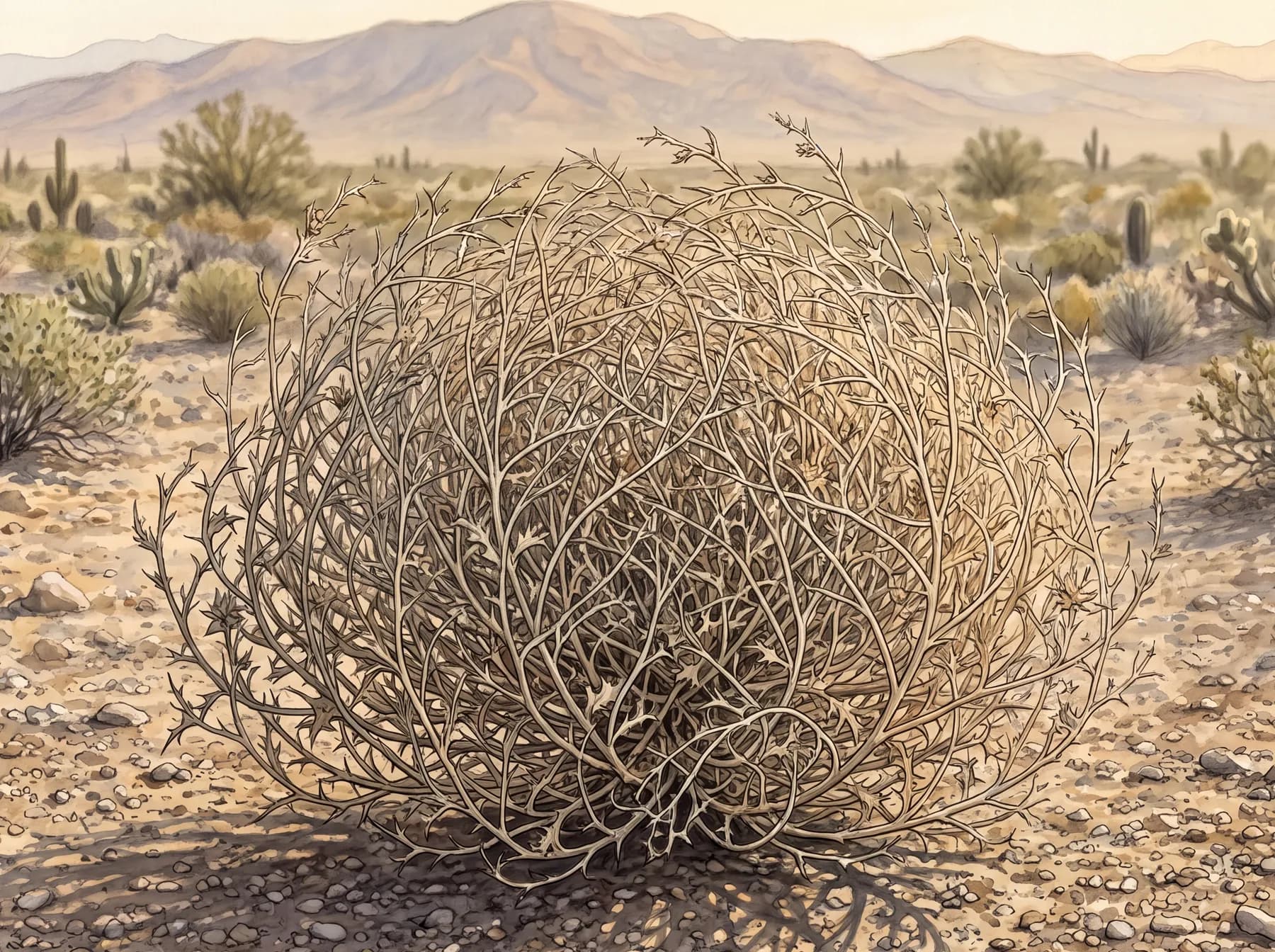
The tumbleweed that rolls down the empty street in every Western you have watched is not native, not western, and not a plant of the American frontier at all. It is Salsola tragus, a summer annual from the dry country of Eurasia, and it did not reach this continent until the 1870s, when its seed arrived as a contaminant in imported flax and was sown in South Dakota. From there the transcontinental railroad carried it, and within a few decades it had crossed nearly every state in the country. It is also not, for most of its life, a tumbleweed. It only becomes one when it dies.
That last part is the whole trick. Through the warm months the plant is rooted and green, a rounded, much-branched bush that can grow 3 feet tall and 6 feet across, quietly setting seed. Then, as it matures in late summer and fall, a band of specialized cells forms at the very base of the stem and lets go. The dead skeleton snaps off clean at that one engineered point and rolls, scattering seed the entire way it travels. A single large plant may carry around 200,000 seeds, and the biggest more than 250,000. It is a seed-dispersal machine that has to die first in order to work.
What it wants is bare, scraped, well-drained ground with nothing already growing on it. This is a shade-intolerant pioneer, the first thing to colonize disturbed dirt — a track, a pad, the scar where a building went in, a patch cleared last spring and left open. A taproot reaching more than 6 feet down, with laterals running 5 feet out, is the engine that lets it hold that dry ground while natives are still absent. It is not a permanent tenant; give the site a few years and better competitors crowd it out. But the machine only needs fresh disturbance to start again, and the upper Mojave offers plenty of it.
Then there is fire, which is where the piles matter. Dead plants stack against fencelines and buildings, and their open, air-spaced stems burn easily and hold their shape as fuel. Worse, a burning tumbleweed can break loose and bounce across a fire line still rolling. And the plant is quick back to scorched ground: it colonizes a burn within 1 to 3 years, and in one Idaho sagebrush stand it made up 58 percent of the community's regrowth two years after a fire. It returns to feed the fire that clears the ground it needs.
To catch it early, look before it dies. Young plants carry semi-succulent, awl-shaped leaves and stems marked with fine red-to-purple lines running lengthwise. The leaf tips are soft at first and harden into stiff prickles as the plant ages. Nothing native here makes that spiny, spherical skeleton, and nothing native breaks off so cleanly at the base.
The clean basal snap is the tell: a native dies standing. This one dies, then leaves, taking next year's seedbed with it.