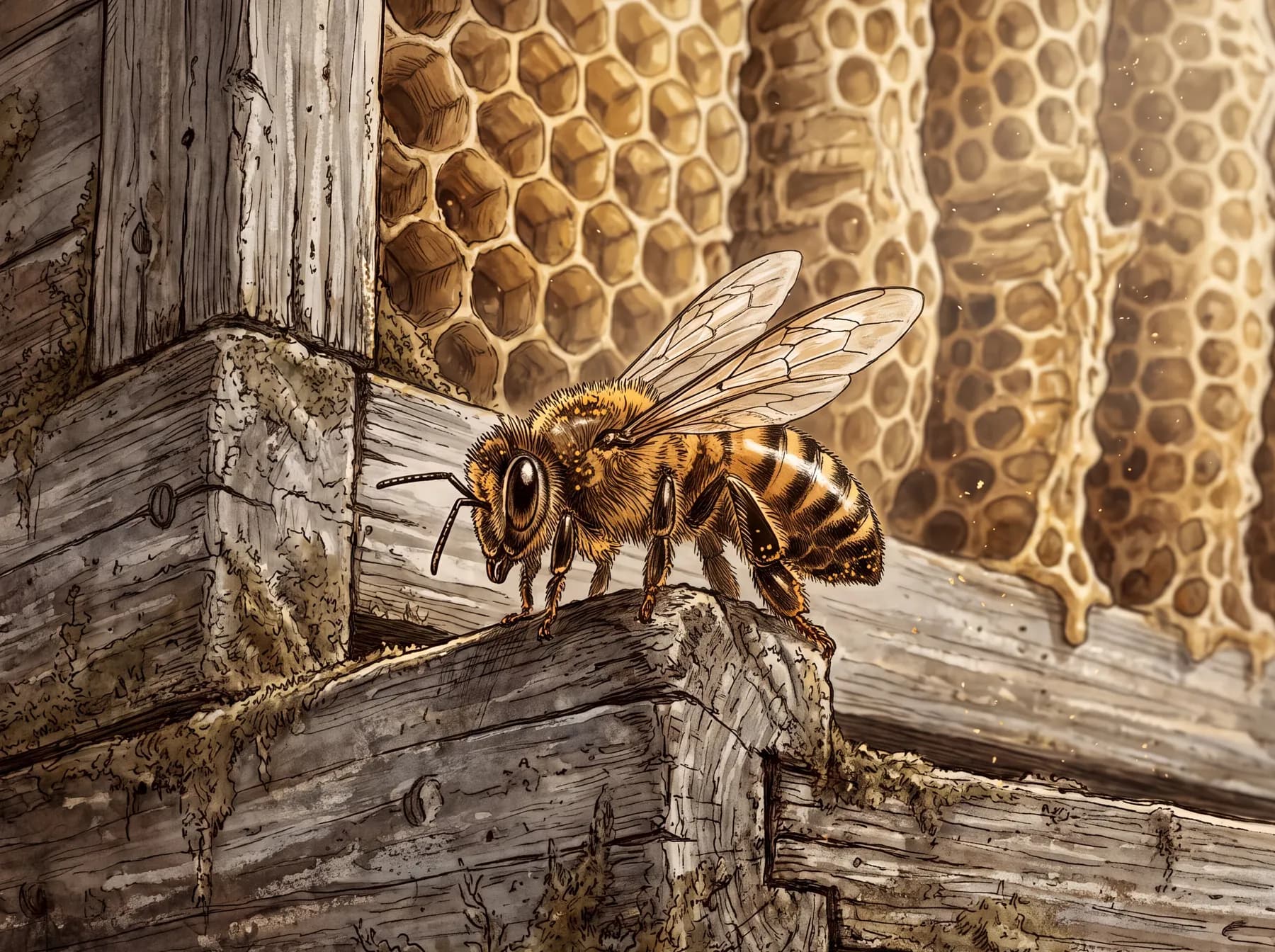
You cannot tell this bee from an ordinary honeybee by looking. Set beside the European honeybee that fills managed hives, the Africanized bee runs only slightly smaller, a gap no eye can catch and only a lab can measure. It is not even its own species, but a hybrid, and every wild colony on this bajada should be assumed to be one. What sets it apart is not in the bee at all. It is in how many of them answer a disturbance.
The venom is the ordinary part. Sting for sting it is no more potent than a common honeybee's, and a single Africanized sting is the same small wound as a single European one. The danger is arithmetic. Disturb a European colony and it may send 10 to 20 guard bees, leave 10 to 20 stings, and go quiet within an hour or two. Disturb an Africanized colony and it may pour out several hundred guards, take far less to provoke, defend a radius near 120 feet where European bees hold about 20, chase a fleeing animal more than a quarter mile, and stay defensive for days. One wrong step at the wrong hive draws 100 to 1,000 stings instead of a handful.
That is a real hazard, not a myth to wave off. Hundreds of stings is a medical emergency, and deaths have been recorded from as few as 200 to 500. But the name oversells the odds. Across the United States these bees kill, on average, two or three people a year, which makes them serious and statistically rare at the same time.
It arrived here the way an escaped experiment does. In the late 1950s a Brazilian researcher imported an African honeybee for breeding, and in 1957 some 26 swarms slipped quarantine and bred with the resident European bees. The hybrid pushed north at 200 to 300 miles a year and reached Arizona between 1991 and 1993. What slows it is cold. Its African ancestry thins above roughly 34 degrees of latitude, and Mohave County lies right along that climatic edge, at the northern margin rather than the core. Elevation is not the brake; this ground, just over 3,000 feet, sits well below the height where that ancestry fades. So the rule the Arizona extension agencies give is the honest one for this bajada: treat any unmanaged colony as Africanized, because here it very likely is. We have not found a colony on this parcel yet.
A homestead is the kind of place it moves into. Africanized colonies will take smaller cavities than European bees accept, and they swarm and abscond far more often, so they are always hunting new quarters. The nest sites researchers list read like an inventory of a working property: water meter boxes, cement blocks, junk piles, house eaves, overturned flower pots, old tires, hollow limbs, and abandoned structures. Standing water is not what they nest in, whatever you hear. They nest in cavities. A place that offers both cavities and water gives them everything at once.
Since you cannot identify the bee, you read the colony instead. Treat any hum in a wall, a box, or a stack of equipment as Africanized: do not open it, do not spray it, and bring in someone who keeps bees to handle it. If a colony does come after you, the sourced advice is plain. Run in a straight line, cover your face, and get indoors. Do not stand and swat, because movement is what draws them, and do not jump into water, since they will wait for you to surface.
A guard bee will knock against your head before it stings. Once the hum starts bumping you, you are already too close.