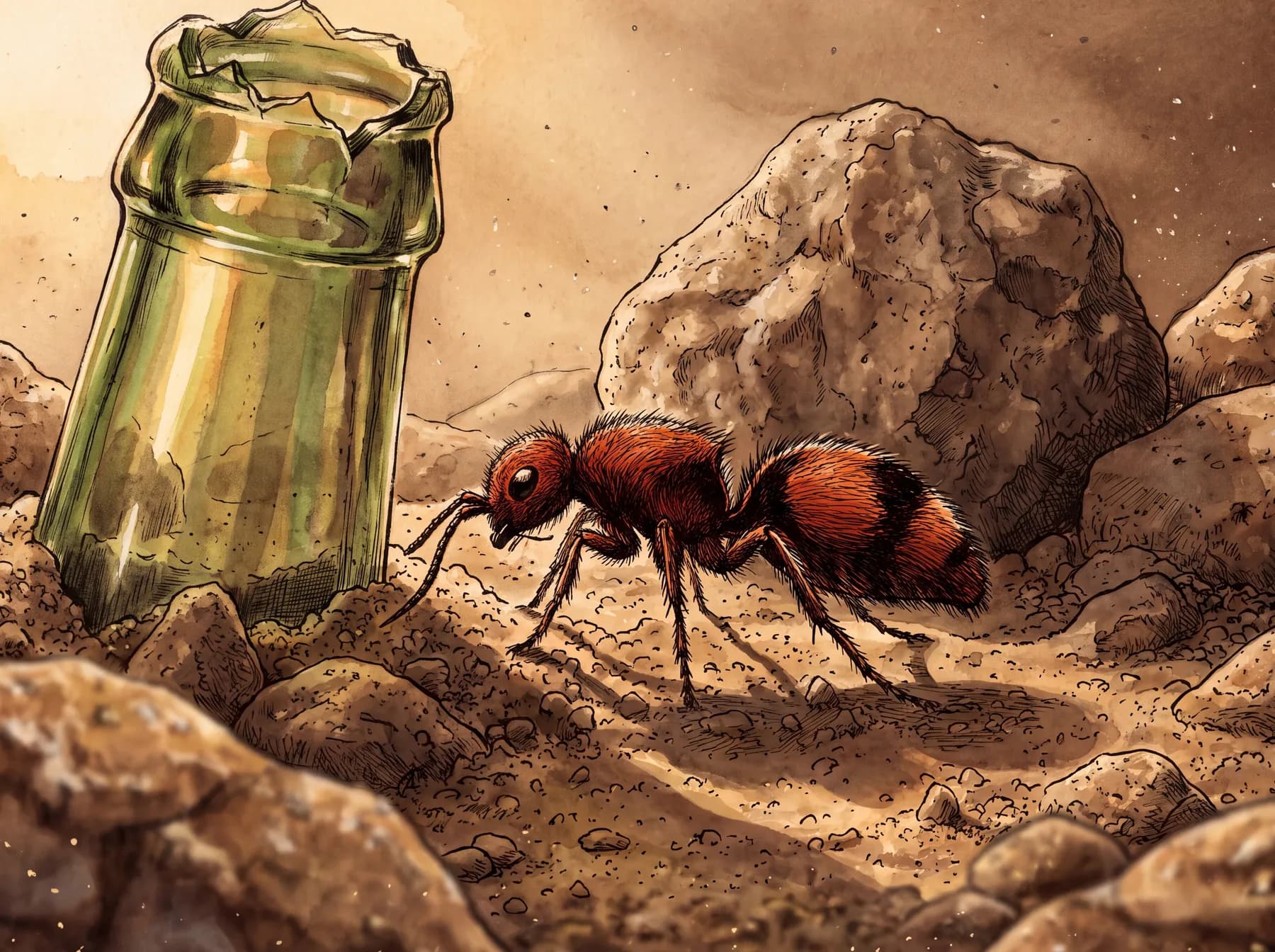
On a hot afternoon you may see a scrap of bright orange velvet moving across open dirt, in full sun, in no particular hurry. It has no wings. Everybody calls it a velvet ant, and everybody is wrong about the ant part: this is a wingless female wasp, one of a family of more than 7,000 species whose females go through life looking like large, hairy ants. The unhurried walk is the thing to notice. Almost nothing else her size crosses bare ground in daylight so plainly unbothered.
She is wingless because the sexes are built for different jobs. The male flies, and looks so unlike her that you would never pair them by eye. She stays on the ground because that is where her work is. Velvet ants are parasitoids: she is hunting the burrow of a ground-nesting bee or wasp, and when she finds one she slips inside and lays a single egg near each host larva or pupa, where her young develop as external parasites on it. She is not tracking you. She cannot fly, and she is busy.
The reason she can afford that stroll is a defense stacked several layers deep, and researchers have taken each layer apart. The bright coat is the first: aposematic coloring, a warning rather than camouflage. Under it is an exoskeleton so hard that one study needed 11 times the force to crush a velvet ant as to crush a honeybee; the cuticle is rounded, so a bite slides off, and entomologists have reported trouble pushing steel pins through dead ones to mount them. If a predator persists, she carries a sting that is a modified egg-laying tube, unusually long and mobile, reaching nearly half her body length, and she squeaks when seized. In staged trials against amphibians, reptiles, birds, and mammals, more than 100 encounters produced only 16 strikes; 4 velvet ants were eaten, and 3 of those 4 were spat back out.
The old nickname is "cow killer," and it records pain, not danger. On the Schmidt sting-pain index the sting rates a 3 out of 4 and can last up to about 30 minutes; in one comparative test it outscored 58 wasp and bee species, ranking third behind only the bullet ant, the warrior wasp, and the tarantula hawk, another desert wasp near it on the same index. Yet the venom itself is less toxic than a honeybee's or a harvester ant's. It cannot kill a cow, and it is no real threat to a person. It hurts enormously and does no lasting damage, which is reason enough not to pick one up.
The genus is well established across the Mojave, so up here on the bench you should expect one, most likely a red-or-orange-and-black one rather than the pale thistledown form of the hotter, lower flats. We have not confirmed a velvet ant on this ground yet. Only the females sting, and the female is the wingless one — the fuzzy thing walking the open dirt in daylight.
She is not chasing you, and she cannot fly. Step around her, and let her go on hunting burrows.