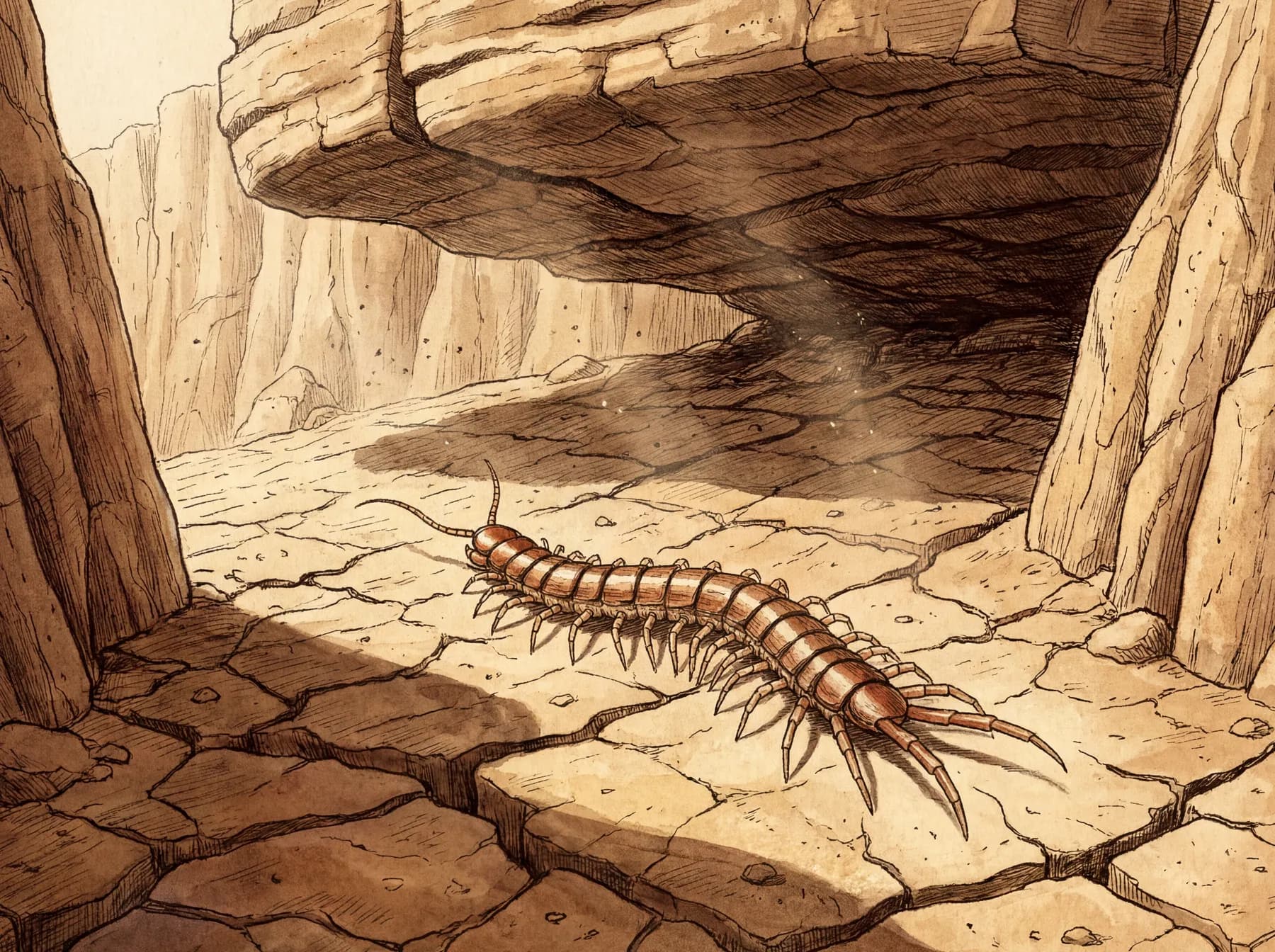
Two desert centipedes side by side can look like two different animals. One comes up tan, the next brick red, another olive or a washed orange, and in some populations farther west the body runs pale blue with indigo bands and turquoise legs. The variation is not a trick of the light or a crowd of look-alike species. It is one animal, and the colour is written into its name: Scolopendra polymorpha, "many forms." The name was given for exactly this refusal to settle on a colour.
Whatever colour it wears, the plan underneath is the same, and it is the plan that separates a centipede from the millipede people confuse it with. The body is a train of 21 segments, each carrying a single pair of legs, 42 in all, held out to the side so the animal seems to flow rather than walk. A millipede doubles its legs on each segment and trundles. This one pours.
The front end is where the interest is. The first pair of legs, the ones just behind the head, are not legs at all anymore but forcipules: modified, hollow, clawed, folded under the face and fed by venom glands back in the body. They are not jaws and not fangs, whatever a field companion tells you; they are legs that turned into hypodermic needles. The animal grabs prey, drives the claws in, and injects. On mice, researchers have watched the venom tear into muscle: fibres losing their structure, mitochondria wrecked, the tissue dying around the puncture.
That last fact is where the reputation runs ahead of the animal. You will hear that a centipede bite is among the worst an arthropod on this continent can hand you, on the order of a bullet ant, a trip to the emergency room. For the common desert centipede that is overstated. The sourced pain for this species is genuinely bad but bounded, running from a bee sting to a few days of ache, and it scales with the animal's size. This is a four-to-seven-inch centipede, not a giant. The bullet-ant tier belongs to the true giants, like Scolopendra heros to the east, which reaches up to 8 inches and is the largest centipede in North America. Skin can die around a bad bite and infection can follow, but that is the rare hard end of the range, not the ordinary outcome.
What it guards against is the air, not you. A centipede lacks the waxy, water-holding cuticle that lets an insect or a scorpion keep moisture in the dry, so it loses water fast and shelters to slow the loss. Under a stone, in the woodpile, in the damp shaded corners of a bajada, it is doing what the dry forces on it, holding water the air keeps trying to pull out. It comes up at night, mostly in the cool of winter or after monsoon rain, and spends the baking months in a burrow underground.
Up here in the Joshua-tree and blackbrush this is well inside the animal's range, though we have not turned one up on this ground yet.
Lift a stone in the cool months, and look before you reach: one pair of legs to a segment, banded, flowing off into the dark.