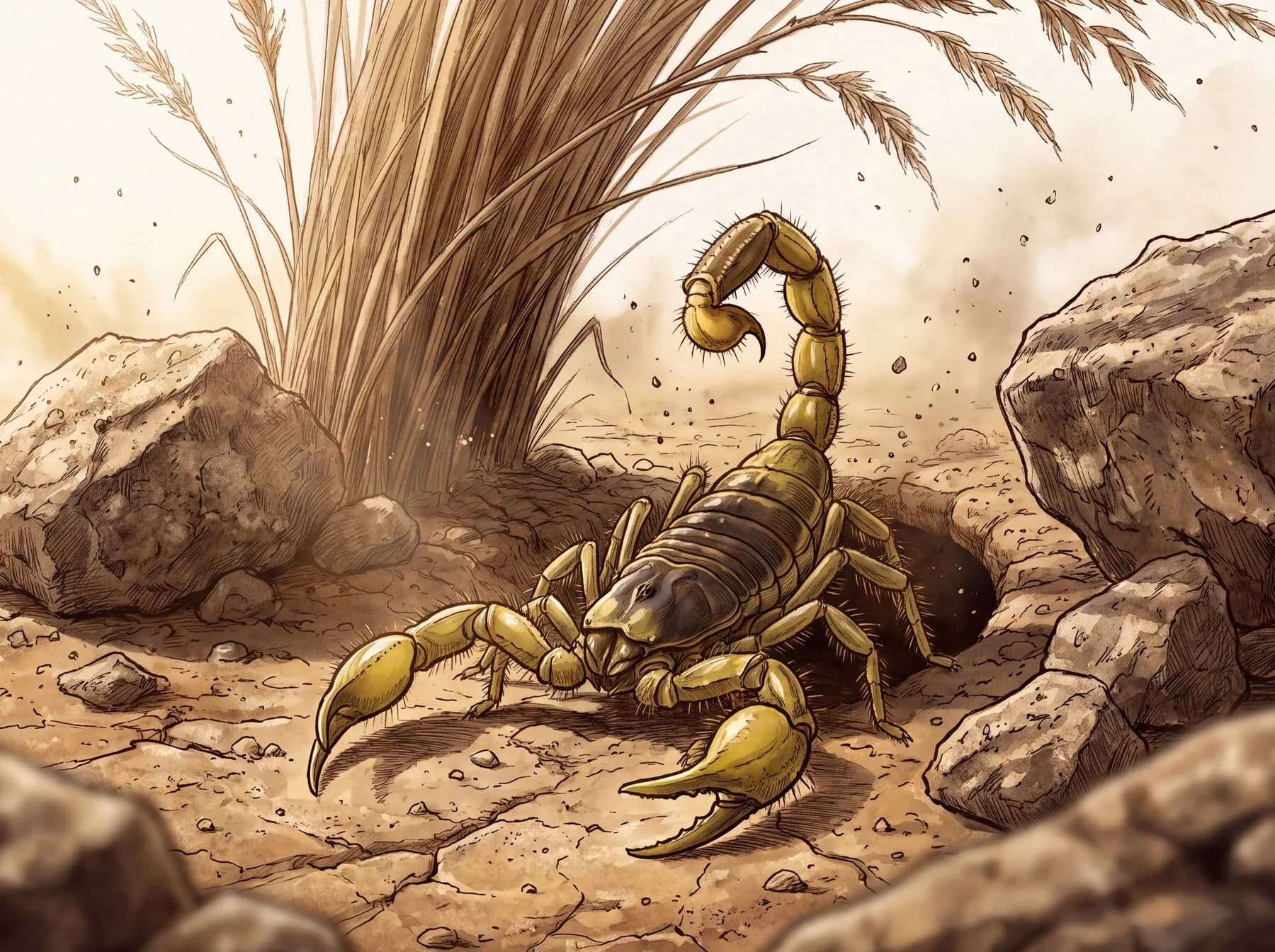
The largest scorpion in North America is a heavy, slow animal the color of dry grass, with a darker saddle across its back and a pair of pincers thick enough to look like the business end. It runs 10 to 18 centimeters long, coarse brown hairs standing along the body and legs, and nearly everything about it reads as the one to leave well alone. The reading is backward. Of the scorpions that turn up in this country, the giant hairy scorpion is close to the one you have least reason to worry about.
Its venom is weak. The sting is usually put at about the level of a honeybee's, and one measure of potency, an LD50 of 168 milligrams per kilogram, says the same thing from another direction: a high number there means it takes a great deal of venom to do real harm. One reference account states plainly that the venom has little effect on vertebrates.
The reason is not luck, and it is not peculiar to this one animal. When researchers compared the venoms of 36 scorpion species, a pattern ran through the whole group: the larger the scorpion and the more robust its pincers, the weaker its venom tended to be, while the slender-clawed species carried the potent stuff. It reads as a trade-off between two ways of overpowering prey, crushing it with heavy claws or dropping it with chemistry, and an animal committed to one can afford less of the other. The spread is wide. The thin-clawed deathstalker sits near an LD50 of 0.16; the thick-clawed rock scorpion near 1800. Big claws, weak venom; thin claws, strong venom. The hairy scorpion, almost all claw, belongs at the mild end of that line.
Those claws go with a life spent mostly underground. It is a deep burrower, digging elaborate shafts reported down to 2.5 meters, dropping below the worst of the surface heat, and it hunts by holding still rather than roaming, a sit-and-wait predator that ambushes whatever large insect, spider, or small lizard wanders past its stance. The brown hairs that name it are working equipment: they pick up vibrations moving through the soil, so it can place a walking beetle in the dark without seeing it. In the Joshua-tree and blackbrush, this bajada sits at the low edge of the elevation band where the species has been recorded, well inside its range.
None of this makes it the region's dangerous scorpion. That is a different, smaller animal, the bark scorpion: slender, pale straw-yellow, with thin delicate pincers, a habit of climbing and hanging upside down, and a venom in a class this one never reaches. The two are worth never confusing, and the claws are how you keep them straight. Big and drab with thick, heavy pincers is the hairy scorpion; small and pale with thin pincers is the bark scorpion. The field mark maps straight onto the venom, the same trade-off the study describes. As with any sting, a bee's included, a rare person reacts badly out of allergy, which is a separate matter from how strong the venom is.
Sweep a UV light across this ground after dark and a hairy scorpion glows cyan-green, unless it molted recently, then gives back nothing.