A hairy spider with a leg span that can reach about five inches, striding across open ground on a warm fall evening, looks like trouble arriving. It is closer to trouble leaving. The animal out in the open is almost always a mature male, and he is not walking toward you. He is walking toward the end of his life, looking for a female before the cold shuts him down.
The asymmetry between the sexes is the strange part. A male spends the better part of a decade underground, eight to ten years reaching maturity, far longer than most spiders take. Then, at his final molt, he leaves the burrow for good and spends a single autumn above ground on one errand. The females do the opposite. They stay near their burrows and live a long time by any measure — roughly twenty years in the wild, and closer to twenty-five in captivity. So the tarantula you see out walking is a male at the very end of his life, and the females, who almost never show themselves, are sitting out two decades underground.
People call the fall movement a migration, and the word oversells it. Nothing is traveling together toward a destination. What looks like a migration is many separate males, each wandering his own line across the desert, most of them visible from late summer through October, some even moving by day. Popular accounts attach a hard mileage to that wandering. The scientific sources don't support the figure, so the honest claim is only that he can travel a long way.
For all the alarm he causes, he is nearly harmless. The venom is mild, among the weakest in the family; a bite is no worse than a bee sting, not medically significant, with no recorded human death, and he would rather retreat than use it. The defense that actually matters is not the fangs. On the top of his abdomen sits a patch of fine barbed hairs, and when something crowds him he kicks them off into its face, where they lodge in skin, eyes, and nose and are hard to work out. That is aimed at a coyote's muzzle, not a person, but it is the reason you never handle one and then rub your eyes.
The honest catch is the name. The blond desert tarantulas were split into several species in 2016, and the splits are genetic, not visible; in the field you cannot reliably tell them apart. The name usually hung on this animal, Aphonopelma chalcodes, belongs to a Sonoran saguaro species that the researchers describe as never ranging north of the Colorado River. This ground sits well north of it. Out in the blackbrush and Joshua tree, the spider here is more likely the Mojave desert tarantula, Aphonopelma iodius. The animal is real and the life story holds either way; the label on the card is the shakiest fact on it.
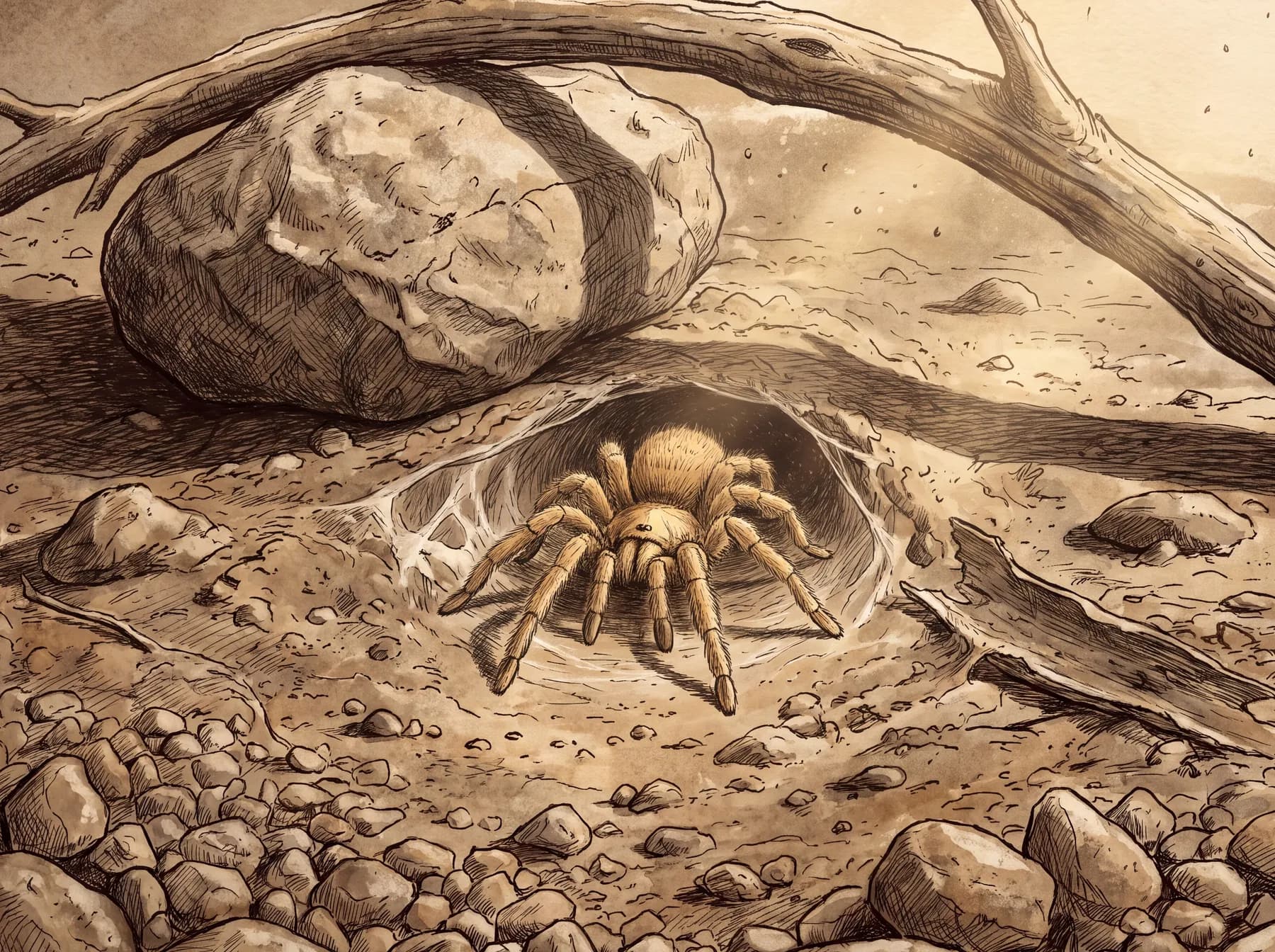
Most of the year, none of this is on the move. The tarantula is a nocturnal ambush hunter that lives in a silk-lined burrow, often the same one for years, sitting at the mouth after dark to take crickets, beetles, and grasshoppers as they pass. The burrow is the clue worth learning.
Look low on this bajada for a hole an inch or two across, a few silk strands across the mouth. That is the female, home.