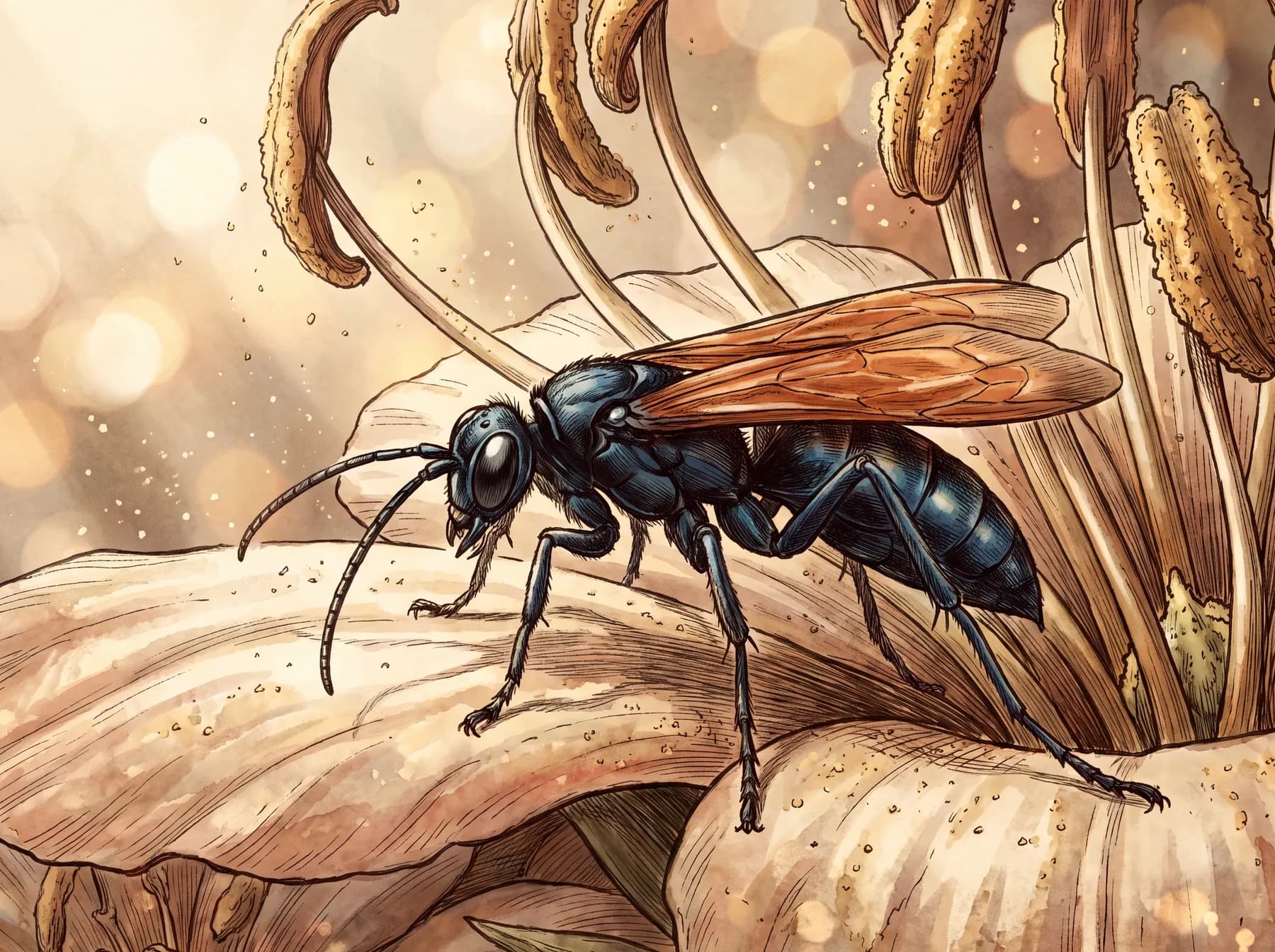
A wasp the color of oil, its wings the color of a live coal, drifts low over the blackbrush and pays you no attention at all. You can stand close. It will fly past your face and keep going. That calm is the first surprising thing about the tarantula hawk, because it carries a sting that Justin Schmidt, who created the pain scale entomologists still use, put at the very top of his index.
He rated a Pepsis wasp a 4, the maximum, and described the sting as blinding, fierce, and shockingly electric. It lasts about five minutes. His practical instruction, which sounds like a joke and is not, is to lie down and scream, because the pain is bad enough that people injure themselves trying to run from it. For years the wasp was called second only to the bullet ant, and by reputation it still is: the bullet ant's pain can run to 24 hours, where this one is spent in five minutes. On the number, the two now tie at the top.
Then it is over, with almost nothing to show for it. The sting is medically minor. It does not threaten your life and destroys no tissue, though a patch of redness can linger about a week, so "no lasting mark" is a little too clean. The strange part is the distance between how much it hurts and how little it harms. Venom that can hold a tarantula paralyzed for the rest of its life does no real damage to something the size of a person. The pain does the whole job by itself, a bluff to buy the wasp a moment to get away. And the wasp would rather get away. Only the females sting, and they are slow to; a male cannot sting at all. Nobody is stung here without first grabbing or crushing one.
That paralysis is the point of the animal, and it works only on spiders. A female finds a tarantula's burrow, draws the spider out, and stings it until it is completely paralyzed but still alive. She drags it back underground, lays a single egg on its abdomen, and seals the entrance behind her. When the larva hatches it eats its way inward, saving the heart and the nervous system for last, so the meat keeps across the three weeks it takes to mature. The spider never recovers. It is not being killed so much as kept.
Presence here follows the spiders, not the elevation lines on a map. Wherever there are tarantulas there are tarantula hawks, and both live across the Mojave; on this blackbrush bajada the wasp is one we expect, though none has turned up on the ground for us yet. The adult you would actually meet is hunting nothing. Adults drink nectar, favor milkweed and mesquite, and pollinate the flowers as they feed; only their offspring are carnivores. New Mexico thought enough of the animal to vote it the state insect in 1989. It runs to about two inches long, and for all of that, it is a visitor of flowers.
Look low over the blackbrush for a black wasp with orange wings, and if one drifts near, hold still and let it pass.