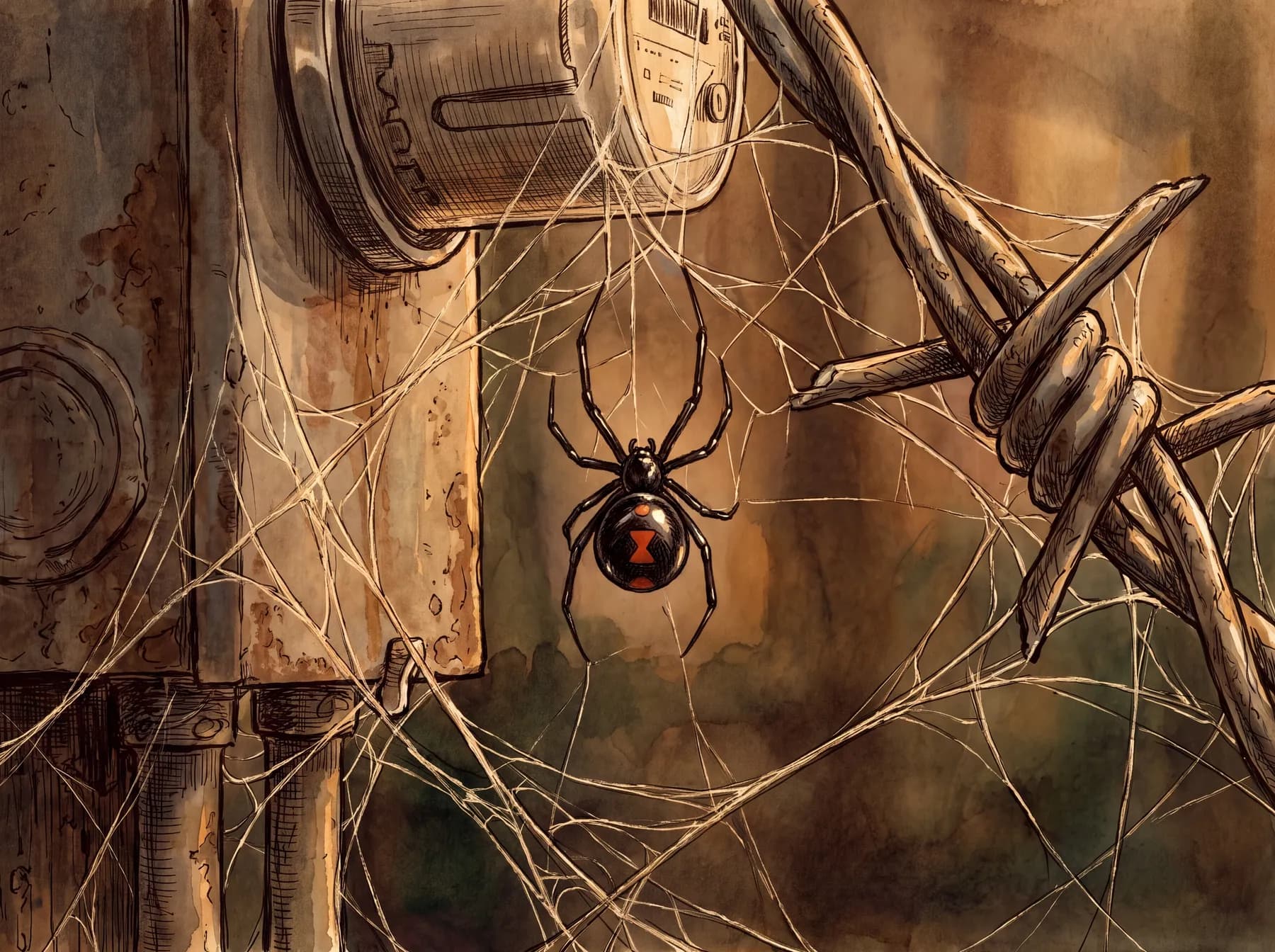
A western black widow does her damage without tearing anything or rotting a scrap of flesh. The trouble is a chemical trick played on your own wiring. Her main toxin, alpha-latrotoxin, fastens onto the ends of your nerve cells and props open pores that let calcium pour in, and the nerve answers by dumping its whole store of signal chemicals at once: acetylcholine, dopamine, norepinephrine, the lot. The pain and the cramping that follow are your nervous system firing everything it has. A widow bite is a precise sabotage of the signal, not a wound.
For all that, it is rarely dangerous to a healthy adult. Her venom is often called, drop for drop, stronger than a rattlesnake's, and that may be true and still beside the point. The spider is roughly a thousand times smaller, injects a minute dose, and does not spend it all at once. Potency per drop and danger to a person are different questions, and by the second measure the rattlesnake wins easily.
The real syndrome, called latrodectism, is a bad day or two. Within an hour the muscle pain and cramping spread from the bite through the limbs to the trunk, with sweating, a racing heart, and the rigid, board-like belly that doctors look for. Recovery is usually complete within 24 to 48 hours. In one poison-center series of 23,409 cases, 65 percent were minor, 33.5 percent moderate, and 1.4 percent life-threatening. Reviewers found no death from a black widow in the United States since 1983, and more than 23,000 bites across 47 states from 2000 to 2008 with none. Antivenom exists, but it is held back for the worst cases. The "deadliest spider" is a documented myth.
So why cross paths with her at all? Not because she hunts you. She is shy and nocturnal, a sit-and-wait spider that does not roam. This is simply her country: hot, dry desert scrub is where the species is described as common, and she is the only widow across most of the western states. She has been recorded above 5,000 feet where snow covers the ground each winter, so this bench is no barrier. What gathers her is us. She favors holes and crevices and the clutter around buildings, so a working homestead on this bajada concentrates her in the woodpile, the shed, the meter and valve boxes, the bucket left standing. We have not turned one up on this ground yet, but core habitat and that clutter make her a spider to expect rather than to imagine. Her web is a messy tangle of unusually strong silk, with a retreat near the ground, usually within 3 feet, in a dark undisturbed void.
The one dependable way to be bitten is to put a bare hand into that void without looking. Only the larger females can drive a fang through skin; the drab, striped males and young cannot. So the fix is not fear but gloves and a light: look before you reach, and knock out a boot or a bucket before your hand goes in. Do not lean on the famous hourglass to warn you, either. The red mark rides on her underside, and it ranges from a clean hourglass to two split triangles to a thin bar to almost nothing at all.
Brush the tangle and the silk tears with a sound you can hear, a surer sign than the mark.