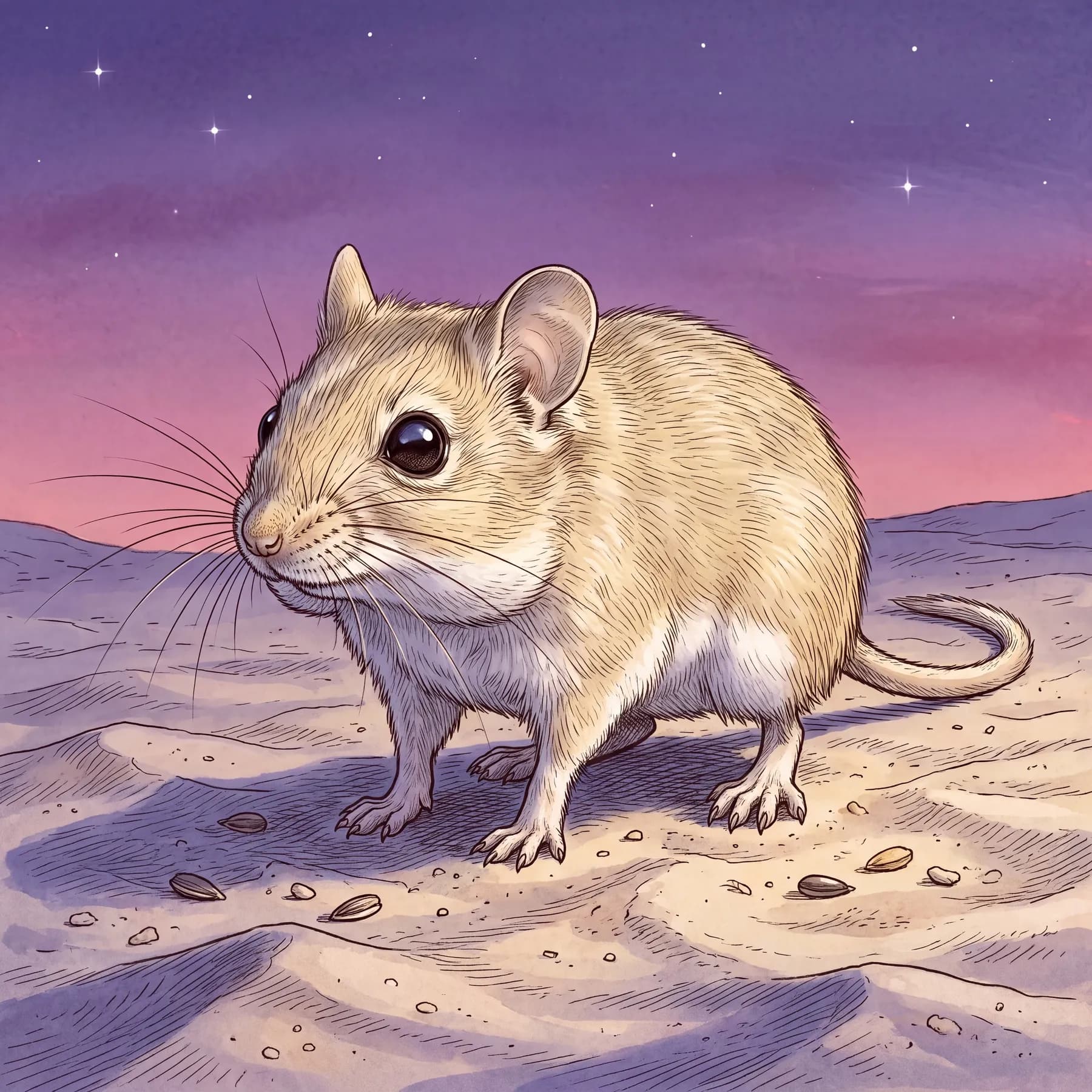
A pocket mouse can live out its whole life without ever taking a drink. Not by finding hidden water, but by making its own: it pulls every drop it needs from the dry seed it eats, wringing water out of starch by burning it. The Arizona pocket mouse is one of the silky kind, Perognathus amplus, not the coarse spiny sort, and its whole life is arranged around not needing the one thing this desert most reliably withholds. How much water it saves this way has never been measured in this species, so the honest claim is the plain one: it does not drink, and it does not seem to have to.
You can see the economy on its face. A pocket mouse carries two fur-lined pouches on the outside of its cheeks, opening beside the mouth rather than into it, so it can stuff them with seed and keep the seed dry and the mouth free. Loaded, those pouches ride full: across 10 heteromyid species, researchers found them packed to about 93 percent of capacity. It ferries that seed to a buried store rather than eating on the spot, banking calories underground against the long dry stretches when nothing new is setting seed.
What it does with the store is the surprising part. It does not fatten itself for winter the way many small mammals do. It banks seed instead, drops into torpor when the cold or the drought closes in, and wakes to eat from its own pantry. In a close relative, the little pocket mouse, researchers measured a relationship that runs backward from intuition: the more seed an animal had cached, the less time it spent torpid. That was found in the cousin, not in this mouse, but the Arizona pocket mouse does the same two things, sleeping out the lean season and rising to eat what it put away.
Here is where water comes back into a life built to do without it. A buried seed store has to be found again, and buried seed is found by smell. When researchers buried caches and let rodents hunt them, the animals recovered 449 of 450 in damp soil but only 13.3 percent in dry ground, because a dry seed gives off almost nothing to smell. That would make a dry-country hoarder oddly dependent on a rare wet spell. But the tidy lesson frays: in that same experiment the pocket mouse in the group found about 83 percent of its dry caches, far better than the deer mice beside it, and it was not this species anyway. Whether the Arizona pocket mouse leans on damp ground to find its seed, or carries some other map, nobody here can yet say.
Range makes it more than a guess on this bajada. Of the rodents whose records cluster around this elevation, the Arizona pocket mouse has the most, and one museum specimen carries the same reading as the ground here, roughly 3,050 feet. No record of our own here yet. Look on a dark night: this mouse forages less under a bright moon and less when owls are hunting, so its hours are the moonless ones. It is pale pinkish-buff above and white below, its tail longer than its body and tufted at the tip.
A moonless night: a pale mouse, cheeks packed, tail longer than its body, headed for a pantry only it can find.