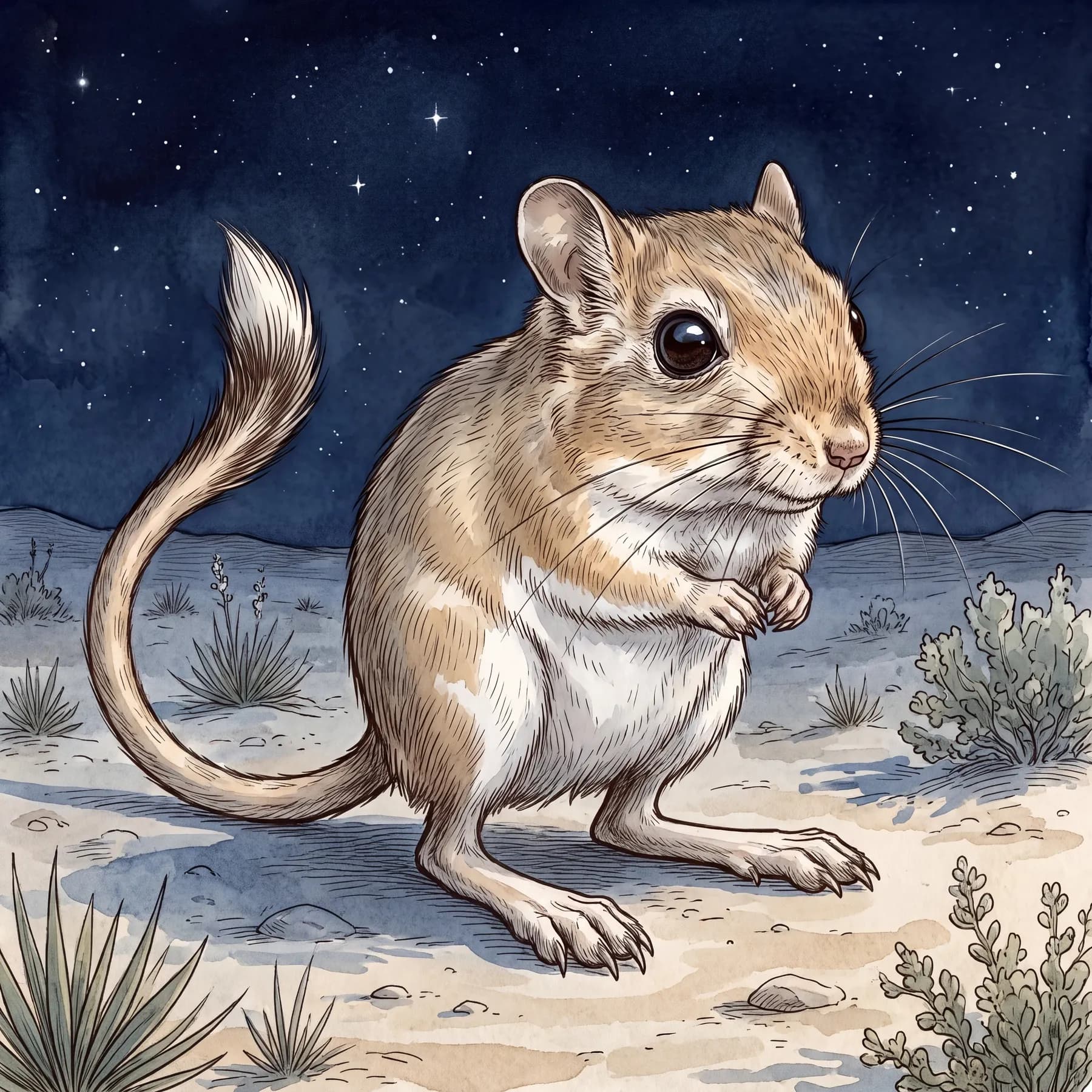
The thing you would expect a desert animal to spend its life doing — hunting for water — this one does not do at all. When researchers followed free-living Merriam's kangaroo rats through the Mojave, the animals did not drink, even when rainwater stood available after a storm. Not rationing it, not sipping at dawn. Declining it, as though water were beside the point.
It can afford to because it manufactures its own. A kangaroo rat lives on dry seeds, and burning those seeds for energy releases water as a by-product, the same chemistry that fogs a cold car window. Roughly 90 percent of the body water in a free-living Mojave Merriam's is made this way, inside the animal, from food that feels bone-dry in your hand. Its problem isn't finding water in the desert. It builds it.
Making water only helps if almost none of it is lost, and this animal is miserly at both ends. Its kidneys wring urine to something near 6,000 milliosmoles per kilogram, about five times the human ceiling of 1,200, so waste leaves as a thick paste instead of a puddle. Through the hot day it stays plugged into a humid burrow, where its cached seeds apparently draw moisture back out of the damp underground air, leaving a stored seed a little more succulent than when it went in. That last part is inferred from the water budget rather than weighed on a bench, so hold it loosely.
All of it rests on seeds, which make up about 64 percent of the year's diet, gathered off the blackbrush and Joshua-tree flats and carried home to be cached. In late winter and spring, as green shoots and insects arrive, it eats those too. This is the most widespread and adaptable kangaroo rat in the Southwest, easy about its soil, and this ground, about 3,000 feet up, sits well inside its range; in Arizona the belt where it turns up runs from roughly 2,800 to 4,500 feet.
Those seeds pull it into the open after dark, where a sidewinder may be coiled and waiting, and the kangaroo rat's reply is to leave the ground. Startled, it fires almost straight up, a jump measured at a take-off angle near 80 degrees in a larger desert relative, high enough to clear a striking snake. The measurement comes from that bigger cousin, though Merriam's makes the same move: it goes up rather than out.
Nothing of ours on the parcel yet. When the sign turns up, count toes: Merriam's leaves four on each hind foot, where the look-alike Ord's kangaroo rat leaves five, and the much larger desert kangaroo rat wears a white-tipped tail this one has not got.
Look for the tail itself: longer than the body it trails, striped dark down its length, and tufted at the very tip.