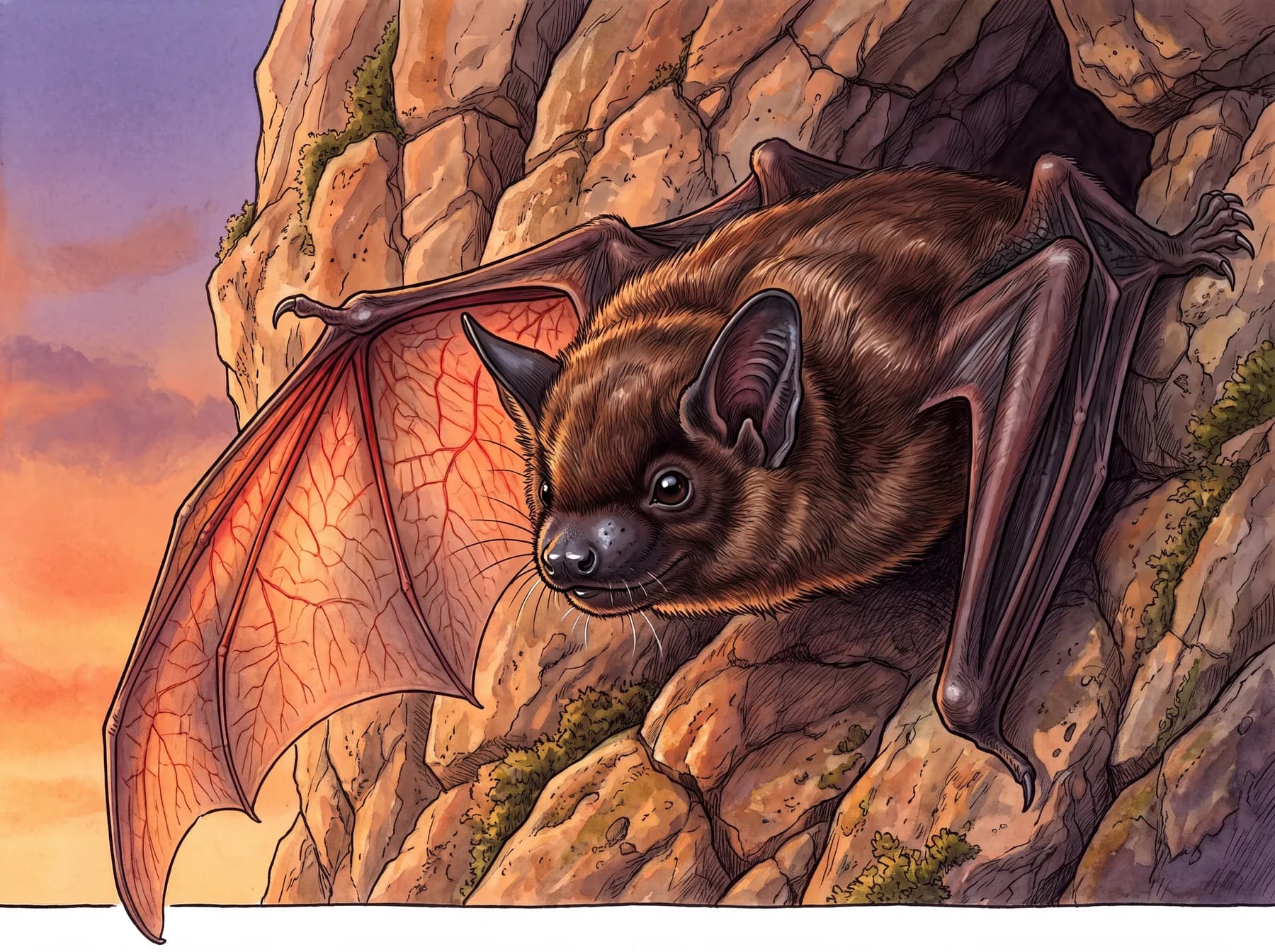
Deep in winter, on a night warm enough that the cold should have emptied the sky, one kind of bat may still be flying over this bajada. Most desert bats spend the cold months folded into a crack, waiting the season out. The big brown bat carries more cold than almost any of them, and it will wake and hunt on a mild winter night when nothing else is up.
You would know it, if you could see it, by the way it moves. Where the small desert bats flutter and jink low over the wash, this one flies slow and steady and nearly straight, a heavier animal holding a level course. It is the family's generalist: large and sturdy, with a broad blunt muzzle, naked and black, and short rounded ears, shorter than the taller ears of a myotis. Here it wears the pale end of the species, a warm tawny brown rather than a deep chocolate brown, the color sanded down to match the dry country.
What sets it apart up close is its jaw. For its size the big brown bat bites unusually hard, hard enough to crack the armored shells of beetles that defeat softer-mouthed bats. It favors beetles and comes equipped for them, though that preference is not a rule: it is a generalist, not a specialist locked to one prey, and it takes what the night offers. The strong bite does not narrow its diet. It widens it.
The same lack of fuss shows in where it sleeps. It will take a crevice in the rock, an old mine, or the eave of a building, and move among them as readily as any bat here. That adaptability is the reason it belongs on this ground. Up in the high desert, a bat tied to one narrow roost or one narrow food might not make a living. A generalist that will eat most things and sleep almost anywhere does.
There is a temptation to treat that as a tidy story of the perfect survivor, and it is worth resisting. Being unfussy is not a promise of thriving; it only spreads the odds of a living a little wider. What the cold tolerance and the broad diet and the open choice of roost add up to is not mastery of the desert. It is a wider margin than most bats keep.
None confirmed on the parcel. Of the desert's bats, though, this is among the likeliest to be here already, tucked into a rock seam or an outbuilding by day, and the one most apt to give itself away at the wrong time of year.
Watch a warm winter night. A slow, level shape crossing the stars when cold should have grounded everything is this bat, almost only this bat.