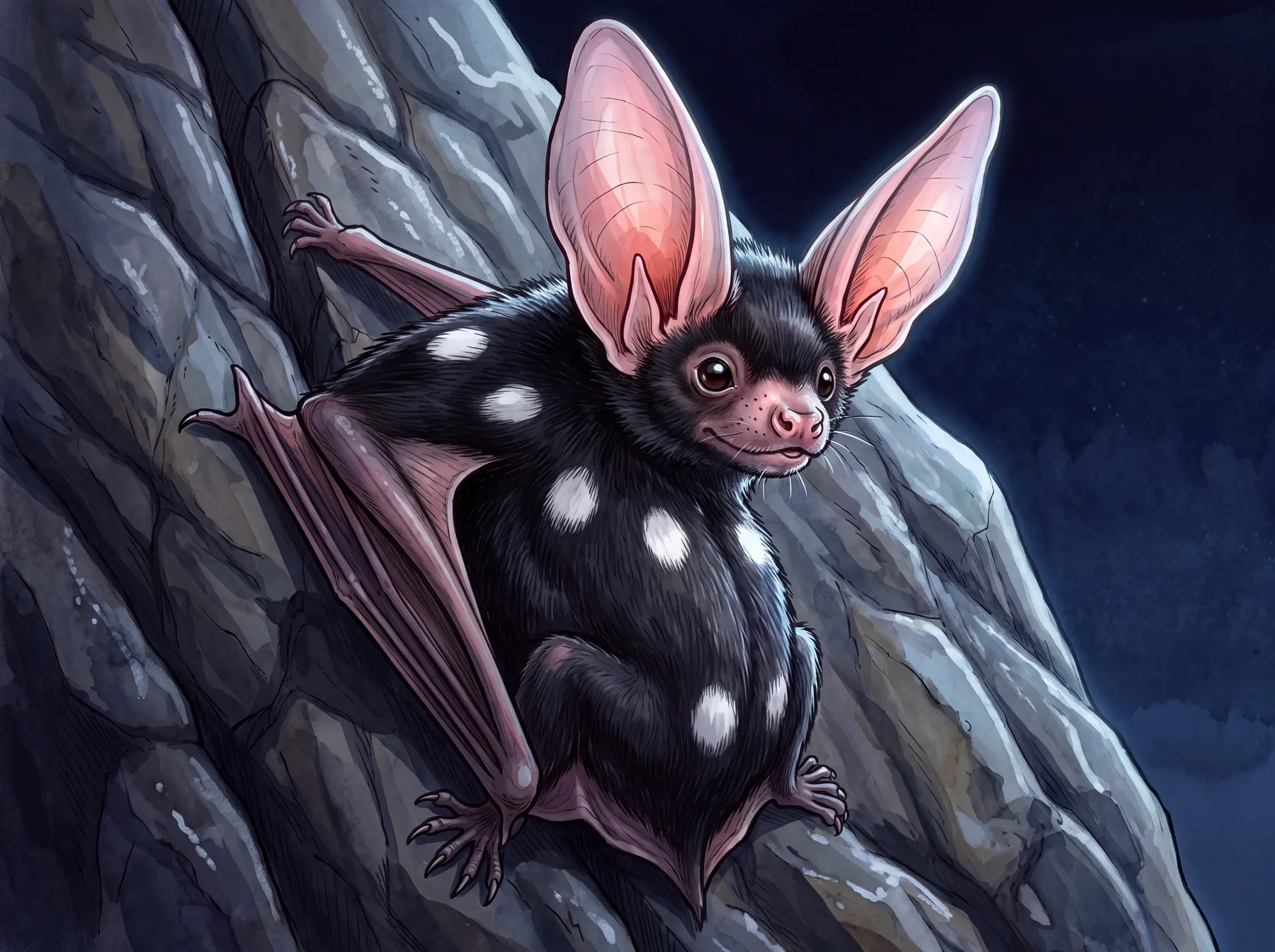
Most bats are calling the entire time you cannot hear them. Their echolocation runs above the ceiling of human hearing, so a hunting bat crosses overhead in what feels like silence. The spotted bat is the exception. Its calls fall low enough for a person to catch, roughly 8 to 12 kilohertz, and on a still night the animal gives itself away as a soft metallic click passing above you in the dark. Of all this desert's bats, it is the one you are likeliest to hear before you could ever see it.
That is fortunate, because seeing it is close to hopeless. The spotted bat is one of the least-documented bats in North America. For seventy years science knew it from barely three dozen animals, and even now it is seldom observed anywhere across its range. It does not gather in warm crowded caves. It roosts alone, wedged in a single crack high on a tall cliff, one animal to a fissure, which is a hard way to be found and very likely the intent.
The low voice is the way in. Echolocation is a bat calling into the dark and reading the returning echoes to map the air ahead, prey and obstacle alike. Most species pitch that call so high it stays their own private channel. The spotted bat works lower, down where human ears reach, so the same tool it uses to find a moth over open ground doubles as the one clue it hands a listener on the ground below. It is well equipped to hear those echoes return: its translucent pink ears are nearly as long as its whole body, the largest ears of any bat in the United States.
The body under those ears is worth knowing if a headlamp ever does catch it. It is jet-black with three bold white spots, one over each shoulder and one on the rump, and a snow-white belly, a pattern shared by no other bat here. Its range reaches this ground. Arizona's wildlife agency lists the spotted bat for the Joshua tree country of northwest Mohave County, and the tall cliffs it needs for roosting stand within reach of this high desert. We've not caught one over the parcel, but habitat and range agree that it could be crossing it, unheard, on a warm night.
So the way to find it is to stop looking and start listening. On a still night in moth season, keep your ears on the air above the blackbrush for a dry, metallic tick with no bird or insect behind it. If a headlamp does swing up onto the animal, the three white spots and the outsized pale ears settle it at once.
It stays a sound we are waiting on here: a click overhead, and a black gap where the bat should be.