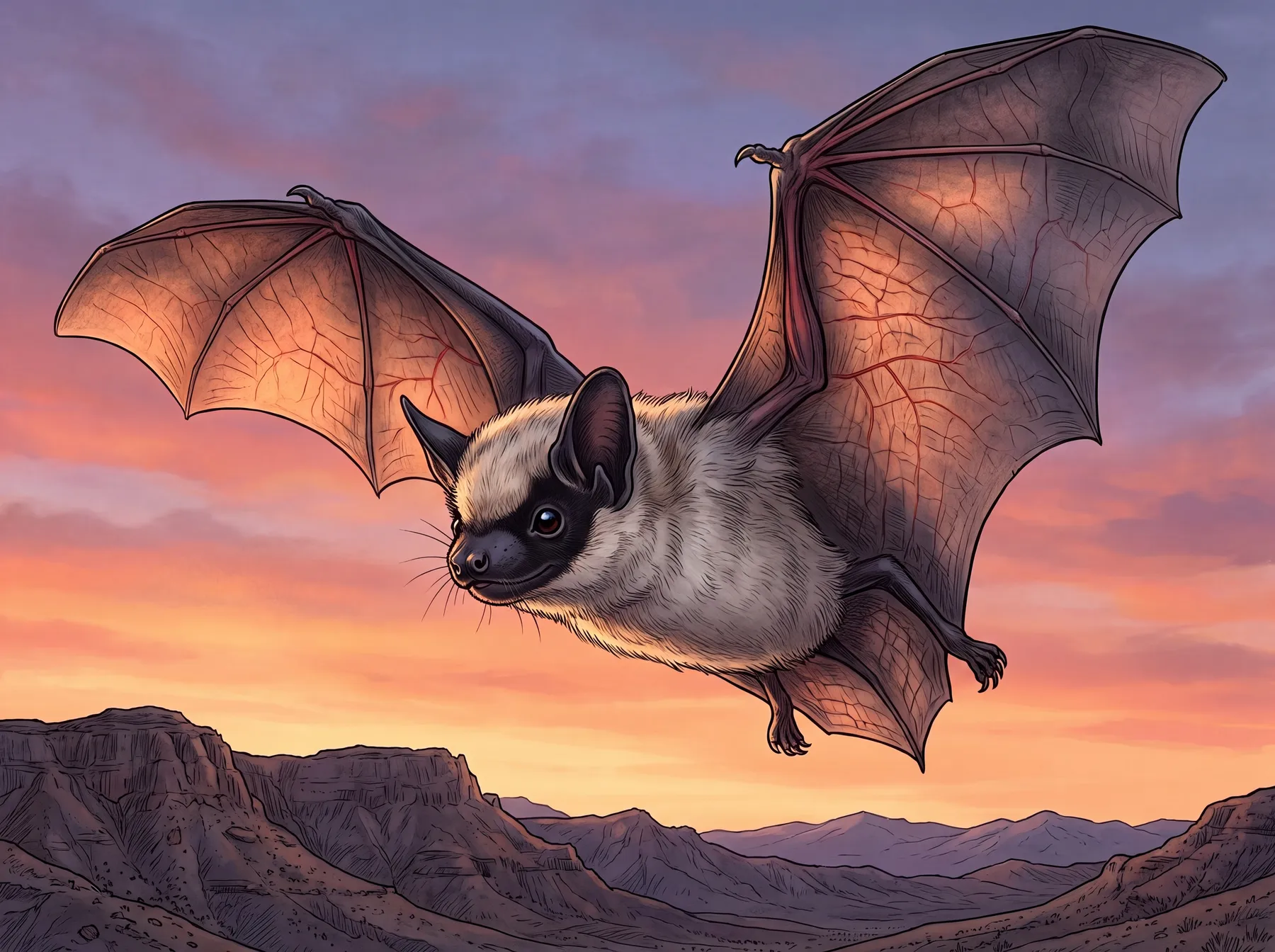
Most bats make you wait for full dark. The canyon bat does not.
It comes out early, sometimes as much as 45 minutes before sunset, while there is still enough light to read a map by. One field account calls it among the most diurnal bats in North America. That one habit is what makes it the bat here you have a fair chance of watching rather than only detecting: it flies during the part of the evening when your eyes still work.
It is small, too, in a way that matters to the watching. The canyon bat is the smallest bat in the United States, 3 to 6 grams, a weight that rounds to nothing in the hand and looks as though a hard gust could carry it off. That lightness shows in the air. It does not cut and climb like a bigger bat. It flutters, slow and looping, closer to a moth around a porch light than to the fast, hard flight most bats fly. In fading light you could take that flutter for a big moth blown across the yard, and it would be an easy mistake to make.
In that low sun the body reads pale, a smoky, washed-out fur that holds the last of the light. Against it, the face is the tell. A canyon bat wears a sharp black mask across the eyes and a set of black ears, and here is the correction worth making first: those ears are short and rounded, not the big cupped ears people expect on a small desert bat. Pale body, dark mask, small blunt ears. Look for that contrast before you look for the shape.
This is its ground. The canyon bat keeps to desert scrub below roughly 5,000 feet, and a bajada just over 3,000 feet sits well inside that band. Why it emerges so far ahead of the other bats, we have not found a settled answer for, and would rather leave open than guess. But the effect is a sort of shift-work in the air: the canyon bat takes the bright early hour, and the rest of the night's bats come out behind it, into the dark it has already left.
We've yet to catch one over this bajada. Range and elevation put it here, and the confirmation, when it comes, will likely arrive in daylight, which is not how anyone expects to meet a bat. Most of the guide's night animals hide inside the dark. This one steps out in front of it.
Watch the air before the sun is fully down. A small pale flutterer, too early and too slow for a bird, is your first guess.