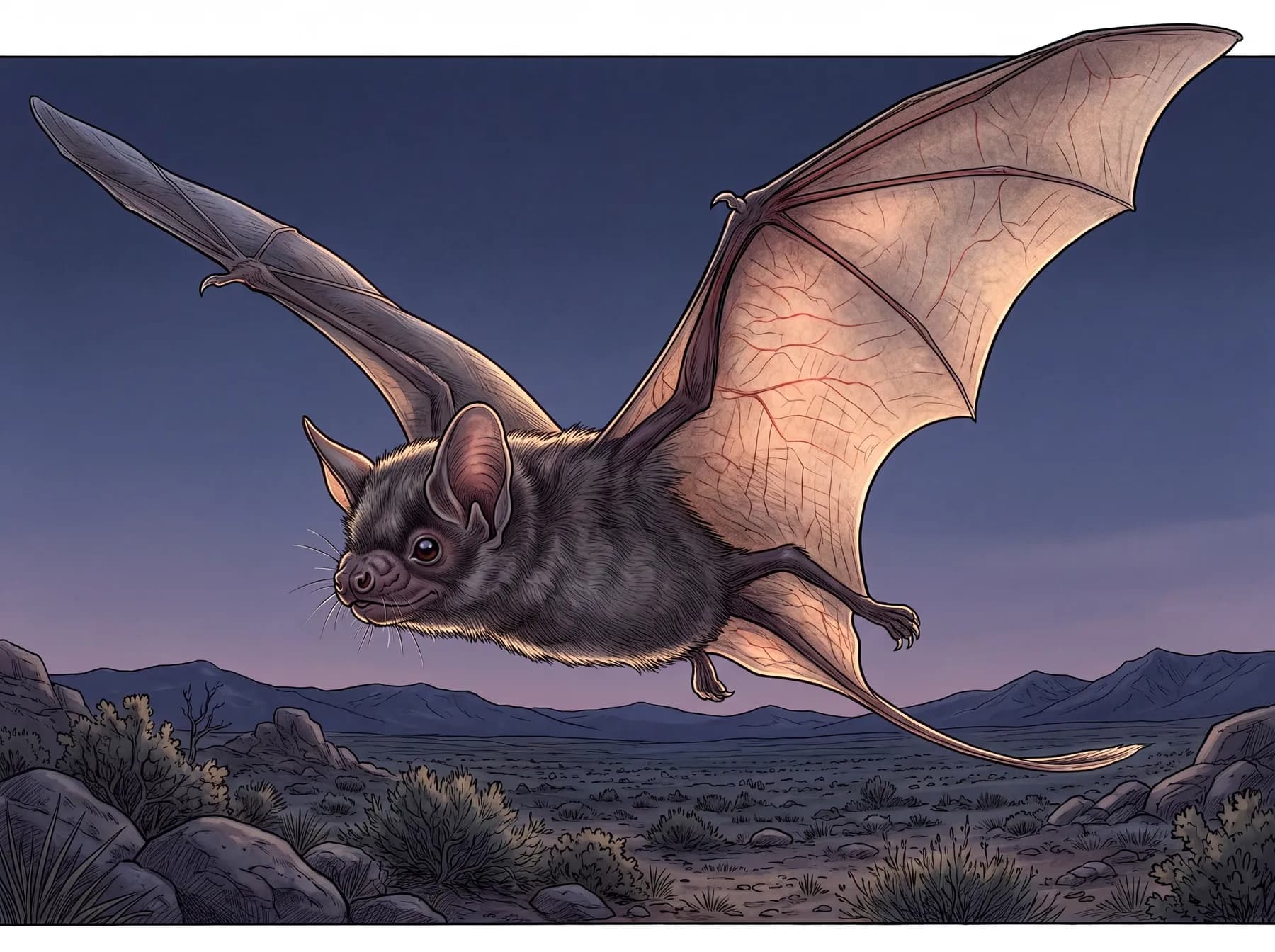
On a summer night the moths do not all stay low. Some ride the high wind well overhead, and one bat here climbs to meet them. The Mexican free-tailed bat has been recorded past ten thousand feet, up in airspace we tend to reserve in our heads for weather and small planes, hunting insects carried on the night wind. It is also the fastest bat anyone has clocked in level flight, faster than sixty miles an hour.
Both numbers come from Bat Conservation International, and both are worth holding at arm's length in the usual way. Fastest and highest describe what the animal can do, not what it does on an ordinary night. Most nights it is probably working far lower and slower, and the record flight is the edge of the envelope, not the commute. Still, the edge is real, and it tells you what the body is built for.
The name points straight at that build. On most bats the tail runs bound inside the flight membrane; on this one it projects well past the trailing edge, free, which is the tell that gives the free-tailed bats their name. The wings are long, narrow, and pointed, the shape of a fast, straight-line flier rather than a fluttering one. The face carries its own marks: broad ears set forward near the middle of the head, close together but not fused, and an upper lip deeply wrinkled.
Here it is a summer animal. At this latitude and elevation the Mexican free-tailed bat is a warm-season resident, arriving to hunt and then leaving for Mexico as the cold comes on, so the calendar is part of the identification: a free-tailed bat working this bajada in January would be a puzzle worth a second look. What holds it here in the warm months is the same thing that pulls it upward at night, the insects, the moths riding the wind.
None verified over this ground yet, and confirming it is mostly a question of when and how you look. At the speed and height it favors, you will not read fine detail against a dark sky; what you may catch is the shape and the manner, long pointed wings, fast straight flight, high up, and only in the warm months. The free tail itself is the certain mark, but that is a thing for the hand or a clear photograph, not for the naked eye at altitude.
Look up on a summer night for the fast, high, straight-flying shape. The tail that names it stays too far off to see.