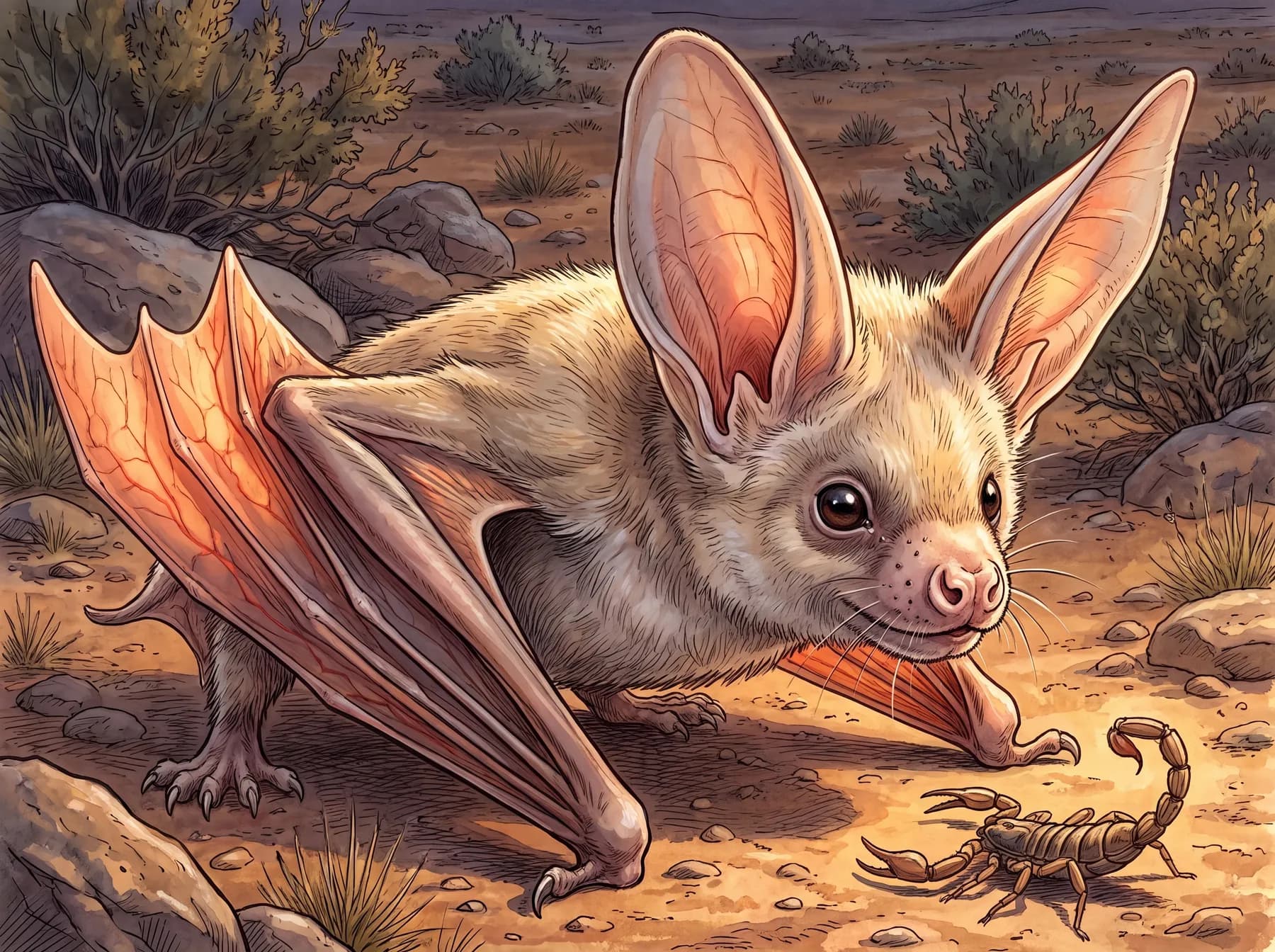
Most bats read the night by throwing sound ahead of them and catching the echo. The pallid bat does something quieter. It listens for its prey to give itself away. Instead of taking insects on the wing, it drops onto open ground for what is crawling there: beetles, crickets, centipedes, and scorpions. Biologists call the method gleaning. It finds that prey mainly by hearing it move, the scrape of an insect walking across dirt enough to place it. Echolocation still runs, but mostly for dodging obstacles and holding its bearings, not for the kill.
This matters more than it first sounds, because sonar cannot do this job. An echo off the ground comes back cluttered with the ground itself, so a bat that wants a cricket sitting in the dust has to hear the cricket rather than ping it. The pallid bat's outsized ears, nearly half the length of its head and body, are the instrument that makes ground-hunting possible. Turn the method around and the ears stop being an oddity and become the whole design.
The prey list includes an animal most hunters leave alone. The pallid bat regularly takes the Arizona bark scorpion, Centruroides sculpturatus, the most venomous scorpion in North America, and takes repeated stings while doing it. The venom has no effect on its behavior. It keeps hunting.
Researchers tested that, both by watching hunts and by injecting the venom directly, and they call the bat resistant rather than immune: the sting still lands and still does whatever it does to the tissue, and it does not stop the animal. The likely reason is written into the bat's genes. Pallid bats carry one or more missense mutations that swap amino acids in their voltage-gated sodium channels — the same channels the scorpion's venom is built to jam. A predator that met its prey's chemistry with chemistry of its own.
It is a characteristic bat of arid country, and this high desert is its kind of ground: rock crevices, cliffs, and the walls of buildings to roost in through the heat of the day, open blackbrush flats to work after dark. None confirmed on the parcel so far. It belongs on the list with good reason.
So learn the flight before the face. Look for a pale bat, sandy to cream and the lightest you are likely to see here, working low over the ground rather than high in open air, with broad ears and a blunt, almost pig-like muzzle. A bat that keeps dropping to the dirt and lifting off again is doing something no other bat here does.
Watch the ground a bat is working, not the sky. The pallid one hunts by listening for footsteps in the dark.