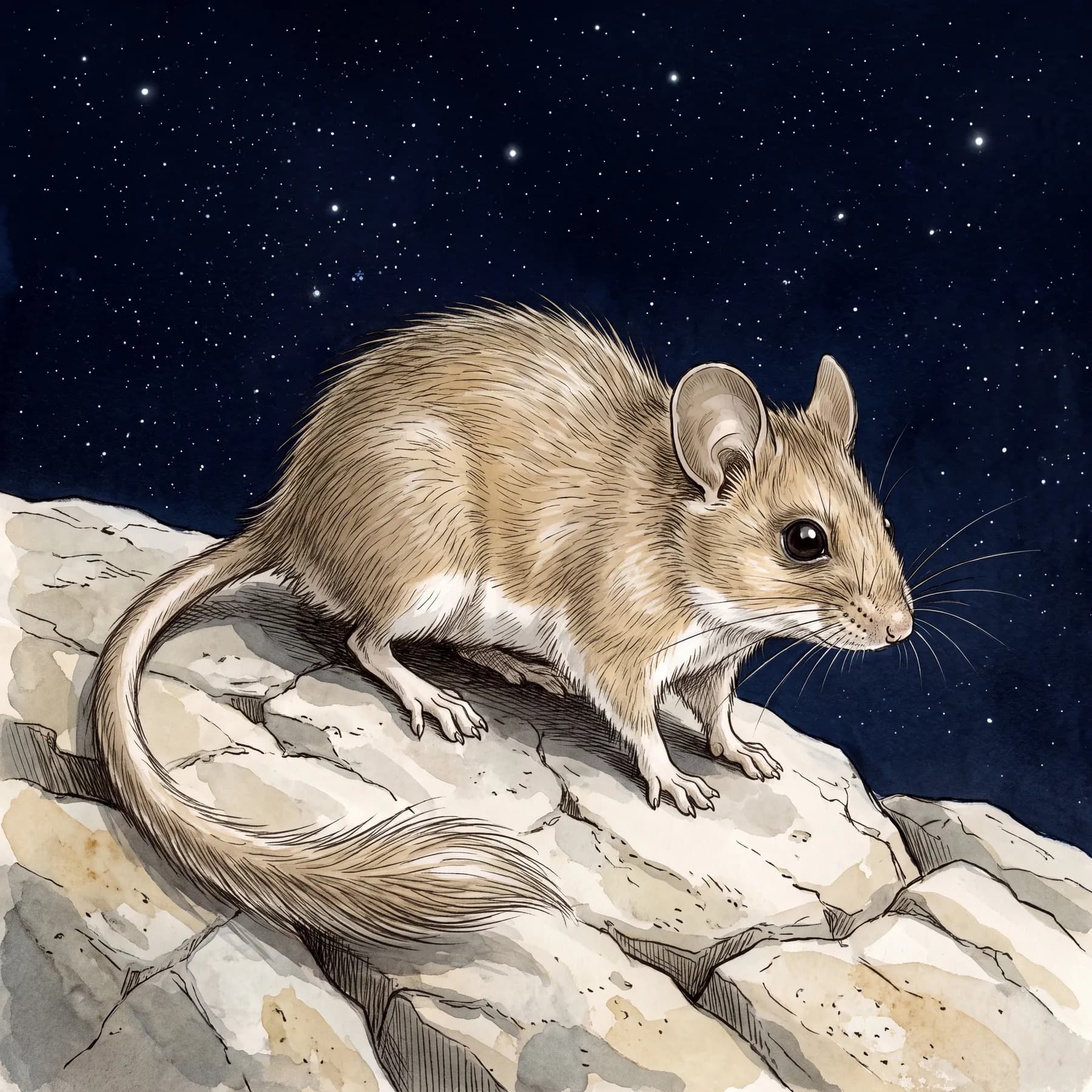
You would expect a desert mouse to follow the food. Find the richest stand of shrubs, the seeds and the shade, and you would expect the mouse that lives on them to be there too. The canyon mouse does not read that way. What draws its map is not the plants. It is the rock.
This small deermouse is tied to rocky habitat: outcrops, boulders, broken cliffs. The kind of vegetation growing among that rock has little bearing on where the mouse turns up. It will move out into shrub cover to forage and to slip whatever is hunting it, so it does not ignore plants. But the thing that decides whether it lives on a patch of ground is the stone, not the plant community. Two slopes carrying the same brush can hold it or not, depending on the rock.
Under lab conditions (low humidity, moderate temperature), the canyon mouse has stayed alive with nothing to drink, running entirely on the water in its food and the water its own body makes as it breaks that food down. It keeps what it has by concentrating its urine hard, shedding waste on very little fluid while the concentration of its blood barely moves. Hold onto the qualifier: that is a controlled result, not proof the animal never drinks in the wild. But it explains how a mouse can be at home on an outcrop with no seep and no standing water for a long walk in any direction.
That habit suits this bajada. The open flats here are ground the mouse can cross but does not depend on; what it wants is rock, and there is rock enough in the draws and along the harder ledges. Its elevation range is wide, from below sea level up to around 10,000 feet, so this high-desert ground sits well inside it, and USGS trapping has recorded the species in this area. That is a research record, not ours. Not confirmed here by us.
The name points straight at the coat. Crinitus means long-haired, and the fur is long and soft, yellowish-brown above and whitish below. What that length does for the animal the research does not actually say, so it is best left as description. If you meet one at all, it will be on the rock, not among the plants; here its whole distribution follows stone rather than any shrub. A small deermouse on a boulder could be any of several things. One feature settles it.
Read the tail: longer than the head and body together, dark above and pale below, and finished in a small tuft at the tip.