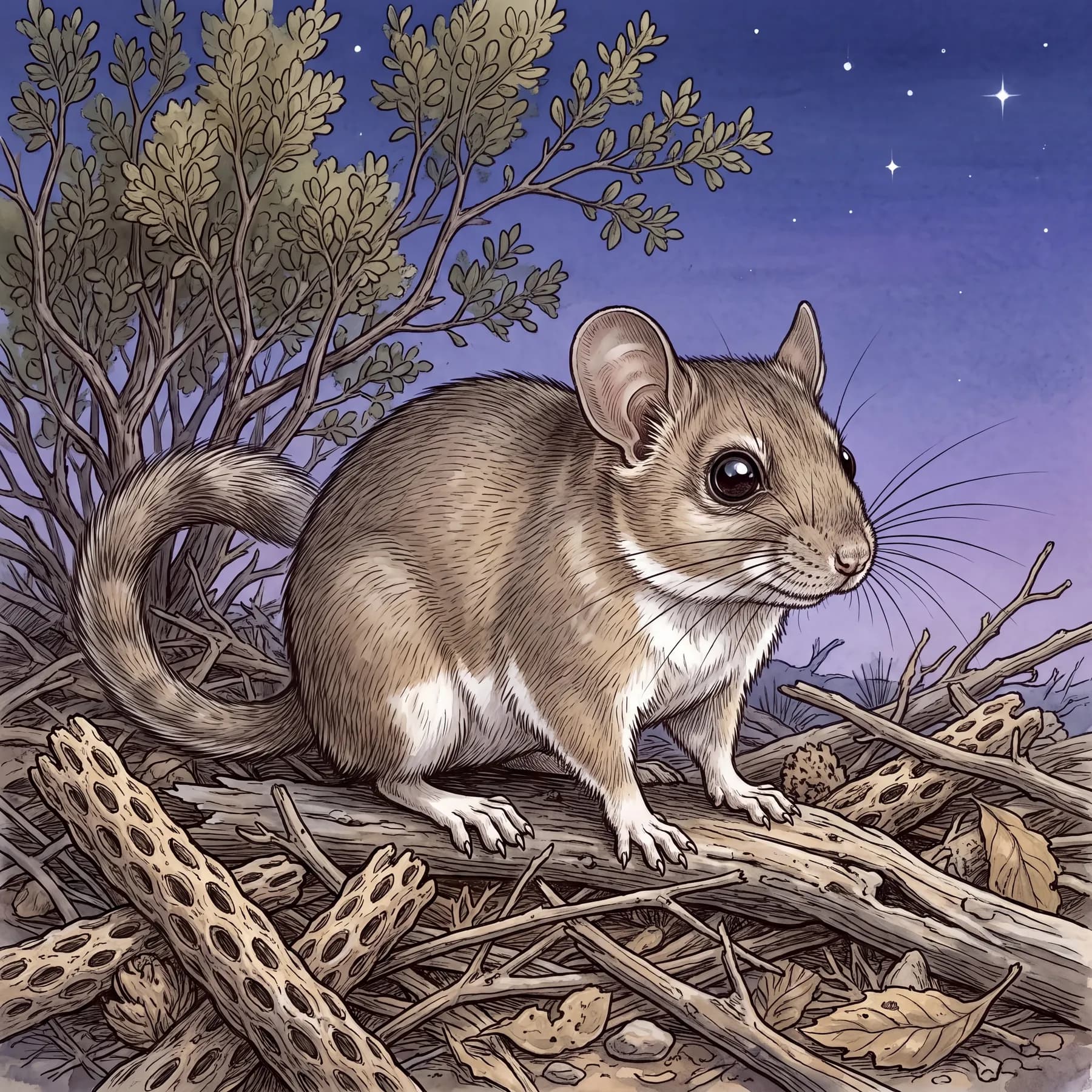
A packrat's nest is not hidden, and it is not tidy. It is a mounded heap of sticks and desert debris, jammed into a crevice or under a rock ledge, and the animal binds the whole pile together by urinating on it. In the dry desert air that urine crystallizes into a hard amber crust researchers call amberat, and that crust is the accident that turns a rodent's trash into an archive. Tucked back under a ledge, out of the weather, some of these middens have held together for about fifty thousand years — the far edge of what radiocarbon can read.
The old temptation is to say the midden was never rained on. That overstates it. What a midden needs is only to stay dry, back far enough under the rock that no storm soaks it, because amberat dissolves in water — which is exactly how the labs take one apart. Dropped in a bucket, the cement lets go in one to two weeks, freeing the sticks and packed plant material the animal carried in. A starving party escaping Death Valley in 1849 learned the sweet half of that chemistry the hard way: they found a midden, mistook the crust for candy, and ate it, sweet first and sickening after.
Everything in a midden was gathered close to home, within about ten to fifteen metres of the den, so each one is a tight core sample of a single patch of ground, stacked century on century. That is what makes them worth digging. In 1964 two researchers opened middens across the now-treeless Mohave and found them packed with juniper, proof that woodland once stood on now-treeless ground. The creosote bush we treat as the oldest thing here is a latecomer, arrived in the Mojave only about nine thousand years ago. None of which the animal intends. It is only building a nest and marking it; deep time does the rest.
The living animal is smaller than its reputation and easy to misname. It is not a Rattus off a ship but a native woodrat, about the weight of a small orange, with a furry two-toned tail, brown above and white below, and large ears and eyes for a life spent after dark. It does not need to drink. It takes its water from the cactus it eats, and that diet carries a catch: cactus is loaded with oxalate, a compound that damages the kidneys of a mammal not built for it. The woodrat is built for it, or rather its gut bacteria are, disarming more than ninety percent of the dose before it can do harm.
This bajada of Joshua tree and blackbrush sits well inside the species' range, and the middens should be here to find even where the animal keeps out of sight. Unconfirmed on this ground so far. If you ever catch one in a headlamp, the name is the tell: the throat is white, and the hairs stay white clear to the base.
The surer sign is the nest: a heap of sticks cemented hard under a ledge, faintly shining where the urine dried to amber.