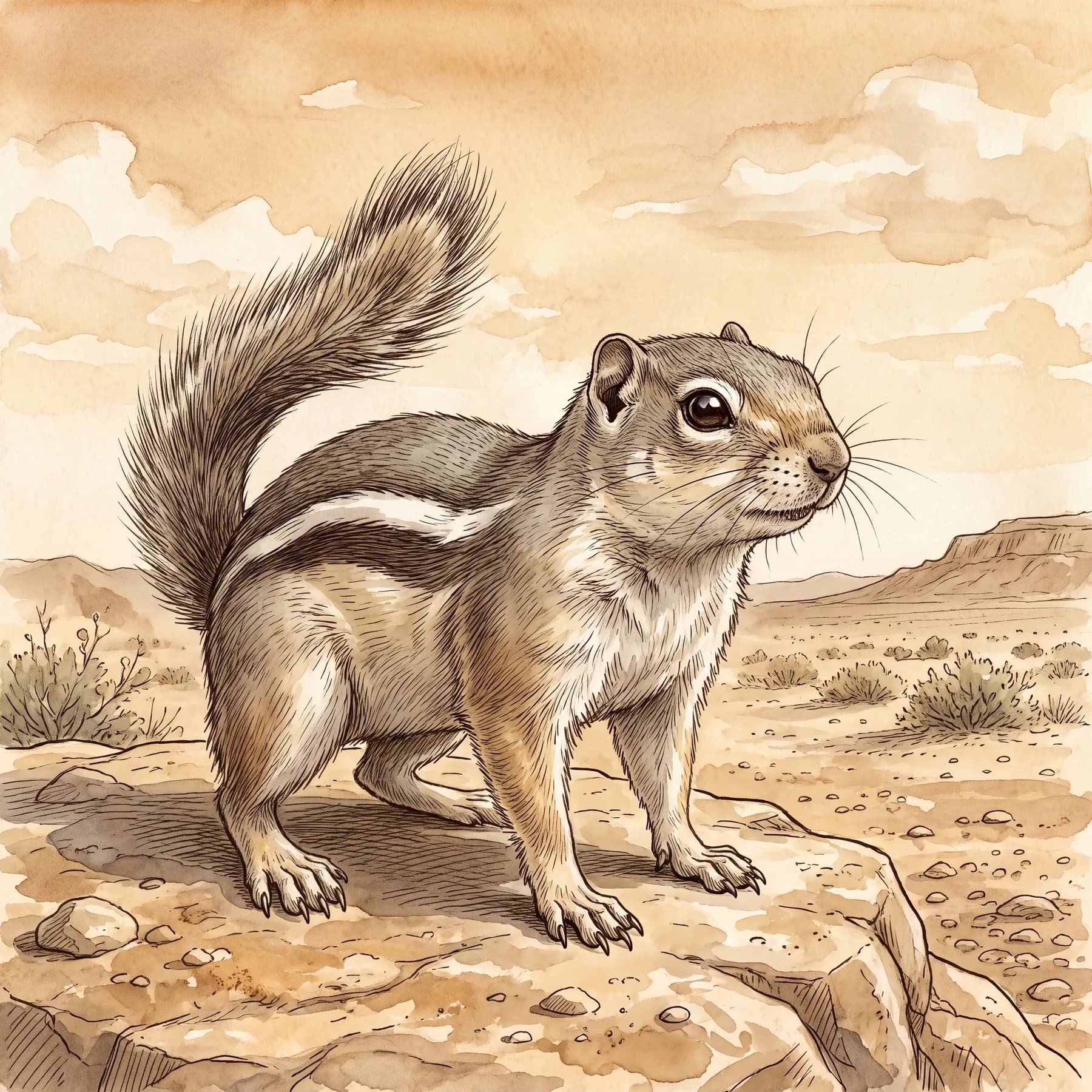
By the range map, the antelope squirrel on these flats is the wrong squirrel. Harris's antelope squirrel is drawn as a Sonoran animal, one that does not cross the Colorado River, so the map says the squirrel on the Mojave side of that river should be the white-tailed species instead. It is a clean argument. It is also the kind of tidy line this ground has overruled before.
A boundary drawn across a continent is not a record on the ground. The occurrence data settle it the other way. Within about 60 km of this parcel there are 57 records of Harris's antelope squirrel, the nearest only 13 km off and sitting at this elevation, against a single record of the white-tailed squirrel, 42 km away. On the map it looks misplaced. In the records it is simply the resident, and the river argument turns out to describe a line, not this animal.
What is worth knowing before you meet it is when it is out. Most desert mammals wait out the middle of the day underground; this one does not. It stays active through the hottest hours and is the most conspicuous small mammal abroad at midday, and it does not hibernate — researchers have found it active in every month of the year. Which raises the obvious question of how a small ground squirrel spends middays in open sun without cooking.
The method was measured in its white-tailed cousin and is read as the genus's answer. The squirrel runs out into full sun and lets its own body temperature climb rather than spending water to hold it down, then ducks back into the burrow and unloads that heat into the cooler soil before the next run. It shuttles. It never stays out long enough to reach the edge of what a small mammal can survive.
This ground works two shifts. In one study the antelope squirrel ended its surface day roughly 20 minutes before Merriam's kangaroo rat came up to start its night, though that handover ran anywhere from 14 to 45 minutes: the day animal clearing off as the night one clocks in. Between runs it forages hard and stuffs its cheek pouches, one carrying 44 mesquite beans at once, and it will sit lookout on top of a cholla, its soft foot pads somehow never carrying a spine or a scar.
We've not logged one on the parcel; the records put it close, not here. When it does turn up, the tail settles the name.
The white-tailed squirrel the map wanted shows pure white beneath its tail. This one does not: the underside is mixed black and white.